How to Set Up an LMS When Your Safety Spreadsheet Is Already Breaking
When turnover and subcontractors hit your manufacturing plant, that training spreadsheet becomes a compliance liability fast. Here's what to do instead.
How to Set Up an LMS for Safety Training When You're Tracking Completions in a Spreadsheet and It's Already Breaking Down
You know exactly what's in that spreadsheet. Forty-seven tabs. Color-coded columns for forklift certification, lockout/tagout, hazard communication, PPE acknowledgment, and powered industrial truck refreshers. You built it yourself over three years, and for a while, it worked. Then your plant hired fourteen new assembly line workers in six weeks because you lost a contract and won a bigger one on the same day. Two of those hires didn't make it past day thirty. Three more came in through a staffing agency. And somewhere in that chaos, a maintenance tech who runs your press brake went four months past his annual LOTO recertification — and nobody caught it until your safety coordinator was pulling records the night before an OSHA general industry inspection.
That's not a spreadsheet problem. That's a turnover and subcontractor layering problem that a spreadsheet was never designed to survive.
Why Turnover Breaks Spreadsheet-Based Training Tracking First
In a 50–300 person general industry facility, your training coordinator — often a safety manager wearing four other hats — is the single point of failure. When a machine operator separates from employment, someone has to manually archive that row. When a new welder starts Monday morning, someone has to add them, assign them to the right training tracks (OSHA 10, hot work, respiratory protection, emergency action plan), and then chase them to actually complete it before they're running equipment.
Most safety managers assume the spreadsheet breaks because it gets too big. The real problem is that the spreadsheet has no enforcement layer. It can't send a reminder to a production supervisor that their new press operator hasn't completed machine-specific hazard training. It can't flag that the staffing agency's temp — who's been on the floor for three weeks — was never formally onboarded into your system at all because the HR handoff didn't include safety. The spreadsheet just sits there, accurate as of the last time someone touched it, which was eleven days ago.
High-turnover facilities — especially those running 12-hour rotating shifts with fluctuating headcount — can see 40–60% annual turnover in production roles. Every separation and every hire is a manual update that probably doesn't happen the same day. Multiply that across subcontractor crews doing maintenance shutdowns, conveyor work, or electrical panel upgrades, and you've got a compliance gap that looks fine on paper until someone pulls the paper.
The Subcontractor Layer That Makes It Worse
Here's where it compounds. You've got a mechanical contractor sending four millwrights for a scheduled press line rebuild. You asked for their training records. They emailed you a PDF with eight names on it — none of whom are the four guys who actually showed up Monday. The crew lead says the original crew had a scheduling conflict. The foreman says everyone's current. You have no way to verify it, and they're already on the floor.
A spreadsheet cannot manage external worker populations. It was never meant to. Your LMS needs to handle both internal employees and contractor personnel with different onboarding tracks, document expiration tracking, and site-access dependencies. If your LMS can't block a contractor from checking in until their confined space entry training is verified current, it's not actually solving your subcontractor problem — it's just digitizing the same gap.
What an LMS Setup Actually Looks Like in a Manufacturing Plant
Setting up an LMS in a mid-size general industry plant is not a software installation. It's a decision about what your compliance architecture looks like. Before you pick a platform, you need answers to these questions:
- Which training tracks apply to which job titles? A material handler has different requirements than a maintenance tech or a quality inspector on the floor.
- What are your recurring certification intervals? OSHA requires forklift operators to be evaluated every three years or after an observed unsafe operation — not "annually" as many plants mistakenly enforce. LOTO authorized employee training has no fixed interval but requires retraining when there's reason to believe the employee doesn't understand the procedure.
- How do you handle contractor onboarding? Do they use your LMS, or do you verify their records against your system?
- Who owns the system? If the answer is "the safety manager," you have a single point of failure again.
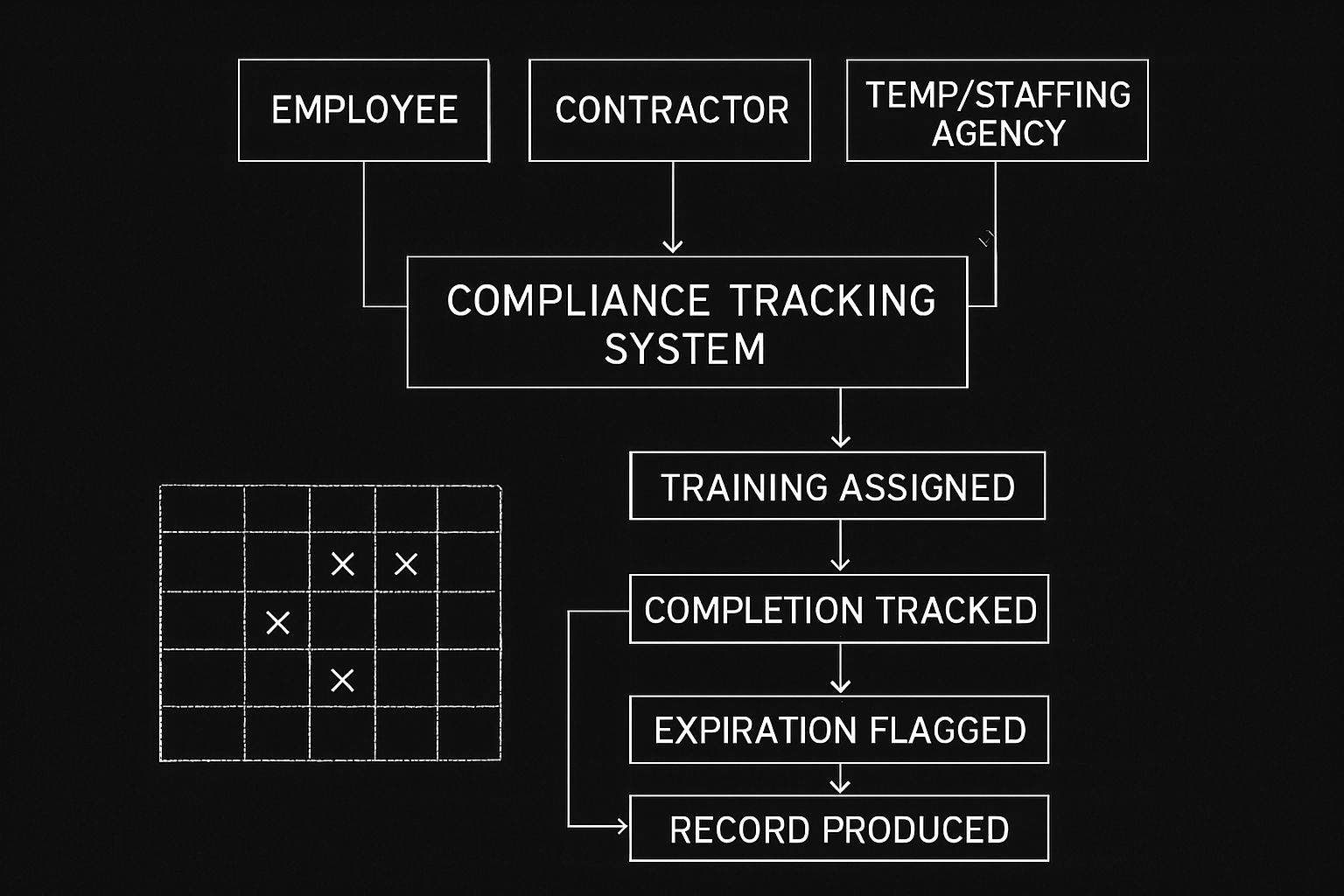
The LMS itself needs to be configured to automatically assign training based on job title at hire, send completion reminders to the employee and their direct supervisor, flag expirations 30 and 60 days out, and generate a compliance report that doesn't require your safety coordinator to build a pivot table at 9 PM before an audit.
What an OSHA Inspector Actually Looks At
Having been on-site during general industry inspections, the documentation request comes fast and specific. The compliance officer will ask for training records for the employees observed during the walkaround — not a summary report. If your maintenance tech is working on a machine with energy isolation, the inspector wants to see that tech's LOTO authorized employee training record, who conducted it, when, and what procedure was covered. "We have it in the system" means nothing if you can't pull it in under two minutes.
A serious violation for inadequate LOTO training runs up to $16,131 per citation item under current OSHA penalty structures. If the inspector finds a pattern — three maintenance techs with lapsed training, all working the same press line — that's not one citation. And if it comes out that you identified the gap and didn't correct it, you're looking at willful or repeat territory: up to $161,323 per violation. No spreadsheet audit trail is going to help you argue good faith at that point.
For more on OSHA's penalty structure, see OSHA's penalty and citation information.
The Migration Problem Nobody Talks About
Switching from a spreadsheet to an LMS mid-year in a manufacturing plant means you have to decide what to do with historical records. Do you import them? Manually enter them? Leave them in the spreadsheet and start fresh? Each option has compliance implications. If an OSHA inspector asks for training records going back three years for a specific employee, and your LMS only has data from six months ago, you need to be able to produce the rest — and "it's in the old spreadsheet" is a legitimate answer only if the spreadsheet is archived, accessible, and actually accurate, which brings you back to where you started.
The practical answer is a parallel period: run both systems for 60–90 days, complete the historical import for all active employees, and then freeze the spreadsheet as an archive. Don't try to do this while also onboarding fourteen new hires during a production ramp.
FAQ
What is the difference between an LMS and a training spreadsheet for OSHA compliance purposes?
A spreadsheet is a documentation tool — it records what happened. An LMS is a compliance management system — it assigns, tracks, reminds, and reports in real time. For OSHA purposes, both can technically satisfy recordkeeping requirements, but an LMS produces audit-ready documentation automatically and doesn't rely on a single person remembering to update a cell.
Do subcontractors need to be in my company's LMS?
Not necessarily in your LMS, but their training status needs to be verifiable before they access your facility. You can either create a contractor portal within your LMS, require them to submit current records that you log on their behalf, or use a contractor management platform. The key is that you can demonstrate, at any point during an inspection, that contractor personnel working on your site had current required training before they started the work.
How often does OSHA require forklift operator training to be refreshed?
The OSHA standard at 29 CFR 1910.178(l) requires evaluation every three years at minimum — but also requires retraining when an operator is observed operating unsafely, is involved in an accident or near-miss, receives a poor evaluation, or when conditions in the workplace change in a way that affects safe operation. Many plants enforce annual retraining as a conservative practice, which is fine, but the three-year evaluation is the regulatory floor.
What happens if a temp agency worker gets injured and has no training record in our system?
Under the OSHA multi-employer worksite policy, the host employer bears significant responsibility for the safety of on-site temporary workers — including ensuring they've received required training. If a temp is injured and your records show no evidence of site-specific safety orientation or hazard communication training, you're exposed. The staffing agency's liability doesn't eliminate yours.
Can a small safety team actually manage an LMS without a dedicated administrator?
Yes, if the LMS is configured correctly up front. Most of the ongoing management burden comes from manual assignment and manual follow-up — both of which should be automated. If you're still manually assigning courses to new hires because your LMS doesn't integrate with your HRIS or at least allow bulk assignment by job title, you haven't actually reduced your administrative load. You've just moved the problem to a different screen.
The Honest Answer
Setting up an LMS in a manufacturing plant during a period of high turnover or subcontractor complexity is a real infrastructure project. It takes time to configure correctly, and it takes someone who knows what OSHA actually looks for in a training record — not just someone who can click through a software demo. If your safety coordinator is already running at capacity managing the floor, the LMS setup will get deprioritized until something forces the issue.
If you'd rather not find out what forces the issue, we handle this. LMS setup, training assignment, completion tracking, contractor recordkeeping, and OSHA documentation — managed for you so your safety team can focus on actual hazard control instead of chasing signature pages.
Download our free safety topics pack to see what a complete training curriculum looks like for general industry: ehs.inc/download/safety-topics
Or if you want to talk through your current setup: ehs.inc/call
AW
Aaron West
Founder, EHS, Inc. — 18+ years in EHS compliance and contractor safety
Aaron West has spent over 18 years helping contractors and businesses navigate OSHA compliance, ISNetworld® certification, and workplace safety management. He founded EHS, Inc. to make enterprise-level EHS accessible to companies of all sizes — serving contractors and businesses nationwide — without long-term contracts or enterprise overhead.
Ready to simplify your EHS compliance?
Our team handles the complexity so you can focus on running your business. No long-term contracts, no learning curve.
Talk to EHSRelated Articles
What Happens to Your LMS When Your Workforce Doubles Overnight
Winning a new contract and doubling your workforce sounds like a win — until your LMS becomes the reason an OSHA inspector writes you up.
What Happens to an LMS When the Safety Manager Who Built It Leaves
When the safety manager who built your LMS walks out the door, OSHA doesn't care who's responsible — they just write citations.
What Your LMS Must Show OSHA When They Walk In Unannounced
When OSHA shows up at your commercial construction site, what's in your LMS either saves you or costs you — here's exactly what they want.
Medium & Enterprise
Safety Culture System
Framework to achieve zero incidents
Get Free System →
Small Businesses
50+ Safety Topics
Stop hitting paywalls
Get Free Topics →
All Companies
Audio Safety Topics
54 topics in English & Spanish
Get Free Audio →