How a Safety Manager Survives an OSHA Inspection With Messy Training Records
OSHA doesn't cite you for the hazard — they cite you for the missing paperwork. Here's what that looks like in oil and gas.
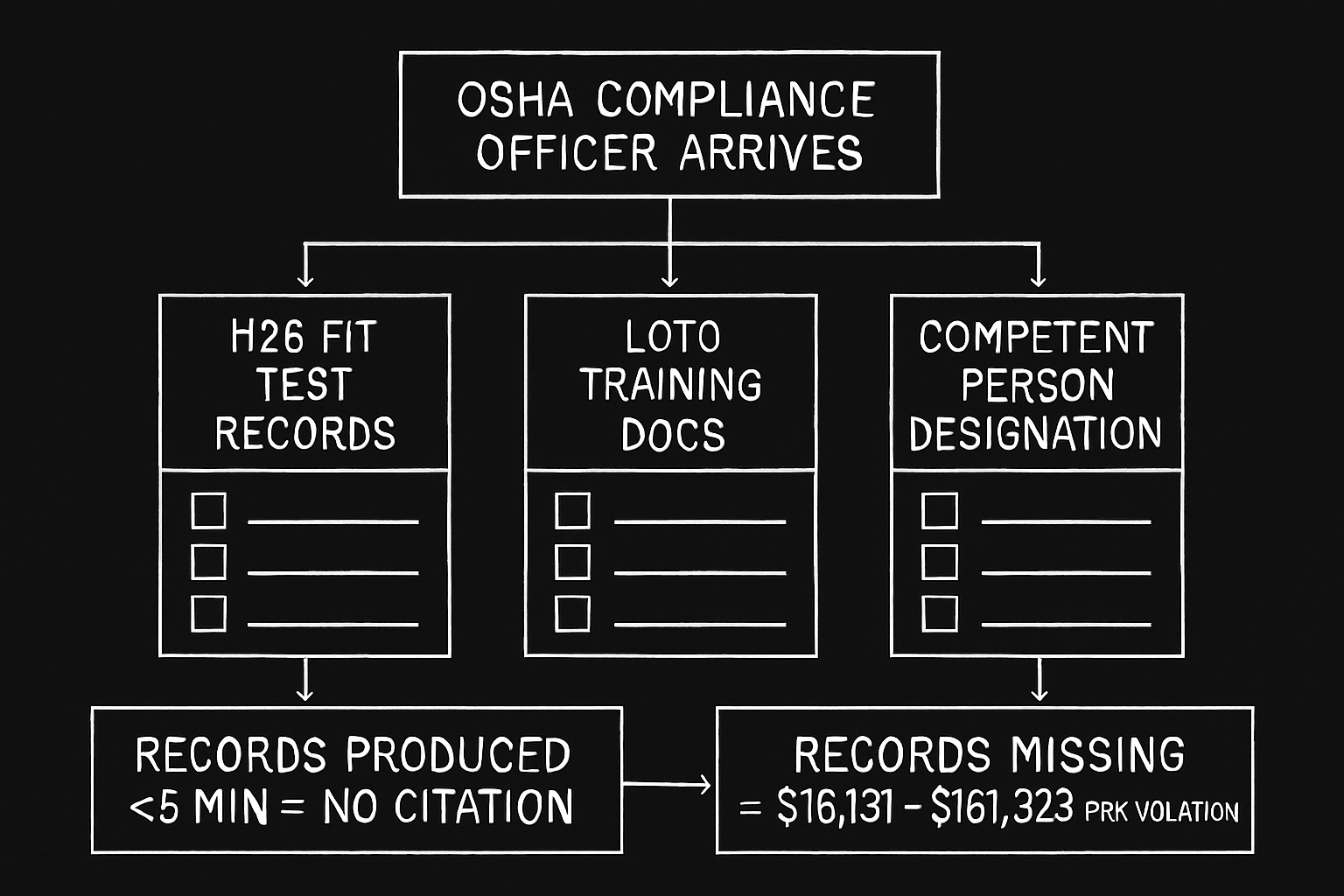
How a Safety Manager Handles an OSHA Inspection When the Training Records Are a Mess
The OSHA compliance officer doesn't walk onto your upstream drilling site and immediately start looking for missing guardrails. They sit down at a table — usually in the tool pusher's trailer — and they ask for your training records. That's the first move. Almost every time.
The hazard that gets someone hurt is not usually what gets the company cited. The paperwork gap is. And in oil and gas contracting — where you've got rig hands, pipeline welders, well servicing crews, and competent persons rotating across multiple locations — that paperwork gap is almost always there, waiting for the wrong Tuesday to expose it.
What the Inspector Is Actually Looking For
When a compliance officer shows up at a well servicing operation following a reported incident or a referral complaint, the first documentation request typically covers:
- H2S awareness and fit testing records for all workers in the affected area
- Lockout/tagout training documentation — not just that it happened, but who conducted it, when, and for which specific energy sources
- Competent person designations in writing for excavation, rigging, and fall protection tasks
- Confined space entry training for anyone who has entered or served as attendant at a tank battery or separator vessel
- Hazard communication training records tied to the specific chemicals on site — not just a generic SDS acknowledgment
If your training coordinator — or whoever's been doubling as your training coordinator while also running safety committee meetings and updating your ISNetworld profile — can't produce those records within the hour, you're already in trouble. Not because a worker wasn't trained. Because you can't prove they were.
The Counterintuitive Part Most Safety Managers Get Wrong
Most safety managers assume the citation risk comes from a rig hand who skipped a module or a new hire who got thrown into production without proper onboarding. That's the wrong assumption.
The real problem is that the training probably happened. The hand got the H2S talk. The operator sat through the LOTO demonstration. The competent person was designated verbally by the company man. None of it got documented in a way that survives a document request. The citation isn't for undertrained workers — it's for the safety manager who couldn't produce the evidence that training occurred.
Under OSHA 29 CFR 1910.147 for LOTO and similar training standards, the burden is on the employer to demonstrate compliance. "We trained them" isn't a defense. A sign-in sheet with a date, a trainer's signature, and a description of what was covered — that's a defense.
A serious citation for failure to document LOTO training runs up to $16,131 per violation. If the inspector determines it's willful — meaning you knew the requirement existed and didn't meet it — that number climbs to $161,323 per instance. On a multi-crew pipeline spread where every operator was supposed to be trained, "per instance" adds up fast.
What This Looks Like on an Actual Oil and Gas Job Site
Picture this: A well servicing company is doing workover operations on a lease in the Permian. A contractor employee gets a hand injury near a pump jack during a service call. OSHA opens an inspection. The compliance officer asks for training records for the injured employee and the two-man crew that was with him.
The safety coordinator pulls up a spreadsheet. The injured employee completed H2S training 14 months ago — but the documentation only shows a name and a date, no trainer, no course content description, no competency verification. The crew's confined space entry training is listed as "completed" but the actual certificates are on a thumb drive that's sitting in the safety manager's truck two states away. The LOTO-specific training for pump jack energy isolation? There's a toolbox talk sign-in sheet that may or may not cover it — nobody's sure because the topic line just says "safety meeting."
That company is getting cited. Not because the workers were incompetent. Because the records are a mess.
The Prequalification Angle Nobody Talks About
OSHA citations aren't the only financial consequence of training record chaos. If your company works through ISNetworld or Avetta to get on approved vendor lists for major oil and gas operators, your grade is directly tied to your documentation. A serious citation shows up in your ISNetworld profile. Your grade drops. The operator's procurement team sees it during contractor prequalification. You lose the bid — or you lose the contract you already have — before anyone has a conversation about it.
Training record failures don't just cost you in OSHA penalties. They cost you work. In upstream oil and gas, where the prequalification grading process is unforgiving and major operators refresh their approved vendor lists quarterly, a documentation gap at inspection time can sideline a company for months.
What to Do Before the Compliance Officer Sits Down
Assume the inspection is coming. It may be triggered by an incident, a disgruntled ex-employee complaint, or a programmed inspection of your NAICS code. When it happens, the window between "the CO is in the parking lot" and "the CO is asking for records" is roughly fifteen minutes.
That means your training records — for every active employee, at every site, across every required topic — need to be pullable in under five minutes. Not "we'll get that to you by end of day." Pullable now, in the room, while the compliance officer is watching.
Practically speaking:
- Every training record needs a trainer name, date, duration, and topic description that maps to the specific OSHA standard it satisfies
- Competent person designations need to be in writing and tied to specific tasks and specific employees — not just "our foremen are competent persons"
- H2S fit testing documentation needs to include the specific respirator model, fit test method, and pass/fail result
- Refresher training cycles need to be tracked proactively — the inspector will ask when the last one was, and "we're due" is not a good answer
FAQ: OSHA Inspections and Training Records in Oil and Gas
Can OSHA cite a company if the training actually happened but wasn't documented?
Yes. OSHA's enforcement position is that undocumented training is the same as no training for citation purposes. The employer bears the burden of proof. If you can't produce the record, you can't prove compliance — regardless of what actually occurred on site.
What's the first thing a safety manager should do when an OSHA compliance officer arrives?
Stay calm, confirm the inspector's credentials, understand the scope of the inspection (programmed vs. unprogrammed/incident-related), and notify your legal counsel if available. Do not volunteer information beyond what's requested. Cooperate fully, but understand you're not required to expand the scope of the inspection beyond what was stated.
How far back can OSHA go when requesting training records?
It depends on the standard. Most training records should be maintained for the duration of employment plus three years. For respiratory protection (H2S fit testing), records must be retained for the duration of employment. LOTO and hazard communication records have similar retention requirements. When in doubt, keep them longer.
Does an oil and gas contractor need separate training records for each job site?
Not necessarily separate records, but records need to be traceable to the individual employee and relevant to the hazards at the specific site. A generic "safety training" entry doesn't satisfy site-specific requirements for confined space, H2S, or process hazard tasks.
What's the fastest way to get training records organized before an inspection?
A centralized LMS (learning management system) that auto-generates certificates, tracks expiration dates, and stores records by employee and topic is the most defensible system. A spreadsheet that someone updates manually when they remember to is not. If you're managing multi-crew, multi-site operations across a drilling or pipeline spread, manual tracking will eventually fail you at the worst time.
Take the Training Admin Off Your Plate
If pulling your training records today would take more than five minutes, that's the gap. EHS, Inc. manages training records, LMS administration, OSHA documentation, and prequalification compliance for oil and gas contractors and safety managers who have more important things to do than maintain spreadsheets under pressure.
Download our free safety topics pack — or if you're ready to talk about what a fully managed solution looks like, schedule a call here.
AW
Aaron West
Founder, EHS, Inc. — 18+ years in EHS compliance and contractor safety
Aaron West has spent over 18 years helping contractors and businesses navigate OSHA compliance, ISNetworld® certification, and workplace safety management. He founded EHS, Inc. to make enterprise-level EHS accessible to companies of all sizes — serving contractors and businesses nationwide — without long-term contracts or enterprise overhead.
Ready to simplify your EHS compliance?
Our team handles the complexity so you can focus on running your business. No long-term contracts, no learning curve.
Talk to EHSRelated Articles
What Happens to Your LMS When Your Workforce Doubles Overnight
Winning a new contract and doubling your workforce sounds like a win — until your LMS becomes the reason an OSHA inspector writes you up.
What Happens to an LMS When the Safety Manager Who Built It Leaves
When the safety manager who built your LMS walks out the door, OSHA doesn't care who's responsible — they just write citations.
What Your LMS Must Show OSHA When They Walk In Unannounced
When OSHA shows up at your commercial construction site, what's in your LMS either saves you or costs you — here's exactly what they want.
Medium & Enterprise
Safety Culture System
Framework to achieve zero incidents
Get Free System →
Small Businesses
50+ Safety Topics
Stop hitting paywalls
Get Free Topics →
All Companies
Audio Safety Topics
54 topics in English & Spanish
Get Free Audio →