What a Safety Manager Should Do in the First 72 Hours After an OSHA Citation
An OSHA citation hits differently when half your workforce turned over last quarter. Here's exactly what to do in the first 72 hours.
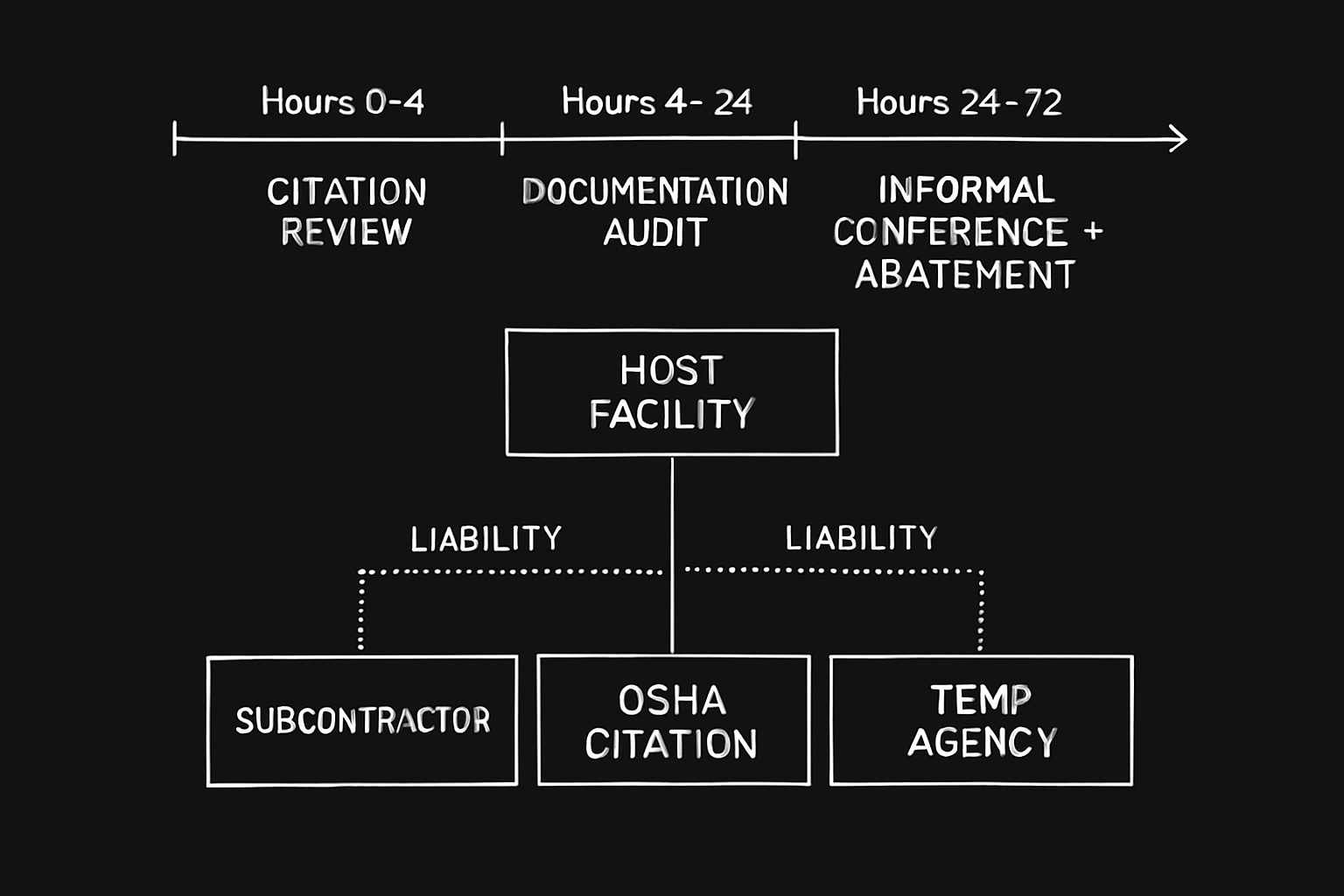
What a Safety Manager Should Do in the First 72 Hours After an OSHA Citation
The certified letter shows up. Or the compliance officer hands it to you before they leave the parking lot. Either way, the clock starts immediately — and in a mid-size manufacturing plant dealing with seasonal hiring surges, subcontractor layering, or back-to-back turnover in the production ranks, those first 72 hours will determine whether this citation costs you $16,131 or $161,323. Or more, once you factor in what a willful/repeat designation does to your next bid.
This isn't a guide for a company with a fully staffed EHS department and an outside law firm on retainer. This is for the safety manager at a 120-person metal fabrication or plastics injection facility who is also the training coordinator, the OSHA 300 keeper, and the person who fields questions from the floor supervisor about whether a subcontractor's employees need to be on your lockout/tagout program. That person. Let's talk about what actually happens in the first 72 hours.
Hour 0–4: Understand Exactly What You Were Cited For
Read the citation in full before you talk to anyone — including your plant manager. Every citation lists a specific standard, a description of the alleged violation, and a proposed penalty. OSHA serious violations carry penalties up to $16,131 per violation. Willful or repeat violations go up to $161,323 each. That "per violation" language matters: if the inspector found the same hazard at three workstations, that can be three separate citations.
The part most safety managers miss on the first read: the classification. A "serious" violation means OSHA determined there was substantial probability of death or serious physical harm. A "willful" classification means they believe you knew about it and didn't act. That distinction is where turnover creates a trap — if a maintenance tech reported a guarding issue six weeks ago and it's in an email chain somewhere, and that tech quit two weeks later and nobody followed up, OSHA may argue constructive knowledge. You knew, or should have known.
Pull the inspection narrative, the closing conference notes if you have them, and every photo or document the compliance officer requested on-site. You have 15 working days from receipt to contest, request an informal conference, or pay the penalty. Missing that window means the citation becomes a final order. OSHA's citation and penalty page lays out the full process — read it before you do anything else.
The Counterintuitive Problem Nobody Talks About
Most safety managers assume the citation is the problem. The real problem is the documentation gap that made the violation look worse than it was — and in plants with high turnover or subcontractor crews, that gap is almost always there.
Here's what that looks like in practice: a general industry facility running three shifts adds a temp agency crew for a production surge. The subcontractor's employees are doing material handling on the floor alongside your direct-hires. Your machine guarding program, your lockout/tagout procedures, your hazard communication training — those are your programs. But who trained the temp crew? When? On which equipment? Is that documented anywhere that survived the staffing coordinator who left in March?
OSHA doesn't care that the temp agency was supposed to handle training. If those workers are on your floor, operating your equipment, you own the hazard. The citation lands on you. And if your training records show a 40% completion gap because three onboarding classes worth of new hires never got formally processed into your LMS, that looks like a pattern — not an oversight.
Hours 4–24: Document What Actually Exists Right Now
Before you start preparing your response, do a rapid-fire documentation audit of the cited area. This is not the time for a full program review — that comes later. Right now you need to know:
- Which employees (by job title: press operators, maintenance techs, material handlers) were working in the cited area at the time of inspection?
- What training records exist for those individuals — and specifically, are any of them recent hires or temp-to-perm employees from the last 90 days?
- What written procedures cover the cited hazard, and when were those procedures last reviewed or updated?
- If subcontractors were involved: what does your subcontractor safety agreement say about training verification? Did anyone actually verify it before they hit the floor?
The goal here is not to build a defense — that comes at the informal conference. The goal is to know what you're working with. Safety managers who walk into an informal conference without knowing their own documentation gaps get surprised by what OSHA already has. Don't be that person.
Hours 24–48: Request the Informal Conference
Request the informal conference in writing within the 15-day window — but do it early. An informal conference with the OSHA Area Director is your best opportunity to reduce penalties, reclassify violations, and negotiate abatement timelines. It is not an admission of anything. Use it.
Bring evidence of good faith: training records that predate the inspection, written programs with revision dates, any corrective actions already completed since the inspection. If turnover drove a documentation gap, show that you've identified the root cause and have a corrective action plan. OSHA compliance officers are human beings — they respond to safety managers who show up with facts and a plan, not defensiveness.
If the citation involves a hazard that was introduced by a subcontractor's work practices or a personnel change that your management-of-change process didn't catch, say that. Clearly. With documentation. It doesn't eliminate liability, but it can shift a willful classification back to serious — and that difference is $145,000 per violation.
Hours 48–72: Fix the Abatement, Not Just the Paperwork
The abatement date on the citation is a hard deadline. Miss it and OSHA can issue a failure-to-abate notice at the full penalty rate per day. For a plant in active production, abatement on equipment guarding or LOTO can mean a temporary production hold while your maintenance crew installs a fixed guard or updates an energy control procedure.
The mistake that happens constantly in plants running lean on safety staff: the paperwork gets fixed (new training records generated, program updated) but the physical hazard stays. A compliance officer doing a follow-up inspection who finds the same guarding issue with new documentation around it is not going to view that charitably. Fix the condition first. Document that you fixed it. Then update the program.
And while you're in that 72-hour window, audit adjacent equipment and procedures for the same class of hazard. If OSHA found one unguarded point-of-operation on a punch press, walk the rest of the floor. A second citation for the same standard on a follow-up visit — that's your repeat violation threshold. Now you're at $161,323 per instance.
The Turnover Factor Nobody Plans For
In a plant running 20–30% annual turnover — which is not unusual in general industry manufacturing right now — your training records are always partially out of date. New press operators, new forklift drivers, new maintenance techs cycling through, subcontractor crews on 60-day contracts. Each personnel change is a management-of-change event that most facilities don't treat as one.
The result: your written lockout/tagout program lists a competent person who left eight months ago. Your hazard communication training roster shows 85% completion, but that 15% gap is entirely concentrated in the night shift hired in the last quarter. Your OSHA 300 log has two entries from temp employees that your injury rate calculation may or may not be counting correctly.
None of that surfaces until an inspector walks in. Then it surfaces all at once.
Frequently Asked Questions
How long does a safety manager have to respond to an OSHA citation?
Fifteen working days from the date the citation is received. After that window, the citation becomes a final order and the penalty is due. Use that time to request an informal conference — it's the most effective tool available to reduce penalties and negotiate abatement timelines.
Can OSHA cite a manufacturer for violations committed by a subcontractor's employees?
Yes. Under the multi-employer citation policy, OSHA can cite the controlling employer — typically the host facility — for hazards that affect workers on-site, even if those workers are employed by a subcontractor. The controlling employer is expected to have reasonable oversight of site conditions.
What's the difference between a serious and a willful OSHA violation?
A serious violation means OSHA found substantial probability of death or serious harm. A willful violation means OSHA determined the employer knew about the hazard and failed to act — or was plainly indifferent to the requirement. Willful violations carry penalties up to $161,323 per instance versus $16,131 for serious violations.
Does high employee turnover affect how OSHA views a citation?
Turnover itself isn't a defense, but it can explain documentation gaps when presented as part of a corrective action narrative. The key is demonstrating that you've identified the root cause — not just patched the symptom — and that your training and onboarding process has been corrected going forward.
What happens if a manufacturing plant misses the abatement deadline?
OSHA can issue a failure-to-abate notice, which carries a civil penalty of up to $16,131 per day beyond the abatement date. That compounds fast. If abatement requires a production hold or equipment modification, build that into your timeline and document the steps being taken before the deadline hits.
If citations, training records, and documentation backlogs are eating your week — every week — that's the problem we solve. Download our free safety topics pack or talk to our team directly about getting the admin off your plate.
AW
Aaron West
Founder, EHS, Inc. — 18+ years in EHS compliance and contractor safety
Aaron West has spent over 18 years helping contractors and businesses navigate OSHA compliance, ISNetworld® certification, and workplace safety management. He founded EHS, Inc. to make enterprise-level EHS accessible to companies of all sizes — serving contractors and businesses nationwide — without long-term contracts or enterprise overhead.
Ready to simplify your EHS compliance?
Our team handles the complexity so you can focus on running your business. No long-term contracts, no learning curve.
Talk to EHSRelated Articles
Lean Safety Staffing and SIF Exposure in Refinery Turnarounds
When headcount drops during a turnaround, critical control ownership doesn't disappear — it just becomes nobody's job.
ISO 14001 and Safety Integration: What Separate Systems Cost You
Running ISO 14001 and your safety program as separate systems isn't just inefficient — it has a specific dollar cost. Here's what it is.
ISO 45001 Clause 7.4 & 8.1: When Paperwork Gaps Become OSHA Citations
In upstream drilling and pipeline work, OSHA doesn't cite the hazard — they cite the missing communication record. Here's what that looks like.
Medium & Enterprise
Safety Culture System
Framework to achieve zero incidents
Get Free System →
Small Businesses
50+ Safety Topics
Stop hitting paywalls
Get Free Topics →
All Companies
Audio Safety Topics
54 topics in English & Spanish
Get Free Audio →