How Avetta Grades Work — and Why Contractors Get Removed Before They Know It
Avetta grades drop silently — and for commercial construction contractors, the first sign is usually a lost bid or a removal notice.
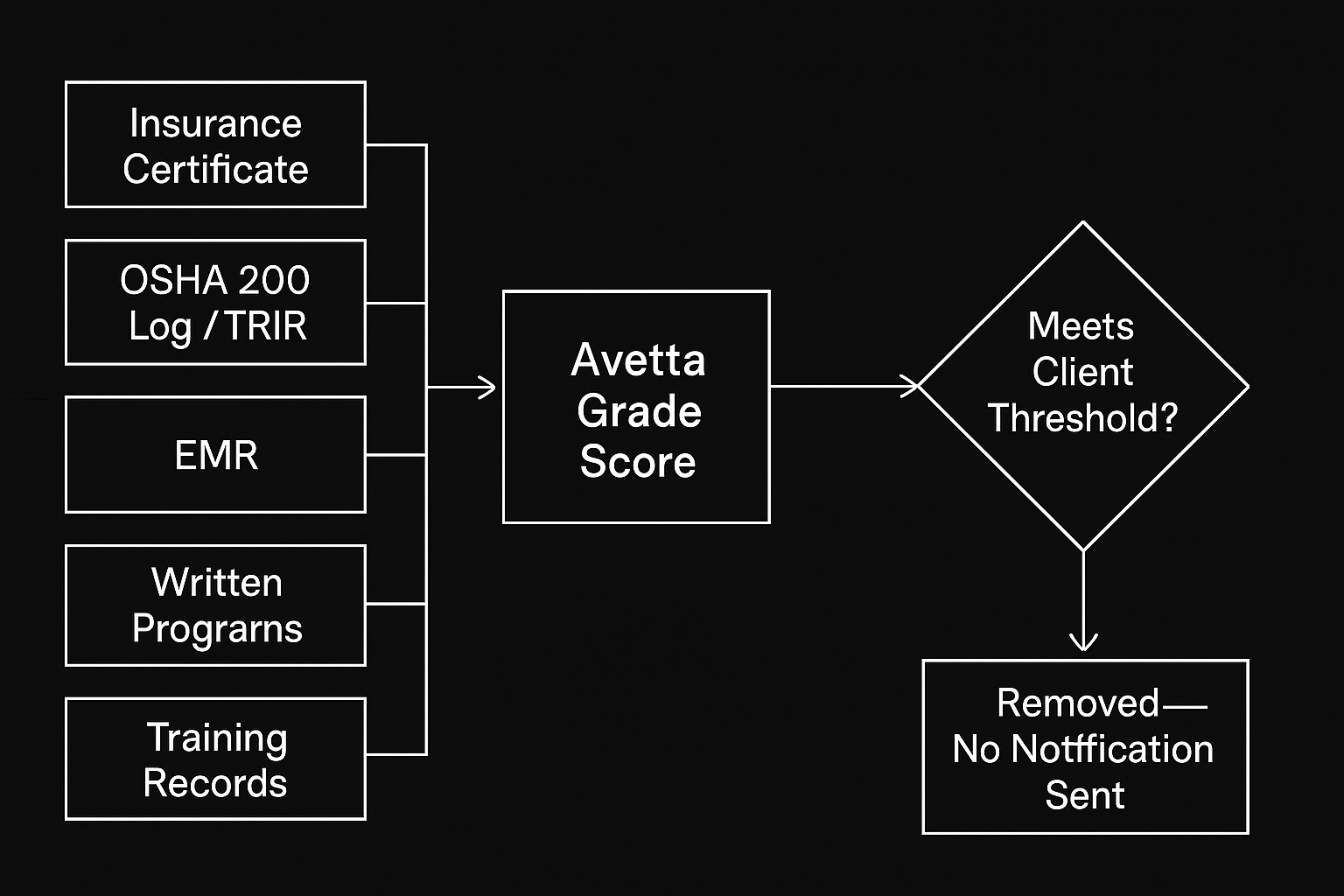
How Avetta Grades Work and Why Contractors Get Removed from Approved Vendor Lists Before They Realize There Is a Problem
You find out your company was removed from a GC's approved vendor list on a Tuesday morning when the project coordinator stops returning calls. Not because anyone told you. Not because Avetta sent a warning. Because the grade dropped below threshold three weeks ago and the client operator quietly flagged your account as ineligible — and nobody on your end caught it.
For a commercial construction specialty sub with 20 to 50 employees, that is not an administrative inconvenience. That is a $400,000 contract that goes to someone else while your crews sit waiting on mobilization paperwork that will never arrive.
What Avetta Actually Scores — and What Most Contractors Get Wrong
Most project managers and office managers who handle Avetta submissions assume the grade reflects whether documents are uploaded. That is the wrong mental model — and it costs money.
Avetta grades your company across several weighted categories: insurance certificates (limits and endorsements), safety statistics (TRIR, DART, EMR), written safety programs, training records, and OSHA recordkeeping. Each client operator — your GC, the owner, the developer — can also apply their own custom requirements on top of Avetta's base scoring. That means a general contractor in the commercial construction space running projects under a developer with a corporate safety standard might require an EMR below 1.0, a TRIR below 2.0, verified OSHA 30 credentials for your superintendent, and a site-specific safety plan signed by a competent person before the first subcontractor mobilizes.
If your EMR is 1.15 because of a single workers' comp claim from 18 months ago, you may not meet their threshold — even if your crews have worked 80,000 hours without a recordable since then. The EMR follows you for three years. That one incident does not care that you hired a new safety coordinator and rewrote your fall protection program.
According to Avetta's published resources, their grading system is designed to give client companies a standardized way to evaluate risk. What that means in practice: your grade is a risk score, and risk scores that fall below a client's threshold get filtered out automatically — no phone call, no appeal process triggered by your side.
The Counterintuitive Problem Most Project Managers Miss
Most project managers assume the danger zone is expired insurance. Insurance certificates get flagged visibly — Avetta sends the expiration notices, your broker is usually on top of it. That is the document everyone watches.
The real problem is OSHA 300 log data entered incorrectly or updated late — and it silently tanks your TRIR calculation without triggering a single visible alert.
Here is how it plays out on a real job site: Your safety coordinator enters a recordable incident in January — a laborer sprains a wrist on a concrete form and returns to restricted duty for three weeks. That gets logged as a recordable. Fine. But your total hours worked for the year are entered at year-end, and whoever submits them to Avetta uses payroll hours instead of actual hours worked — a number that is typically lower because it excludes overtime properly, or sometimes higher because it includes salaried staff hours incorrectly. Either error shifts your TRIR. If it shifts it above your client's threshold, your grade drops. That grade drop may not surface until the next time a client operator runs a contractor report — which could be when they are building out the approved list for a new project you were counting on.
What It Costs When the Grade Drops
The financial consequences in commercial construction are specific and they compound quickly.
Lost prequalification: If you are removed from a GC's approved vendor list mid-year, you typically cannot be reinstated until the next annual review cycle. For a 35-person electrical subcontractor running $3M to $5M in annual revenue, losing access to two or three projects in that window is not a rounding error. That is operating revenue that does not come back.
Delayed contract execution: Even when a GC wants to bring you on, an Avetta grade below their threshold creates a manual exception process that takes weeks. Project schedules do not wait. Concrete doesn't stop curing because your OSHA 300 log has a calculation error. By the time your grade is corrected and the exception is approved, the scope went to someone else or the mobilization window passed.
OSHA citation exposure from the same data: If your OSHA 300 log errors include willful underreporting of recordables — even unintentionally — OSHA serious violations run up to $16,131 per violation. Willful or repeat violations reach $161,323. A roofing sub or iron worker crew that has had two unrecorded restricted duty cases in the same year and gets audited faces per-instance exposure that makes the cost of a proper safety administrator look embarrassing in retrospect.
Insurance premium impact: An EMR above 1.0 already costs you more per dollar of payroll on your workers' comp premium. At 1.25, you are paying 25% more than a competitor with a 1.0 — before the job even starts. That margin gap shows up in every bid, which means you either eat it or lose competitively priced work.
Why Contractors Get Removed Before They Realize There Is a Problem
Avetta does not send a "you're about to be removed" warning to the contractor. The system is designed to serve the client operator — the GC, the owner, the developer. Your grade is their tool for managing their vendor risk. When it drops, they act on it according to their own internal policy. Some flag you immediately. Some do quarterly sweeps. Some only check when a new project is being scoped.
The gap between when your grade drops and when you find out is entirely your problem to close. Nobody on the client side has any obligation to tell you before they act on it.
What typically causes the silent drop in commercial construction:
- OSHA 300 log submitted with hours worked miscalculated — TRIR shifts without anyone noticing
- Written safety programs not updated after an OSHA standard revision — the program is there, but it references outdated requirements
- Superintendent's OSHA 30 card expired — credential verification fails on document review
- Insurance certificate auto-renewed with different limits than the prior year — endorsement wording no longer matches client requirements
- EMR updated by the insurer and the new number uploaded to Avetta without anyone checking how it scores against the client's threshold
None of these are dramatic failures. They are ordinary administrative gaps that a 20-person specialty sub does not have dedicated bandwidth to catch — because the project superintendent is running the job and the office manager is handling three other things at the same time.
What Fixing It Actually Looks Like
Staying in good standing on Avetta is not a once-a-year task. It is a continuous monitoring job. Your OSHA 300 log needs to be accurate and reconciled quarterly. Your hours worked calculation needs to match the formula OSHA uses — not whatever the payroll system exports. Your written programs need to reflect current standards. Your credentials — competent persons for fall protection, confined space entry supervisors, flagging supervisors — need active expiration tracking, not a folder in a shared drive that nobody opens until someone asks for it.
That is a real job. It is not a big job for someone who does it full-time. But for a 30-person masonry sub whose safety "department" is the owner checking boxes between site visits, it is exactly the kind of thing that falls apart quietly.
Frequently Asked Questions
What is a good Avetta grade for a commercial construction contractor?
There is no single universal threshold — each client operator sets their own minimum score. Many large GCs and developers require a grade of 70 or above, with some tier-one clients requiring 80+. Your grade can meet one client's threshold and fail another's based on how they weight safety statistics versus documentation completeness.
How often does Avetta update contractor grades?
Avetta grades can update in near real-time when documents are submitted or expire. If an insurance certificate lapses, the grade can drop the same day. OSHA statistics and EMR updates typically follow the annual renewal cycle, but any document change triggers a re-score.
Can a contractor appeal an Avetta grade or removal?
The appeal process runs through the client operator — the GC or owner — not through Avetta directly. If your grade dropped because of a data error, you correct the data in Avetta and request that the client review your updated profile. There is no formal appeal timeline, and some clients will not reconsider until their next scheduled review cycle.
Does a high EMR automatically remove you from Avetta?
Not automatically — but many client operators in commercial construction set hard EMR cutoffs (commonly 1.0 or 1.25). If your EMR exceeds their threshold, their system may filter you out without any manual review. The EMR reflects three years of claims experience, so one bad year affects you for 36 months.
What written programs does Avetta require for commercial construction subs?
Requirements vary by client, but commonly required programs include fall protection, hazard communication, personal protective equipment, scaffolding, excavation and trenching, and emergency action. Clients running projects under OSHA's construction standards (29 CFR 1926) typically require programs that specifically address the subpart relevant to your scope of work.
If Your Avetta Grade Is Not Something You Watch Every Month, It Is Watching You
EHS, Inc. manages Avetta prequalification, OSHA recordkeeping, written programs, and safety training for commercial construction contractors who do not have a full-time safety department — and for those who do but have better things to do than chase document expiration dates. One managed service. Everything included.
Find out where your company stands right now: take the free 2-minute Avetta & ISNetworld Readiness Check.
AW
Aaron West
Founder, EHS, Inc. — 18+ years in EHS compliance and contractor safety
Aaron West has spent over 18 years helping contractors and businesses navigate OSHA compliance, ISNetworld® certification, and workplace safety management. He founded EHS, Inc. to make enterprise-level EHS accessible to companies of all sizes — serving contractors and businesses nationwide — without long-term contracts or enterprise overhead.
Ready to simplify your EHS compliance?
Our team handles the complexity so you can focus on running your business. No long-term contracts, no learning curve.
Talk to EHSRelated Articles
Your Avetta Score After Winning a Large Public Contract
Winning a large public contract can crater your Avetta score overnight — here's what that costs and how to stop it.
ISNetworld Grade Drop: When Insurance Limits Fall Short
Your ISNetworld grade can crater overnight when your renewed policy carries lower limits than your operator contract requires — here's exactly how it happens.
Avetta Score After a New Contract Win: What Changes and Why
Winning a new utility contract can silently tank your Avetta score — here's what in-house safety managers miss until the damage is done.
Medium & Enterprise
Safety Culture System
Framework to achieve zero incidents
Get Free System →
Small Businesses
50+ Safety Topics
Stop hitting paywalls
Get Free Topics →
All Companies
Audio Safety Topics
54 topics in English & Spanish
Get Free Audio →