Strong Safety Culture Keeps Your Prequalification Grade High
Learn how embedding safety culture into daily operations protects your prequalification grade even as your workforce changes.
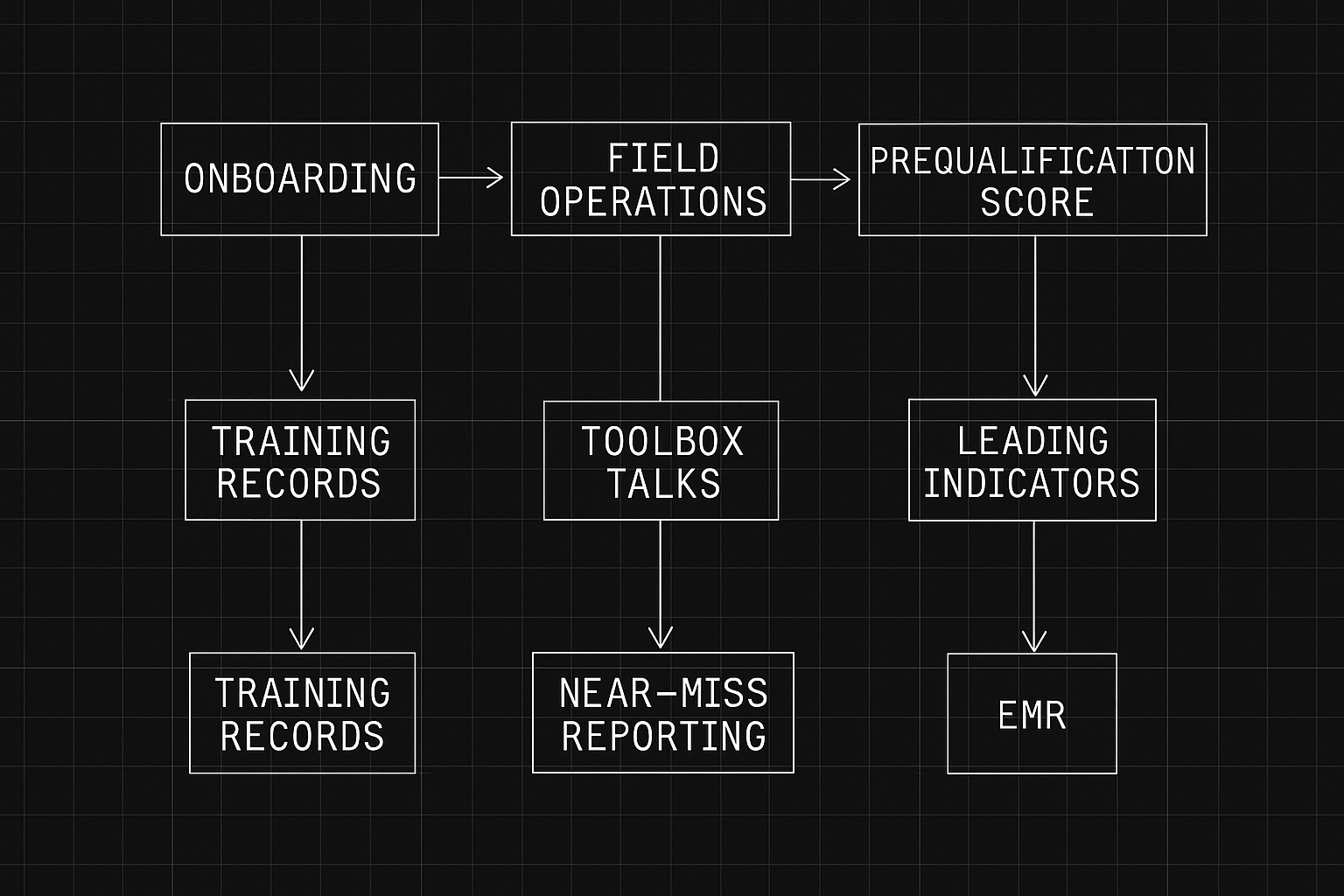
How a Strong Safety Culture Keeps Your Prequalification Grade High Through Employee Turnover
If you work with platforms like Avetta or similar contractor prequalification systems, you already know your grade isn't just a number — it's a business development tool. It influences which contracts you're eligible for and how clients perceive you as a long-term partner. What a lot of contractors don't fully account for is how much employee turnover quietly erodes that grade — not overnight, but steadily, through gaps in training documentation, inconsistent field behavior, and incident upticks that show up in your EMR before you realize what happened. A strong safety culture is the most reliable buffer you have against that erosion.
The Turnover Problem Most Contractors Underestimate
Here's a scenario that plays out more often than it should: A mid-size pipeline contractor in West Texas has spent two years building a solid prequalification profile. Low TRIR, clean audit history, up-to-date training records. Then spring hits, they land three new jobs simultaneously, and they bring on 40 new field hands over six weeks. The experienced crew leads are stretched thin. Onboarding is rushed. Toolbox talks still happen on paper, and half the new hire certifications are tracked in someone's email inbox.
By Q3, they've had two recordable incidents — both involving workers hired in that spring surge. Their EMR ticks up. Their Avetta score dips. A tier-one oil and gas client flags them for review. None of that had to happen. The work was good. The leadership genuinely cared about safety. But the system wasn't built to survive growth.
That's the core issue. Safety culture isn't just a values statement on the break room wall. It's the operational infrastructure that ensures every worker — whether they've been with you for five years or five days — behaves the same way in the field.
What "Culture" Actually Means in Operational Terms
When we talk about safety culture in the context of prequalification performance, we mean a few concrete things:
- Consistent onboarding regardless of hiring pace. New workers receive the same training, in the same sequence, with documentation that feeds directly into your prequalification record — not into someone's filing cabinet.
- Leading indicators, not just lagging ones. Inspection completion rates, toolbox talk attendance, near-miss reporting frequency — these numbers tell you the health of your safety system before an incident happens.
- Supervisor behavior as the cultural signal. Field supervisors set the tone. If they skip the pre-task safety check when things get busy, the crew notices. Culture lives in what gets done under pressure, not what's written in the policy manual.
- Systems that don't depend on one person. When your safety coordinator is on vacation or leaves the company, nothing should fall through the cracks. Reminders, reports, training cycles — all of it should run on a process, not a personality.
How Culture Protects Your Grade During Workforce Transitions
Prequalification platforms are looking for evidence of systemic competence. They want to see that your safety performance isn't an accident — that it's reproducible. When you have turnover, that's actually an opportunity to demonstrate exactly that.
Contractors who maintain strong grades through hiring cycles typically share a few traits. Their training records are always current because documentation is automated, not manual. Their incident rates stay stable because near-miss reporting is normalized — workers report because they trust the process, not because they fear the paperwork. And their supervisors reinforce the same behaviors on day one with a new hire as they do on day one thousand with a veteran.
That consistency is what clients notice. It's also what keeps your work comp premiums from climbing after a rough quarter. Insurers and prequalification platforms are both reading the same underlying signal: does this company's safety performance hold up under stress?
Practical Steps to Stabilize Your Grade Year-Round
You don't need a complete overhaul to get this right. A few structural changes tend to make the biggest difference:
- Build a standardized onboarding checklist that triggers automatically when a new hire is added to your system.
- Schedule recurring safety topics — weekly or bi-weekly — so the cadence doesn't depend on someone remembering to do it.
- Track leading indicators monthly and share them with your field supervisors, not just your safety manager.
- Treat near-miss reports as wins. A crew that reports near-misses is a crew that's paying attention.
- Review your prequalification profile quarterly, not just at renewal time. Surprises in your score are almost always preventable if you catch the trend early.
The Long Game: Reputation as a Competitive Advantage
Contractors who treat prequalification scores as a compliance checkbox tend to scramble before renewals. Contractors who treat them as a reflection of their actual safety system tend to stay consistently high — and they win more work because of it.
Clients in oil and gas, construction, and utilities are increasingly looking at safety performance as a proxy for overall operational reliability. A contractor who manages turnover well, keeps training current, and sustains low incident rates is a contractor who's less likely to create schedule problems, liability exposure, or reputational issues for the client. That reputation compounds over time.
The goal isn't a perfect score. It's a score that accurately reflects a genuinely well-run safety program — one that holds up even when your workforce is changing.
Frequently Asked Questions
Does employee turnover directly affect my prequalification grade?
Not directly on its own — but turnover creates conditions where training gaps and documentation lapses are more likely, which can affect your incident rates and audit readiness. A strong safety system reduces that risk significantly.
What leading indicators matter most for prequalification platforms?
Inspection completion rates, toolbox talk frequency, near-miss reporting rates, and training compliance percentages are among the most useful. They show that your safety system is active, not just documented.
How often should we review our prequalification profile?
Quarterly reviews are typically more effective than annual ones. Catching a trend early — like a dip in training completion — gives you time to correct it before it affects your score or a client relationship.
Can a small contractor maintain a strong prequalification grade without a dedicated safety staff?
Yes — many do. The key is having systems that run with minimal manual effort: automated reminders, standardized checklists, and digital documentation that's always audit-ready. The system does the heavy lifting so the safety culture doesn't depend on one person's bandwidth.
Does safety culture actually influence work comp premiums?
In most cases, yes. Insurers review your incident history and often consider the maturity of your safety program when setting or adjusting premiums. Lower incident rates and documented safety activity typically support better rates over time.
One Tool Worth Having in Your Corner
If you're working on strengthening the cultural foundation behind your prequalification performance, the resource I'd point you to first is the Awesome Safety Culture System — a practical, structured framework for building safety culture that actually holds up through hiring cycles, supervisory changes, and growth. It's free, and it's built for contractors who want a real system, not just a poster on the wall.
AW
Aaron West
Founder, EHS, Inc. — 18+ years in EHS compliance and contractor safety
Aaron West has spent over 18 years helping contractors and businesses navigate OSHA compliance, ISNetworld® certification, and workplace safety management. He founded EHS, Inc. to make enterprise-level EHS accessible to companies of all sizes — serving contractors and businesses nationwide — without long-term contracts or enterprise overhead.
Ready to simplify your EHS compliance?
Our team handles the complexity so you can focus on running your business. No long-term contracts, no learning curve.
Talk to EHSRelated Articles
Your Avetta Score After Winning a Large Public Contract
Winning a large public contract can crater your Avetta score overnight — here's what that costs and how to stop it.
ISNetworld Grade Drop: When Insurance Limits Fall Short
Your ISNetworld grade can crater overnight when your renewed policy carries lower limits than your operator contract requires — here's exactly how it happens.
Avetta Score After a New Contract Win: What Changes and Why
Winning a new utility contract can silently tank your Avetta score — here's what in-house safety managers miss until the damage is done.
Medium & Enterprise
Safety Culture System
Framework to achieve zero incidents
Get Free System →
Small Businesses
50+ Safety Topics
Stop hitting paywalls
Get Free Topics →
All Companies
Audio Safety Topics
54 topics in English & Spanish
Get Free Audio →