What Your LMS Must Show OSHA When They Walk In Unannounced
When OSHA shows up at your commercial construction site, what's in your LMS either saves you or costs you — here's exactly what they want.
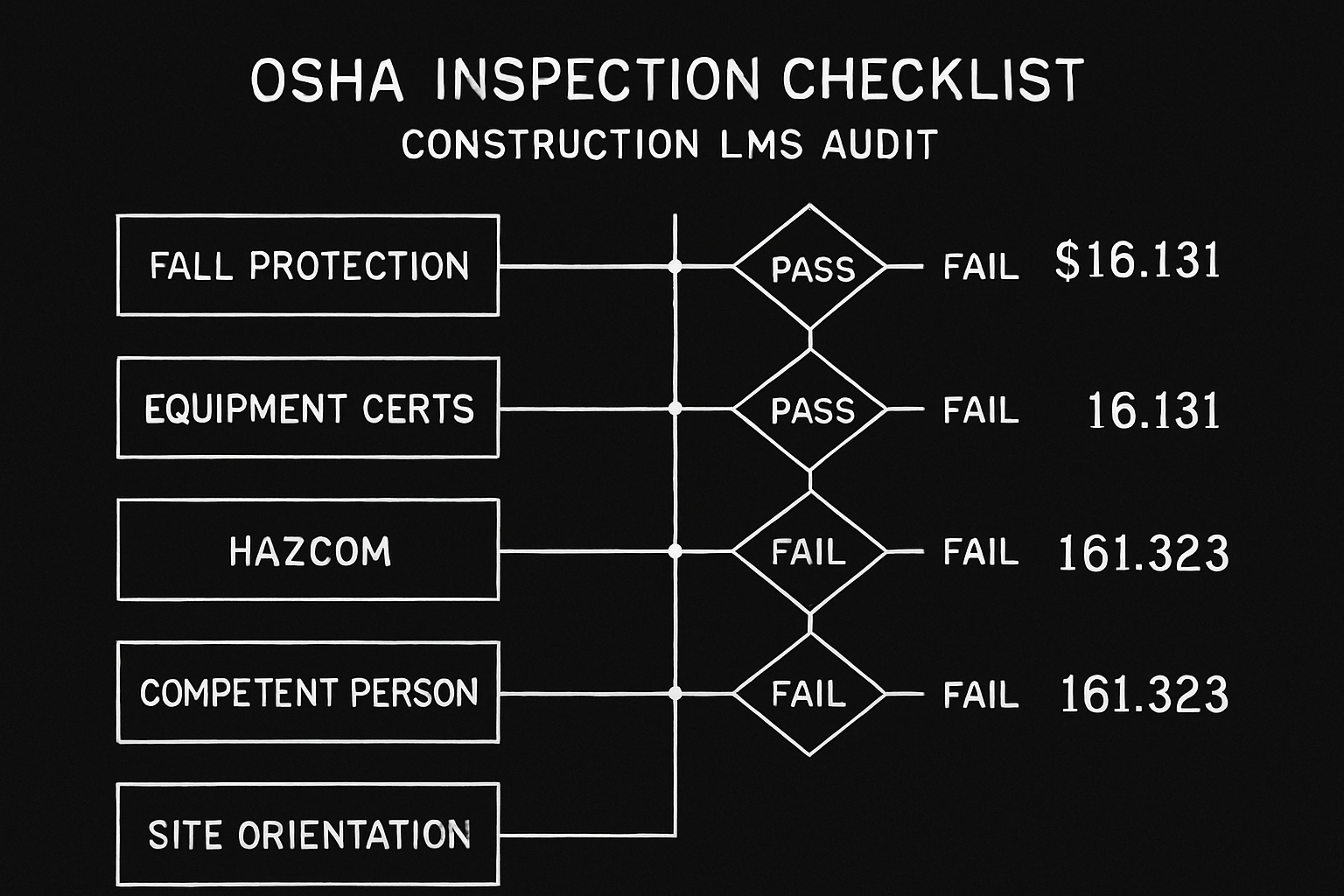
What Safety Managers at Small Contractors Actually Need to Track in an LMS When OSHA Shows Up Unannounced
OSHA doesn't call ahead. That's the whole point. One morning you're doing a pre-task walkthrough on a 4-story commercial build and by 9 a.m. a compliance officer is standing at your site trailer asking for documentation. If you're a safety manager at a 30-person specialty sub or a GC running 50 field hands across two active projects, that moment is either uneventful or it becomes a very expensive day. The difference usually lives inside your LMS — or more accurately, in what you never got around to loading into it.
The Inspection Starts Before They Ask a Single Question
The compliance officer walking your site is already building a picture before they sit down with you. They're looking at your ironworkers and whether fall protection is on. They're clocking your competent person on the excavation crew — or the absence of one. They're watching whether your foreman acknowledges them or looks panicked. By the time they ask for training records, they already have a hypothesis. Your LMS documentation either confirms it or contradicts it.
What they're going to ask for isn't complicated. But pulling it together on the spot, from three different spreadsheets, a binder in a pickup truck, and a shared Google Drive folder your last safety coordinator set up in 2021 — that's where contractors hemorrhage money.
The Five Things Your LMS Actually Needs to Produce in Real Time
- Completion records by employee, course, and date — not just "who finished what" but timestamps that survive scrutiny. If your scaffold erector completed his competent person training 14 months ago and there's no refresher on record, that's a problem.
- Proof of site-specific orientation for every worker on that project — OSHA's inspectors know that generic online training doesn't substitute for a documented site-specific orientation. If your LMS can't filter completions by project or location, you're flying blind.
- Operator certifications for equipment on-site — your telehandler operator, your aerial lift tech, your rigging foreman. Not the certificate hanging in someone's wallet — the record your company holds, with expiration dates.
- HAZCOM training tied to the chemicals actually present on that site — if your crew is using epoxy coatings on a parking structure and your LMS shows generic HAZCOM training from two years ago with no SDS acknowledgment attached, expect a citation.
- Training records for any employee operating in a designated competent person role — excavations, fall protection, scaffolding, confined space. "Competent person" is a legal designation under OSHA standards. Your LMS should show the training that justifies that designation, and it needs to be current.
What a Single Serious Violation Actually Costs a Small Contractor
OSHA's current penalty for a serious violation is up to $16,131 per violation. A willful or repeat violation runs up to $161,323. For a 40-person framing sub running on 4–6% margins, a single willful citation — say, a foreman who was told about a fall hazard and didn't fix it — can wipe out the profit on an entire project.
But the citation isn't even the most expensive part for most small commercial contractors. The real damage is what happens at prequalification. If you're on ISNetworld or Avetta for a GC relationship, an OSHA citation triggers a documentation requirement. You have to report it. Your grade drops. The GC's supplier management team sees it. You lose access to bid lists. One mid-size GC in the commercial sector can represent $800K to $2M in annual subcontract revenue. That's the number that should be in your head when you're deciding whether to bother updating your LMS.
The Counterintuitive Part Most Safety Managers Get Wrong
Most safety coordinators at small subs assume the biggest LMS risk is incomplete training — someone who never finished a course. The real problem is training that's complete on paper but indefensible under questioning.
Here's what that looks like in practice: your equipment operator passed a 45-minute online aerial lift course. It's in the LMS. Completion date is there. But when the compliance officer asks your operator to walk through the pre-operation inspection checklist on the JLG 600S sitting on your deck, he can't do it. At that point, your LMS record doesn't protect you — it becomes evidence that you checked a box instead of actually training someone. OSHA can and does cite for inadequate training even when training records exist. The record shows the training happened; it doesn't prove competency was achieved.
This is why your LMS needs more than completion timestamps. It needs practical sign-offs from a qualified evaluator — a foreman, a superintendent, a safety manager — confirming the employee demonstrated the task. Without that, you have paperwork. You don't have a defense.
A Real Scenario: 11:15 a.m. on a Tuesday in Atlanta
A 22-person masonry sub is three weeks into a tilt-up commercial warehouse project. OSHA walks on site following a complaint from an adjacent subcontractor. The compliance officer asks for fall protection training records for the crew working elevated on the panel forms — six masons and two laborers. The safety manager, who is also running another job across town, has records for five of the eight workers in the LMS. The sixth completed training under a previous employer. The seventh is a recent hire who was supposed to finish orientation that week. The eighth is a foreman who hasn't refreshed his competent person designation since 2021.
Three potential serious violations. At $16,131 each, that's $48,393 before any negotiation. If the foreman's gap is cited as willful because he was designated competent person and the records show the gap was known, you're looking at a number that starts with a comma. And when this hits their ISNetworld profile, the GC on this project — and three others they were qualifying for — now has a decision to make about whether to keep them on approved vendor lists.
What "Audit-Ready" Actually Means in an LMS for a Sub Under 75 People
Audit-ready doesn't mean everything is perfect. It means you can produce clean documentation within two minutes, filtered by site and employee, without calling anyone or opening a second system. For a small contractor, that usually requires:
- One LMS — not a mix of paper, email confirmations, and a training spreadsheet
- Completions tied to specific job roles, not just individual names
- Expiration date tracking with automatic alerts — not a calendar reminder someone set in 2022
- A record of who holds active competent person designations on each project and what training supports that designation
- Practical evaluation sign-offs attached to equipment-specific or task-specific training
If your current system can't do this, it's not really an LMS for a construction environment. It's a completion tracker. Those are not the same thing when a compliance officer is sitting across the table from you.
Frequently Asked Questions
What training records does OSHA typically request during a construction site inspection?
OSHA compliance officers commonly request fall protection training, competent person designations, equipment operator certifications (aerial lifts, forklifts, telehandlers), HAZCOM training with SDS acknowledgments, scaffold erector and user training, and site-specific orientation records. For excavation work, they will specifically ask for documentation supporting the competent person on-site. All of these should be retrievable from your LMS by employee name, role, and project within minutes.
Can OSHA cite a contractor if training records exist but the employee can't demonstrate competency?
Yes. OSHA's training standards require that training be sufficient to ensure employees can perform tasks safely — not just that it was completed. A compliance officer who observes an employee performing a task incorrectly can cite inadequate training regardless of what the LMS shows. This is why practical evaluations with documented sign-offs matter alongside completion records.
How does an OSHA citation affect ISNetworld or Avetta prequalification scores?
Both platforms require self-reporting of OSHA citations and may cross-reference OSHA's public inspection database. A serious or willful citation will typically lower your safety grade, which can result in removal from a GC's approved vendor list or disqualification from bid opportunities until corrective actions are documented and verified. For specialty subs dependent on a few key GC relationships, this can be more damaging than the citation penalty itself.
How far back do training records need to go for an OSHA inspection?
It depends on the standard. HAZCOM training records should be kept for the duration of employment. Equipment operator records should reflect current certification, typically with recertification cycles of three years. Competent person training records should be current and supported by ongoing documentation — an outdated record with no refresher training is a liability, not a defense.
What's the difference between a completion record and a competency record in an LMS?
A completion record shows that an employee finished a course. A competency record documents that a qualified evaluator verified the employee can actually perform the task. For OSHA purposes — particularly in equipment operation, fall protection, and competent person roles — you need both. Most small contractors have one and call it good.
If managing this across multiple active projects with a lean team sounds like exactly the situation you're in, talk to EHS, Inc. We handle the LMS administration, training tracking, and OSHA documentation so your safety staff can spend time on the site instead of the spreadsheet. Download our free safety topics pack or schedule a call here to see how it works for contractors your size.
For current OSHA penalty amounts and inspection procedures, see OSHA's penalty schedule at osha.gov.
AW
Aaron West
Founder, EHS, Inc. — 18+ years in EHS compliance and contractor safety
Aaron West has spent over 18 years helping contractors and businesses navigate OSHA compliance, ISNetworld® certification, and workplace safety management. He founded EHS, Inc. to make enterprise-level EHS accessible to companies of all sizes — serving contractors and businesses nationwide — without long-term contracts or enterprise overhead.
Ready to simplify your EHS compliance?
Our team handles the complexity so you can focus on running your business. No long-term contracts, no learning curve.
Talk to EHSRelated Articles
What Happens to Your LMS When Your Workforce Doubles Overnight
Winning a new contract and doubling your workforce sounds like a win — until your LMS becomes the reason an OSHA inspector writes you up.
What Happens to an LMS When the Safety Manager Who Built It Leaves
When the safety manager who built your LMS walks out the door, OSHA doesn't care who's responsible — they just write citations.
How a Safety Manager Survives an OSHA Inspection With Messy Training Records
OSHA doesn't cite you for the hazard — they cite you for the missing paperwork. Here's what that looks like in oil and gas.
Medium & Enterprise
Safety Culture System
Framework to achieve zero incidents
Get Free System →
Small Businesses
50+ Safety Topics
Stop hitting paywalls
Get Free Topics →
All Companies
Audio Safety Topics
54 topics in English & Spanish
Get Free Audio →