What OSHA Finds When a Worker Gets Hurt and Training Records Are Gone
When a maintenance tech gets hurt during a refinery turnaround, OSHA doesn't read your safety manual — they pull your training records. Here's what they find.
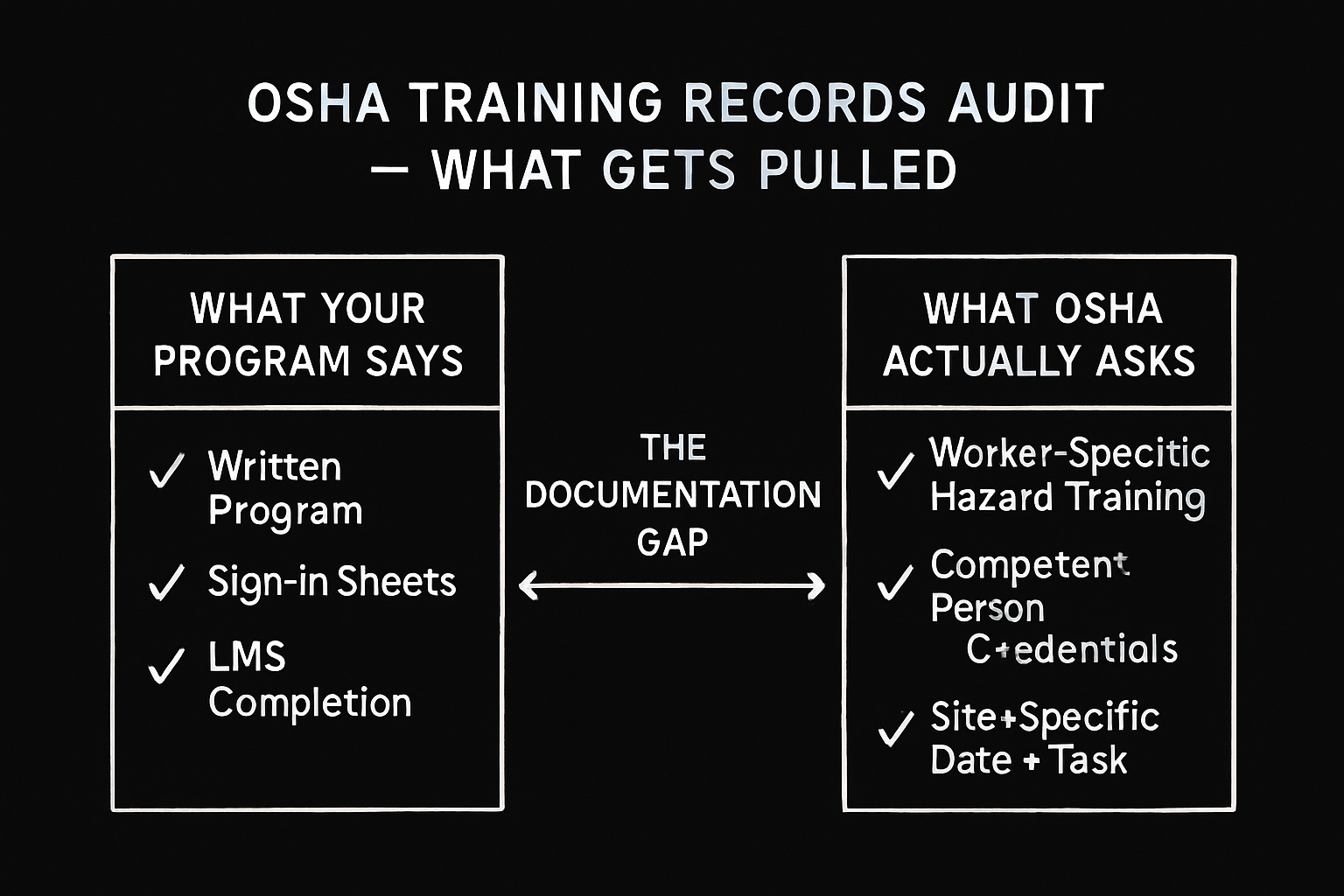
What OSHA Looks for When a Worker Gets Hurt and Your Training Records Are Missing
A maintenance tech goes down during a refinery turnaround. Scaffold work, elevated platform, third day of a compressed outage schedule. By the time EMS clears the site, an OSHA compliance officer is already on the phone requesting records. Not your written fall protection program — your training records. Specifically: who trained this worker, on what, when, and how do you know it stuck.
That last part is where most industrial maintenance contractors fall apart. Not because they don't have a training program — they usually do. They fall apart because the program that exists on paper and the program that actually runs on the ground are two different things, and OSHA knows exactly where to look to prove it.
The Gap OSHA Exploits Every Time
Here's how it actually goes on a refinery turnaround or plant shutdown: your safety coordinator has a binder. The binder has sign-in sheets. The sign-in sheets have names. Some of those names are barely legible. Some of those workers have been cycled through four different crews across three contractors in the last two weeks. A few of them signed a sheet for a toolbox talk they attended at a different site, for a different job type, six months ago.
OSHA doesn't care about the binder. They care about whether you can demonstrate that the worker who got hurt was trained on the specific hazard that hurt them — before they were exposed to it. OSHA 1926.503 on fall protection training, for example, requires retraining whenever a worker demonstrates inadequate knowledge or works conditions change. "We trained everyone at the start of the turnaround" doesn't hold up if the crew rotated in on day six.
What the Inspection Actually Looks Like
The compliance officer doesn't walk in swinging. They're methodical. First request: your OSHA 300 log and your written safety program. Second request: training documentation for the workers involved. Third request — and this is the one that exposes the gap — training documentation for the competent person who signed off on the task that caused the injury.
In industrial maintenance, that's often a crew lead or a working foreman who carries the "competent person" designation on paper but whose last documented scaffold competency training was two years ago from a vendor who no longer operates. OSHA will pull that thread. When they do, you're no longer defending one incident — you're defending your entire training program across every crew on the job.
The Counterintuitive Part Most Safety Coordinators Miss
Most safety coordinators assume the problem is that they don't have enough training. So they add more. More toolbox talks. More sign-in sheets. More LMS modules. The real problem isn't volume — it's traceability. OSHA isn't counting your training hours. They're asking one question: can you prove, right now, that this specific worker was trained on this specific hazard before this specific task? If your LMS shows "Scaffold Safety — Completed" but you can't tie that completion to the crew member who fell, the record doesn't help you.
The distinction matters because it changes what you actually need to fix. It's not more training. It's training that's tied to the individual, the task, the date, and the site — and retrievable inside of an hour when someone is standing in your trailer asking for it.
What It Costs When You Can't Produce the Records
A serious violation — inadequate or undocumented fall protection training — runs up to $16,131 per violation. If OSHA determines the missing training was a systemic failure across multiple workers or multiple tasks on the same site, those citations stack. Willful or repeat violations go up to $161,323 per citation. On a major turnaround with 200 workers across scaffold, confined space, and LOTO-intensive tasks, a single inspection can turn into a six-figure citation event before you finish the outage.
That's before you calculate what the citation does to your ISNetworld grade. A serious OSHA citation triggers a score drop that your owner-operators see before you even get a chance to explain the context. On a competitive bid market for the next refinery contract, that grade drop costs more than the fine.
A Real Scenario That Plays Out Every Turnaround Season
Here's what actually happens: a pipefitter takes a fall from a temporary scaffold platform during a heat exchanger bundle pull. He's hurt — recordable, maybe serious. The safety coordinator pulls the training binder and finds a toolbox talk sign-in from the first day of the outage with the pipefitter's name on it. The toolbox talk topic was "General Site Orientation." OSHA wants scaffold-specific training documentation. The safety coordinator goes to the LMS. The pipefitter completed an online scaffold awareness course — eight months ago, at a different refinery. Nobody has documentation of a site-specific scaffold competency assessment. The competent person designation for that crew? It's the foreman, whose last scaffold training was a one-hour module from 2021.
That's three separate documentation failures from one incident. Three potential citations. One inspection that now covers the entire turnaround workforce.
What Actually Fixes This
The fix isn't a better binder. It's a system where training records are attached to individual workers, verified before task assignment, and retrievable without a scavenger hunt. That means your LMS has to be configured for the reality of contract maintenance work — rotating crews, multi-employer worksites, compressed schedules — not for a fixed workforce at a single facility.
It also means your safety coordinator isn't spending half their turnaround rebuilding training records at 11pm because someone got hurt and OSHA is coming in the morning.
Frequently Asked Questions
What training records does OSHA typically request after an injury in industrial maintenance?
OSHA will request training documentation specific to the hazard involved — scaffold training for a fall, confined space entry training for a gas exposure, LOTO training for an energy isolation failure. They'll also request records for the competent person designated for that crew or task. General orientation records or blanket completion certificates rarely satisfy the requirement.
How far back can OSHA request training records?
There's no single answer — it depends on the standard. OSHA 1910.147 (LOTO) doesn't specify a retention period, but OSHA 1926.503 (fall protection training) documentation is expected to be available for the duration of the project. In practice, inspectors will ask for whatever supports or undermines the citation they're building. Having nothing is the worst position.
Does an OSHA citation for missing training records affect ISNetworld grades?
Yes. OSHA citations are reported in ISNetworld and can trigger immediate score reductions. Owner-operators in refining and petrochemical often filter contractors by ISNetworld grade before shortlisting for turnaround bids. A serious citation that drops your grade mid-contract season can cost you the next contract entirely.
What's the difference between a training record and proof of competency?
A training record shows someone sat through content. Proof of competency shows they demonstrated understanding — usually through a practical evaluation, a skills check, or a documented assessment by a qualified evaluator. For competent person designations on scaffolding or confined space work, OSHA expects more than a completion certificate. If your records only show attendance, you have a gap.
Can EHS, Inc. help manage training records for rotating turnaround crews?
Yes. EHS, Inc. manages LMS administration, training record maintenance, and OSHA documentation for industrial maintenance contractors — including multi-employer worksites with rotating crews. The goal is that every worker's training record is current, tied to specific tasks and hazards, and retrievable immediately when you need it.
If your training records are living in a binder in someone's truck, or spread across three different systems that nobody fully manages, this is the part where it becomes your problem — not someday, but the next time someone gets hurt on your site. Download our free safety topics pack to start filling the gaps, or talk to the team at EHS, Inc. about taking the whole thing off your plate.
AW
Aaron West
Founder, EHS, Inc. — 18+ years in EHS compliance and contractor safety
Aaron West has spent over 18 years helping contractors and businesses navigate OSHA compliance, ISNetworld® certification, and workplace safety management. He founded EHS, Inc. to make enterprise-level EHS accessible to companies of all sizes — serving contractors and businesses nationwide — without long-term contracts or enterprise overhead.
Ready to simplify your EHS compliance?
Our team handles the complexity so you can focus on running your business. No long-term contracts, no learning curve.
Talk to EHSRelated Articles
MOC as a Pre-SIF Control: What Failure Looks Like Before the Report
MOC failures don't start with the incident — they start with the change nobody logged. Here's what that looks like at a refinery turnaround.
Lean Safety Staffing and SIF Exposure in Refinery Turnarounds
When headcount drops during a turnaround, critical control ownership doesn't disappear — it just becomes nobody's job.
ISO 14001 and Safety Integration: What Separate Systems Cost You
Running ISO 14001 and your safety program as separate systems isn't just inefficient — it has a specific dollar cost. Here's what it is.
Medium & Enterprise
Safety Culture System
Framework to achieve zero incidents
Get Free System →
Small Businesses
50+ Safety Topics
Stop hitting paywalls
Get Free Topics →
All Companies
Audio Safety Topics
54 topics in English & Spanish
Get Free Audio →