What Avetta Contractors Must Do Before Their Next Audit
Utility contractors getting removed from Avetta approved vendor lists aren't failing on safety — they're failing on paperwork their in-house safety managers never learned to manage.
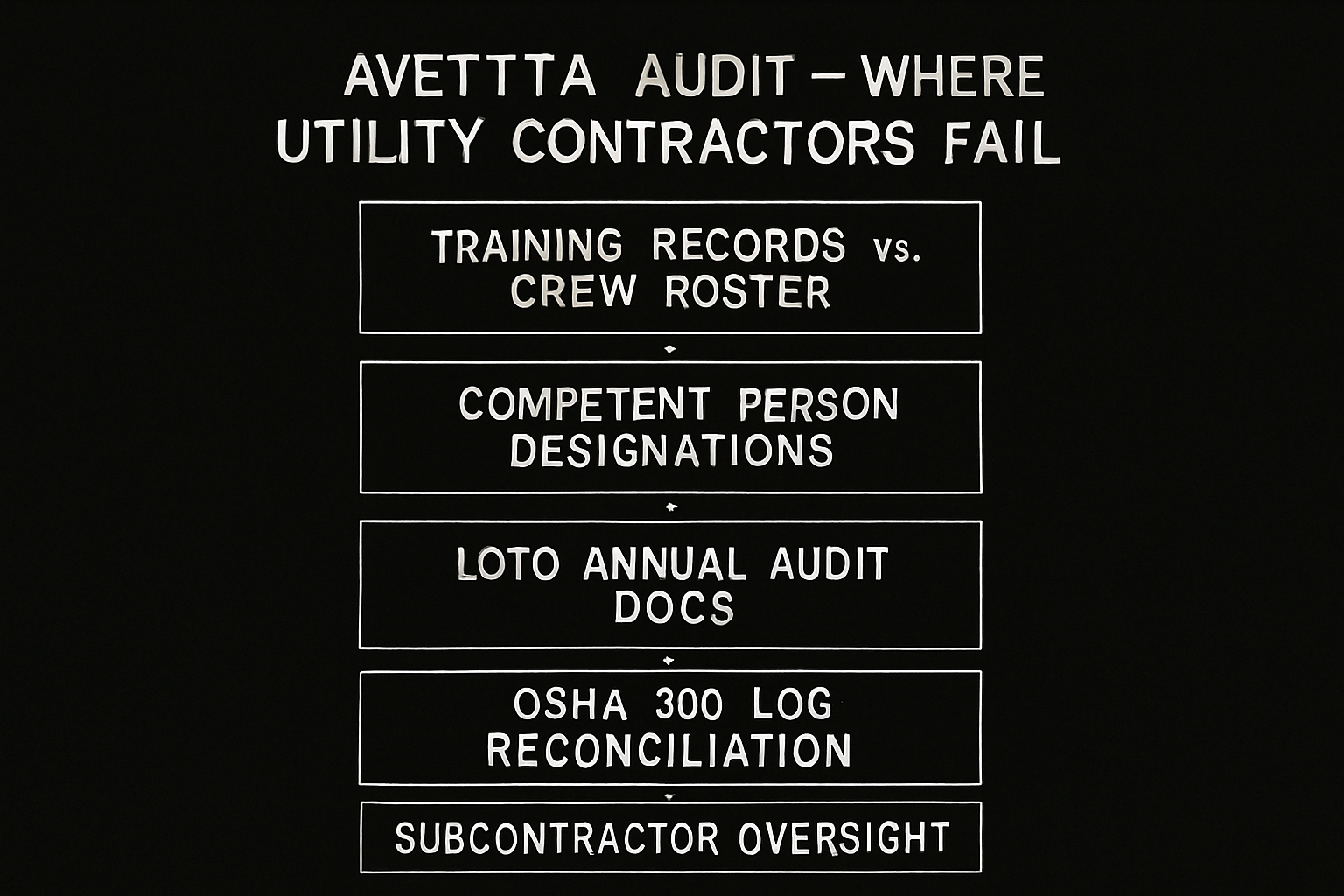
What Avetta Contractors Need to Do Before Their Next Audit to Avoid Getting Removed from the Approved Vendor List
If you run electrical transmission and distribution crews or gas distribution crews, you already know the drill: a client operator sends a prequalification renewal notice through Avetta, and suddenly your safety coordinator is sprinting to pull together documents that should have been maintained all year. The problem isn't that your crews aren't safe. The problem is that your Avetta profile doesn't reflect that — and the client's procurement team doesn't know the difference.
Getting removed from an approved vendor list doesn't always happen because something went wrong on a job site. It happens because a safety manager who learned compliance from a standard — not from an actual T&D project — built a documentation system that looks right on paper and falls apart under review.
What In-House Safety Managers Get Wrong (And Why)
Most safety coordinators who manage Avetta compliance for utility contractors learned their trade from CFR 29 1910 or NESC, not from standing on a 138kV transmission right-of-way at 6 AM while a crew energizes a new tap. That gap matters more than most people admit.
Here's the counterintuitive one: Most safety managers assume their written programs are the problem — but the real problem is their training documentation. Avetta auditors rarely reject a contractor for having a mediocre confined space program. They flag contractors because the program says "all employees receive annual retraining" and the training records show 40% completion. For a gas distribution crew rotating through seasonal hires and temporary linemen, that gap is almost guaranteed to exist if nobody's actively tracking it.
Avetta scores contractors on a weighted rubric. Training records carry significant weight. An incomplete roster — even for one crew working a gas main replacement — can push your score below the threshold that triggers a client review. Some operators set automatic removal at scores below 70. You don't get a phone call. You get a status change.
The Specific Documents That Get Utility Contractors Flagged
These aren't theoretical. These are the items that show up unresolved on Avetta audit reports for electrical T&D and gas distribution contractors specifically:
- OSHA 300 logs with classification errors. A lineman's laceration from a conductor gets logged as first aid when it required stitches. That's a recordkeeping violation — up to $16,131 per serious citation under current OSHA penalty schedules. Worse, Avetta's system cross-references your submitted TRIR against your 300 log. Discrepancies trigger manual review.
- Competent person designations that aren't current. Your excavation competent person for gas main work left in March. Nobody updated the written program. The designation still has his name on it. Avetta's auditor will ask for proof that a qualified individual currently holds that role.
- LOTO/LOTOTO procedures with no annual inspection record. Electrical T&D contractors operating under NFPA 70E need documented annual LOTO audits. Many safety coordinators file the initial procedure and consider it done. The annual audit documentation — showing a qualified person reviewed each procedure while the equipment was actually in use — is what's missing.
- Subcontractor management records that stop at insurance certificates. If you're using subcontract crews for gas distribution tie-ins, Avetta expects you to demonstrate oversight of those subcontractors' safety programs. An insurance certificate isn't that. A pre-work safety evaluation is.
- Incident investigation reports that close with "retraining provided." That phrase is a red flag to any reviewer who's spent time on actual job sites. It signals that the investigation stopped at the surface. Avetta and the clients behind the platform are looking for corrective action that actually changes conditions, not corrective action that generates a sign-in sheet.
A Scenario That Plays Out More Than It Should
A mid-size electrical contractor — about 85 field employees, mixed T&D and substation work — renewed their Avetta profile in Q1. Their safety manager had maintained everything in a shared drive: written programs, training logs, incident reports. Clean-looking system. The Avetta review flagged them anyway.
Two issues: First, their EMR had ticked up to 1.4 after a serious hand injury the prior year — a compression injury on a hydraulic crimping tool that got recorded late and without a proper investigation. Second, their confined space training records showed completion for only 28 of 41 employees who worked manholes and underground vaults during that period. The safety manager's count was based on classroom attendance, not the actual task-based crew roster. Thirteen people who entered permit-required spaces had no documented training on file.
The client — a regional utility — paused contract awards while the contractor remediated. That pause cost them approximately six weeks of work on a scheduled distribution upgrade. Nobody got cited. Nobody got hurt. They just couldn't prove what they said they'd done.
What to Do Before Your Next Avetta Audit
Work backwards from the Avetta scoring rubric, not forward from your written programs. The rubric tells you exactly what carries weight. Build your document maintenance calendar around those categories. For utility contractors specifically:
- Reconcile your training records against your actual field crew roster — not your HR headcount. Seasonal linemen, temporary gas crew labor, and contract operators all need documentation.
- Verify your competent person designations are current, named, and defensible. If the person left, the program needs to be updated before the audit — not during it.
- Pull your OSHA 300 log and reconcile it against your incident reports. Every entry should match. Every severity classification should be defensible without explanation.
- Document your subcontractor oversight process. Pre-work safety evaluations, site-specific orientations, and any corrective actions taken with sub crews should be in writing.
- If your EMR is above 1.0, prepare a narrative. Avetta clients can see your rate. They can't see your explanation unless you provide one. A documented corrective action plan attached to a high EMR tells a different story than a number sitting alone in a profile.
Frequently Asked Questions
What score do Avetta contractors need to avoid getting removed from the approved vendor list?
It varies by client operator. Many utilities and oil majors set automatic review triggers between 60–70 on Avetta's scoring scale. Some clients set their threshold higher. The safest approach is maintaining a profile that scores above 80 with no open corrective actions — because once a review is triggered, the contractor is typically paused from new work awards until it closes.
How often does Avetta require utility contractors to update their safety documentation?
Avetta typically requires annual renewal, but some document categories — especially insurance certificates, OSHA 300 logs, and EMR updates — require updates as they change throughout the year. Many contractors miss mid-year updates and take a score hit they don't notice until renewal.
Does a high EMR automatically get a contractor removed from Avetta?
Not automatically — but it's weighted heavily in client-side evaluations. An EMR above 1.2 or 1.4 can trigger manual review by the client's procurement or EHS team, which delays contract awards even if the Avetta score itself is passing. The EMR follows you for a three-year lookback period, so a single serious incident compounds longer than most safety managers account for.
Can a utility contractor dispute Avetta's assessment if they believe the score is wrong?
Yes, through Avetta's support process — but it takes time and requires documentation. The more effective approach is building a profile that doesn't require a dispute: accurate records, current designations, and reconciled incident logs before the audit clock starts.
Stop Chasing Your Avetta Score Every Renewal Cycle
The contractors who stay on approved vendor lists without scrambling aren't doing more safety work. They're maintaining documentation year-round instead of rebuilding it every twelve months. If your team is in sprint mode every time a renewal notice comes in, the system isn't working — it's just surviving.
EHS, Inc. manages Avetta and ISNetworld prequalification, training records, OSHA documentation, and written programs for utility and construction contractors. You don't touch it. We keep it current.
Find out if your company qualifies — take the free 2-minute Avetta & ISNetworld Readiness Check.
AW
Aaron West
Founder, EHS, Inc. — 18+ years in EHS compliance and contractor safety
Aaron West has spent over 18 years helping contractors and businesses navigate OSHA compliance, ISNetworld® certification, and workplace safety management. He founded EHS, Inc. to make enterprise-level EHS accessible to companies of all sizes — serving contractors and businesses nationwide — without long-term contracts or enterprise overhead.
Ready to simplify your EHS compliance?
Our team handles the complexity so you can focus on running your business. No long-term contracts, no learning curve.
Talk to EHSRelated Articles
Your Avetta Score After Winning a Large Public Contract
Winning a large public contract can crater your Avetta score overnight — here's what that costs and how to stop it.
ISNetworld Grade Drop: When Insurance Limits Fall Short
Your ISNetworld grade can crater overnight when your renewed policy carries lower limits than your operator contract requires — here's exactly how it happens.
Avetta Score After a New Contract Win: What Changes and Why
Winning a new utility contract can silently tank your Avetta score — here's what in-house safety managers miss until the damage is done.
Medium & Enterprise
Safety Culture System
Framework to achieve zero incidents
Get Free System →
Small Businesses
50+ Safety Topics
Stop hitting paywalls
Get Free Topics →
All Companies
Audio Safety Topics
54 topics in English & Spanish
Get Free Audio →