What Contractors Get Wrong When Their ISNetworld Grade Drops
When an oil & gas contractor's ISNetworld grade tanks mid-contract, the hazard isn't the problem — the missing paperwork is.
What Contractors Get Wrong When Their ISNetworld Grade Drops and a Contract Is Already on the Line
Your ISNetworld grade just dropped. You have a well servicing contract starting in three weeks with a major operator — let's say Halliburton or a mid-size E&P running pad drilling in the Permian. The hiring client gets the alert. Now you're on the phone explaining yourself instead of mobilizing your crews. The frustrating part? Nothing blew up. Nobody got hurt. The hazard that caused this problem doesn't exist on any Job Hazard Analysis. The problem is a folder — or the absence of one.
After years of watching upstream drilling and pipeline contractors lose grades, lose contracts, and occasionally lose their prequalification status entirely, one pattern holds almost every time: the hazard wasn't the issue. The documentation of the hazard program was.
The Admin Failure Nobody Wants to Talk About
Here's the scenario that plays out constantly in the upstream oil and gas space. A well servicing company has a solid safety coordinator — decent toolbox talk participation, no serious OSHA recordables in two years, crews that mostly know what they're doing on a kill job or a coil tubing run. Then the safety coordinator leaves. Maybe they took a better offer from an operator. Maybe they got promoted. Doesn't matter.
What happens next is predictable: ISNetworld keeps running. Insurance renewals come due. Written program update windows open. RAVS audit requests land in an inbox nobody's monitoring anymore. And three months later, the grade drops — not because the field work got less safe, but because nobody renewed the contractor's RAVS Plus submission, nobody uploaded the updated Stop Work Authority procedure, and the proof of safety training for the new hands hired during the spring drilling push? Gone. Never logged. Those workers completed their orientation — the competent person on the rig checked them off — but there's no LMS record, no sign-in sheet uploaded, nothing ISNetworld can verify.
The operator's prequalification team doesn't call to ask. They just see a C grade where a B used to be, and your contract review gets flagged.
Most Safety Coordinators Assume the Wrong Thing
Most safety coordinators assume a grade drop means something happened — a recordable incident posted to the OSHA 300, an EMR spike, a failed audit finding. The real problem is usually a documentation gap that's been sitting open for 60 to 90 days.
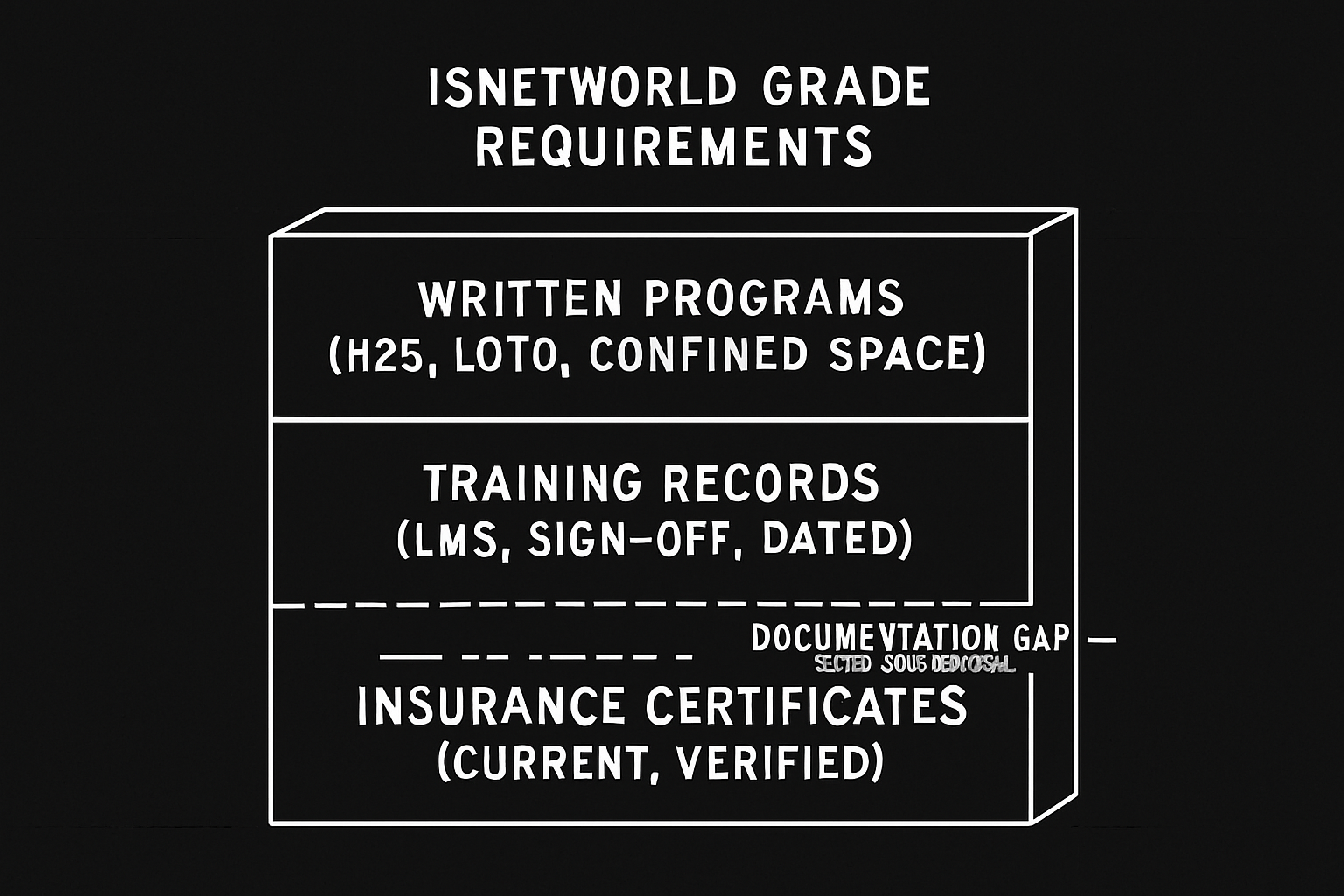
ISNetworld doesn't penalize you for having a hazardous operation. Upstream drilling is a hazardous operation by definition — H2S exposure, high-pressure wellhead work, rotating equipment, confined space entry on production vessels. ISNetworld penalizes you for not being able to prove you have a written program that addresses those hazards, proof that your employees received training on those programs, and current insurance certificates that match what your profile says you do.
That's it. Three documentation categories. And contractors miss all three — simultaneously — more often than anyone wants to admit.
What a RAVS Audit Actually Looks For in the Field
When ISNetworld's RAVS team reviews a pipeline contractor's submission, they're not sending someone out to walk your right-of-way. They're reviewing documents. Specifically: does your written H2S program reference the exposure limits in OSHA's H2S standard? Does your confined space program name a competent person for permit-required spaces? Are your training records dated, signed, and tied to specific employees — not just a generic sign-in sheet from a group safety meeting where someone circled "Confined Space" at the top?
A maintenance tech who can recite the steps for atmospheric testing before entering a production separator is more prepared than most. If there's no documented proof that he received confined space training in the last 12 months, ISNetworld scores that as a gap. The auditor doesn't know what he knows. They know what you can prove.
The Dollar Number That Focuses the Mind
Losing a single well servicing contract while you scramble to fix a grade is not a minor inconvenience. A typical five-well service agreement in the Permian or Eagle Ford can run $800,000 to $2 million over the contract term. If the operator puts you in "corrective action required" status and slots in a competitor while you resubmit your documentation, that revenue doesn't come back. Neither does the relationship, usually.
On the OSHA side, if the documentation failure cascades into an inspection and an auditor finds that your workers didn't have documented training for the tasks they were performing — say, Lockout/Tagout on a pump jack, or H2S monitoring near a wellhead — a serious violation runs up to $16,131 per instance. Willful or repeat violations go to $161,323. Those aren't hypotheticals. They're the published penalty schedule, and inspectors in oil and gas country know how to stack citations.
The Fix Is Not What You Think It Is
The instinct is to hire someone. Post for a safety coordinator, get a body in the seat, hand them the ISNetworld login. That buys you six months, maybe a year, before the same problem recurs when that person turns over — and turnover in oil and gas safety staffing is brutal.
The actual fix is building a system that doesn't depend on one person knowing where everything lives. Written programs that get reviewed on a calendar trigger, not when someone remembers. Training records logged in an LMS the moment a worker completes orientation — not uploaded in a batch at the end of a drilling campaign. Insurance certificates tracked against renewal dates. ISNetworld submission windows on a managed schedule.
That's not glamorous. It's also not optional when a C grade is costing you contracts.
FAQ
How fast can an ISNetworld grade drop after a documentation lapse?
Grade changes can occur within a single review cycle — sometimes within 30 days of a missed renewal or expired document. Hiring clients receive automated notifications when a contractor's grade changes, so the visibility is immediate even if you don't notice it yourself.
Does a lower ISNetworld grade automatically disqualify a contractor from a contract?
Not automatically — but most major oil and gas operators set a minimum grade threshold in their contractor management policies. Dropping from a B to a C, or from a C to a D, frequently triggers a corrective action hold or automatic disqualification from new work orders until the grade is restored.
What documents cause the most ISNetworld grade drops for upstream oil and gas contractors?
Expired insurance certificates, missing or outdated written safety programs (H2S, confined space, LOTO, HazCom), and unverifiable training records for field personnel are the most common culprits. The written programs exist — they just haven't been updated to reflect current operations or regulatory language.
Can a contractor recover their ISNetworld grade quickly after a drop?
Yes, but not instantly. Resubmitting documentation, completing a RAVS review, and having the hiring client acknowledge the update can take two to six weeks depending on queue times and the number of gaps. The best recovery is preventing the drop — not reacting to it.
If your ISNetworld grade is slipping — or you're one personnel change away from it slipping — we manage the entire submission, training records, written programs, and renewal calendar for upstream contractors. Find out if your company qualifies: take the free 2-minute ISNetworld & Avetta Readiness Check.
AW
Aaron West
Founder, EHS, Inc. — 18+ years in EHS compliance and contractor safety
Aaron West has spent over 18 years helping contractors and businesses navigate OSHA compliance, ISNetworld® certification, and workplace safety management. He founded EHS, Inc. to make enterprise-level EHS accessible to companies of all sizes — serving contractors and businesses nationwide — without long-term contracts or enterprise overhead.
Ready to simplify your EHS compliance?
Our team handles the complexity so you can focus on running your business. No long-term contracts, no learning curve.
Talk to EHSRelated Articles
Your Avetta Score After Winning a Large Public Contract
Winning a large public contract can crater your Avetta score overnight — here's what that costs and how to stop it.
ISNetworld Grade Drop: When Insurance Limits Fall Short
Your ISNetworld grade can crater overnight when your renewed policy carries lower limits than your operator contract requires — here's exactly how it happens.
Avetta Score After a New Contract Win: What Changes and Why
Winning a new utility contract can silently tank your Avetta score — here's what in-house safety managers miss until the damage is done.
Medium & Enterprise
Safety Culture System
Framework to achieve zero incidents
Get Free System →
Small Businesses
50+ Safety Topics
Stop hitting paywalls
Get Free Topics →
All Companies
Audio Safety Topics
54 topics in English & Spanish
Get Free Audio →