How a Safety Manager Builds an LMS Business Case That Gets Budget Approved
Utility safety managers keep losing budget requests for LMS — here's why the standard taught you the wrong argument.
How a Safety Manager Builds an LMS Business Case That Gets Budget Approved
Every safety manager in electrical T&D or gas distribution eventually hits the same wall. You know the training operation is broken. Your journeyman linemen are signing paper rosters for tailgate talks that may or may not have happened. Your apprentices are overdue on confined space refreshers. Your competent persons for excavation work can't prove they completed their annual recertification because the record is a manila folder in someone's truck. You build a case for an LMS. You send it to the ops VP. And nothing happens.
Here's what's actually going wrong — and it's not your deck.
You're Making a Compliance Argument. Finance Doesn't Speak Compliance.
Most safety managers learned to build their case from the standard. OSHA 1910.269 requires documented training for electrical hazards. PHMSA requires qualification records for gas distribution operators under 49 CFR Part 192. So the business case reads like a compliance checklist: "We need an LMS to meet regulatory requirements." The ops VP reads that and thinks: we've been doing this for 20 years without one.
The counterintuitive insight here: most safety managers assume the compliance gap is the argument — but the real problem is they've never translated that gap into a number the CFO already cares about.
Finance isn't afraid of OSHA citations in the abstract. They're afraid of the $161,323 repeat/willful penalty that lands when an OSHA compliance officer shows up after a substation energization incident and finds out your journeyman lineman never completed his arc flash PPE training — and there's no record proving he did. That's a different conversation. So is the one where your prime contractor notifies you that your ISNetworld grade dropped below their threshold and you're off the bid list for a $4M transmission line project.
What an Actual Utility Contractor Training Failure Looks Like
Here's a scenario that plays out constantly in T&D shops: A crew of four is doing underground URD work — a combination job involving excavation, confined space entry into a transformer vault, and energized secondary conductors. The field supervisor is an experienced foreman, but he's also acting as the competent person for the excavation and the attendant for the confined space. He's done this a hundred times.
Nobody has formally documented that he's a competent person in years. The last sign-off is from a classroom session three years ago run by a safety coordinator who left the company. That training record lives on a spreadsheet on a server nobody has accessed since the IT migration.
When OSHA opens an inspection — triggered by a neighbor's call, not an injury — they ask for the competent person designation records. The foreman can't produce them. The safety manager can't produce them. That's a serious violation at up to $16,131 per instance. If the inspector finds a pattern across multiple job sites, repeat violation territory starts at $161,323. And that's before anyone gets hurt.
An LMS doesn't prevent that foreman from making a field decision. But it means when the inspector asks for the record, you pull it up in 45 seconds instead of saying "let me make some calls."
The Argument That Actually Gets Budget Approved
Stop leading with compliance. Start with the three numbers finance already tracks:
- Workers' comp premium and EMR. A single lost-time injury on a lineman — arc flash, fall from aerial lift, struck-by from a spinning conductor — can run $200,000–$500,000 in direct costs. Your EMR carries that for three years. A deteriorating EMR doesn't just raise your premium; it gets you prequalified out of jobs you should be winning. If you're on ISNetworld and your grade slips, that's not a compliance problem — it's a revenue problem.
- Productive hours lost to training admin. Calculate what your safety coordinator actually spends per week chasing down sign-off sheets, re-creating training logs before an audit, and scheduling make-up sessions for crews who missed the in-person session because they were on a storm response. In a 150-person T&D contractor, that's often 8–12 hours per week of a $75,000 salary. That's real money on administrative drag.
- Contract prequalification risk. Utilities and grid operators increasingly require documented training completion as a prequalification condition — not just ISNetworld grades, but specific programs: NFPA 70E, OSHA 10/30, operator qualification for gas crews. Losing a prequalification grade because you can't produce records is not recoverable in the short term. The next bid cycle is six months away.
What Your Business Case Needs to Actually Say
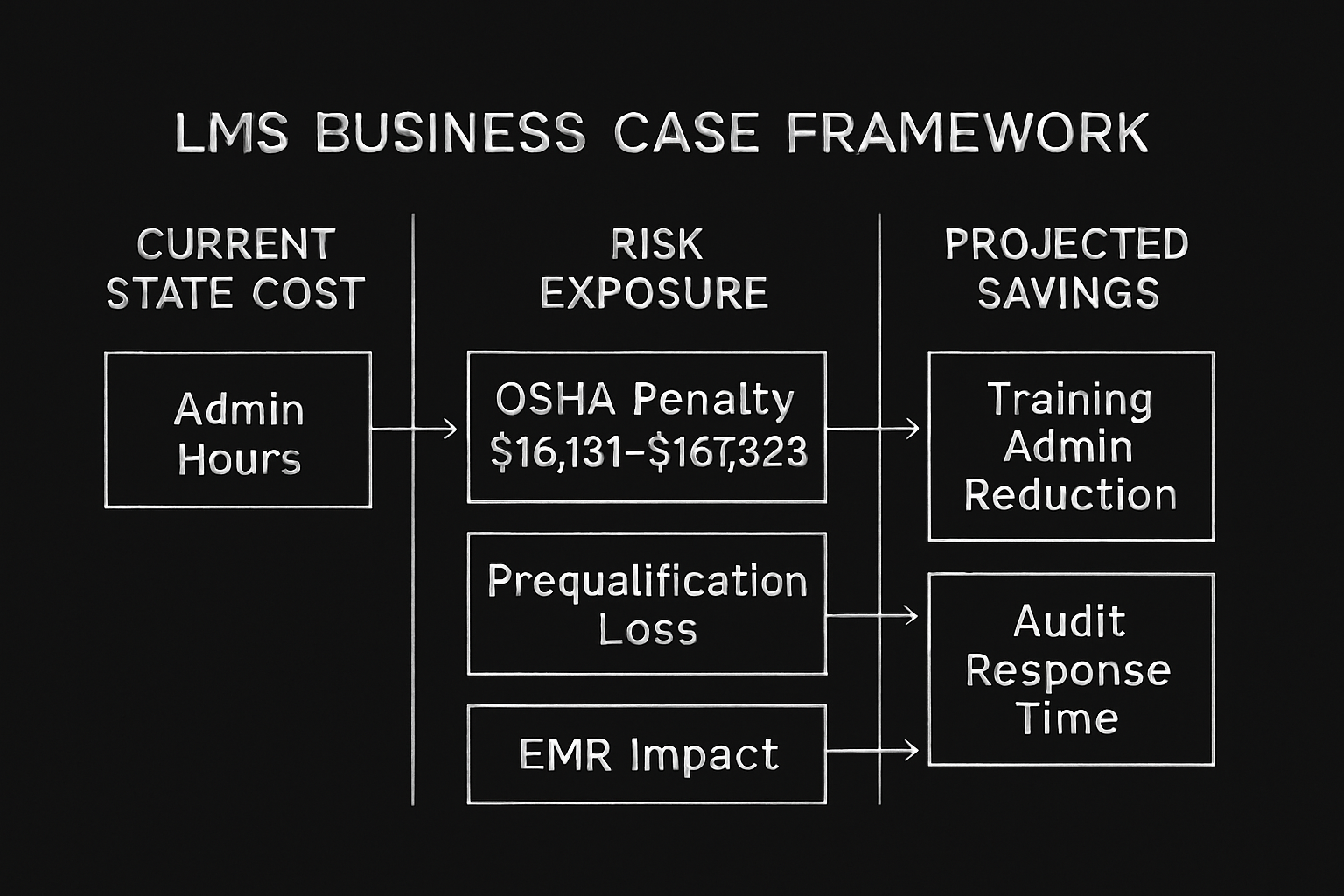
Build the case in three columns: current state cost, risk exposure, and projected savings. Current state: hours spent on training admin per month × loaded labor cost. Risk exposure: one serious OSHA violation, one prequalification suspension, one workers' comp claim — assign dollar ranges, not percentages. Projected savings: reduced admin hours, faster audit response, documented competent person records that don't disappear when a safety coordinator leaves.
Finance can approve that. "We need to meet 1910.269" is not a budget line item. "We're spending $4,200/month in coordinator time on training admin that an LMS handles automatically, and one prequalification suspension costs us more than two years of subscription fees" — that's a budget line item.
The other thing most safety managers skip: the cost of retraining. When your gas distribution crew fails an OQ (Operator Qualification) audit because training records are incomplete, the remediation isn't just the retrain cost. It's the crew day rate while they're pulled off revenue-generating work, plus the audit re-scheduling, plus any regulatory findings from the PHMSA review. Those numbers add up fast, and they're all avoidable with a functioning records system.
FAQ
What is an LMS business case for a utility contractor?
An LMS business case for a utility contractor is a financial and operational justification for purchasing a learning management system. It should quantify current training admin costs, document regulatory exposure under OSHA 1910.269 and PHMSA Part 192, and calculate the cost risk from prequalification failures or workers' comp incidents tied to inadequate training records.
How does a missing training record affect an OSHA inspection in electrical T&D?
If an OSHA compliance officer requests documentation that a crew member completed required training — arc flash, electrical hazard, competent person designation — and the employer cannot produce it, that's treated as a serious violation even if the training occurred. The penalty for a serious violation runs up to $16,131 per instance. A pattern of missing records can escalate to repeat or willful classification.
How does training documentation affect ISNetworld grades for utility contractors?
ISNetworld grades are partially determined by training program documentation, OSHA recordkeeping, and EMR. Gaps in training records, especially for high-hazard tasks like energized electrical work or confined space entry, can lower a contractor's grade below the threshold required by the hiring utility — effectively removing them from bid consideration without any formal notification.
Can an LMS help with PHMSA Operator Qualification compliance?
Yes. PHMSA 49 CFR Part 192 requires gas distribution operators to document OQ completion for covered tasks. An LMS provides a centralized, auditable record of who completed what, when, and with what result — which is exactly what a PHMSA inspector or prime contractor audit will request.
If you're tired of rebuilding the same training documentation from scratch every time an audit hits — or if you want to hand this entire operation off to someone who already has the system built — talk to EHS, Inc. We manage LMS administration, training completion tracking, and compliance documentation for utility contractors so your safety coordinator is doing safety work instead of chasing sign-off sheets. Or grab our free safety topics pack at ehs.inc/download/safety-topics and see what a managed training library actually looks like.
AW
Aaron West
Founder, EHS, Inc. — 18+ years in EHS compliance and contractor safety
Aaron West has spent over 18 years helping contractors and businesses navigate OSHA compliance, ISNetworld® certification, and workplace safety management. He founded EHS, Inc. to make enterprise-level EHS accessible to companies of all sizes — serving contractors and businesses nationwide — without long-term contracts or enterprise overhead.
Ready to simplify your EHS compliance?
Our team handles the complexity so you can focus on running your business. No long-term contracts, no learning curve.
Talk to EHSRelated Articles
What Happens to Your LMS When Your Workforce Doubles Overnight
Winning a new contract and doubling your workforce sounds like a win — until your LMS becomes the reason an OSHA inspector writes you up.
What Happens to an LMS When the Safety Manager Who Built It Leaves
When the safety manager who built your LMS walks out the door, OSHA doesn't care who's responsible — they just write citations.
What Your LMS Must Show OSHA When They Walk In Unannounced
When OSHA shows up at your commercial construction site, what's in your LMS either saves you or costs you — here's exactly what they want.
Medium & Enterprise
Safety Culture System
Framework to achieve zero incidents
Get Free System →
Small Businesses
50+ Safety Topics
Stop hitting paywalls
Get Free Topics →
All Companies
Audio Safety Topics
54 topics in English & Spanish
Get Free Audio →