Your ISNetworld Grade When You Lose Your Safety Manager
Utility contractors lose ISNetworld grades fast after safety manager turnover — here's what actually causes it and how to stop it.
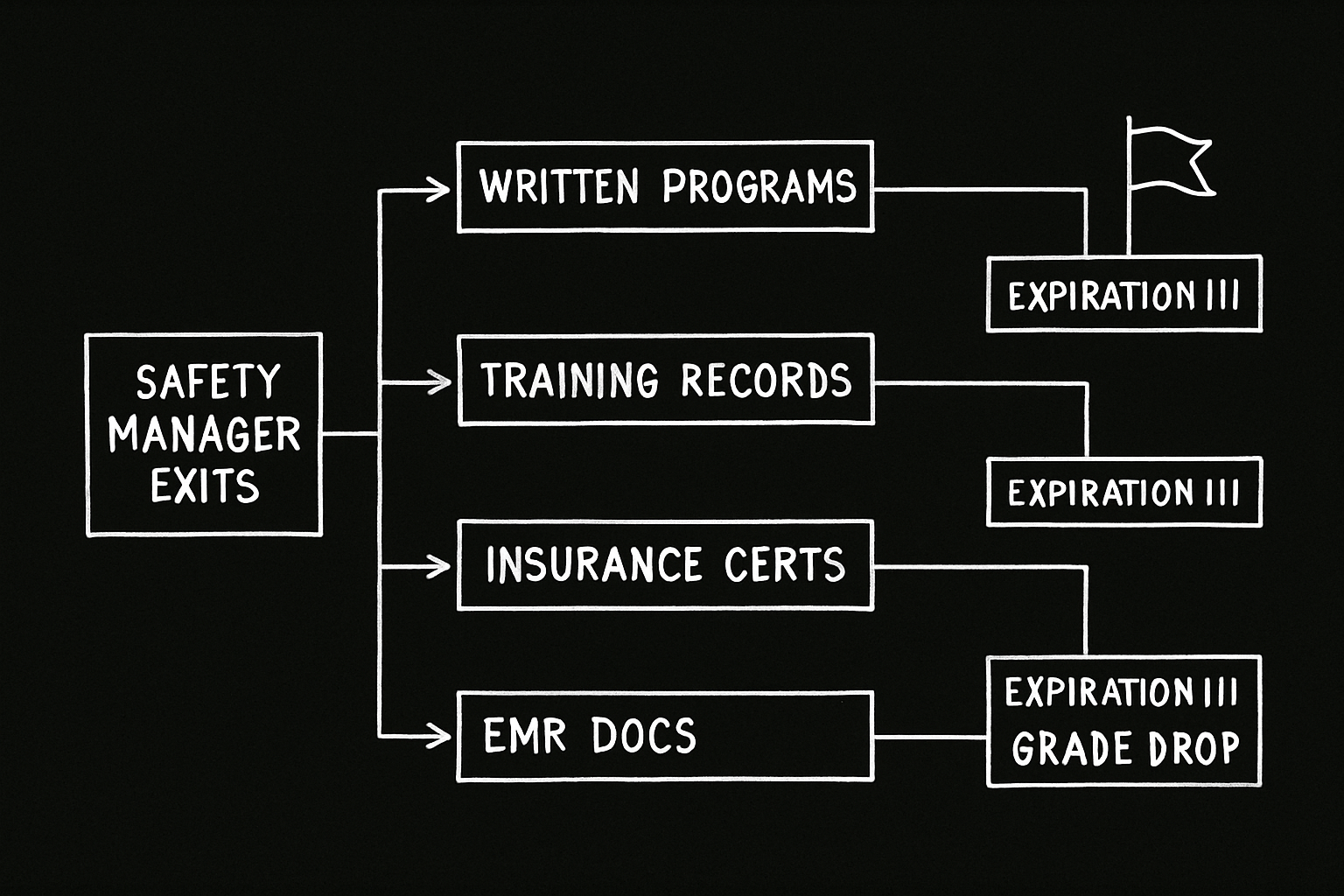
What Happens to Your ISNetworld Grade When You Lose Your Safety Manager — and How to Protect It Before It Drops
Your safety manager gave two weeks' notice on a Monday. By Friday, your T&D crews are still pulling energized conductors on 138kV lines, your gas distribution guys are still hotwork-permitted into pipeline corridors, and your ISNetworld grade is sitting at a B+ that you can't afford to lose. Nobody told the grade that your safety manager left.
The grade doesn't care. ISNetworld's system runs on document expiration dates, and those dates don't pause for personnel transitions. Written programs expire. Training records age out. Insurance certificates lapse. And the person who knew where all of that lived just took that knowledge to your competitor.
What Actually Expires — and How Fast
Most utility contractors find out what's expiring the hard way: the client operator flags a deficiency, the grade drops, and suddenly you're on the phone with your hiring client explaining why your underground locating crew can't mobilize on Monday morning.
Here's what moves fastest after turnover in an electrical T&D or gas distribution operation:
- Written safety programs — Confined space entry programs for vault and manhole work, excavation/trenching programs for direct burial gas line work, energized electrical work (NFPA 70E-aligned) programs. These require annual review signatures. The person who signed them is gone.
- Training records — OSHA 10/30 completions, first aid/CPR certifications, fit test records for half-face respirators used in gas-atmospheres. ISNetworld flags these when they hit the 12-month or 36-month threshold. They all hit at the same time if one person was managing them.
- Insurance certificates — COIs have to be uploaded manually. If no one's watching the renewal date, a lapsed certificate drops your grade before your broker even sends the renewal.
- EMR documentation — Your Experience Modification Rate letter from your carrier has to be current. A single unflagged workers' comp claim that pushed your EMR above 1.0 can disqualify you from client prequalification entirely — and if that claim was being managed by your safety manager, it may have just stopped being managed.
The Counterintuitive Problem Nobody Talks About
Most operations managers assume the ISNetworld grade drops because the new safety coordinator doesn't know the system yet. The real problem is that the old safety manager didn't build a system — they built a personal workflow. And when they left, they took it with them.
This is where the "learned from the standard, not from the field" problem shows up hard. An in-house safety manager who trained on OSHA 29 CFR 1910.269 — the standard that governs electrical utility work — can recite the arc flash PPE requirements cold. They know Table R-3. They know the minimum approach distances for energized conductors. They passed their certifications.
What they didn't build was a calendar that says: confined space program review due March 15, fit tests due April 3, NFPA 70E program review due June 1. Because the standard doesn't tell you to do that. The standard tells you what to have. It doesn't tell you how to maintain it under ISNetworld's quarterly review cycle when you're running 12 line crews across three utility service territories.
The result: a beautiful written program, last reviewed 14 months ago, sitting in a shared drive folder that nobody else has the password to.
What This Costs in Real Terms
A grade drop from B+ to C on ISNetworld isn't an abstract problem. For a utility subcontractor bidding transmission line work, a C grade can mean automatic disqualification from a project. The hiring utility operator sets minimum grade thresholds, and if you're below it, your bid doesn't get read.
That's not hypothetical. That's the call where your project manager finds out your crew can't mobilize on the storm restoration contract because your prequalification grade dropped while everyone was distracted by the hiring process for a replacement safety coordinator.
Add to that: if a compliance gap during the transition window leads to an OSHA inspection — and inspectors do show up to active T&D and gas distribution job sites — a serious violation runs up to $16,131 per citation. A willful or repeat violation hits up to $161,323. A crew working without a current confined space entry program for vault work isn't a technicality. That's a citation. And the company's safety manager who would have caught it is gone.
According to OSHA 1910.269, the standard covering electric power generation, transmission, and distribution, the competent person requirements alone create multiple documentation obligations that have to be maintained continuously — not just at hire.
The Field Reality Nobody Writes in the Handbooks
Here's what actually happens during a safety manager transition at a mid-size utility contractor running mixed T&D and gas distribution work:
The outgoing safety manager does an "exit handoff." They walk the operations manager through the ISNetworld login, show them where the written programs are saved, and explain that the training matrix is in a spreadsheet somewhere on the server. The operations manager nods. The safety manager leaves. Three weeks later, the operations manager realizes the spreadsheet has 14 tabs, no legend, and the last update was eight months ago. The confined space program for the vault crew expired during the transition window. ISNetworld auto-flagged it. The grade moved.
The new safety coordinator hired six weeks later inherits a compliance gap they didn't create, in a system they've never used, for a client portal that requires specific document formats they've never uploaded before. They spend their first 60 days doing ISNetworld triage instead of being on job sites with the crews who actually need them.
How to Protect the Grade Before the Transition Happens
The answer isn't a better offboarding checklist. The answer is that your ISNetworld compliance can't live inside one person's head. It has to live in a managed system with external oversight that doesn't leave when your safety manager does.
- Every expiration date — programs, training records, certifications, insurance certificates — has to be in a system that sends alerts to someone other than the safety manager.
- Your written programs for energized line work, excavation, confined space, and respiratory protection need to be on a documented review calendar with version control. Not "saved in the safety folder."
- Your ISNetworld account needs a secondary owner who isn't the safety manager — operations, HR, whoever — so access doesn't disappear with the person.
- Your EMR documentation and any open workers' comp claims need a status that lives somewhere outside the safety manager's inbox.
If your compliance infrastructure can't survive a two-week notice period, it's not infrastructure. It's a person.
Frequently Asked Questions
How fast does an ISNetworld grade drop after a safety manager leaves?
It depends on what was expiring. A written program that hits its anniversary date unreviewed can trigger a deficiency within days. Insurance certificates that lapse during a transition are flagged the moment they expire. Most contractors see grade movement within 30–60 days of an unmanaged transition.
Can I pause ISNetworld requirements during a staffing transition?
No. ISNetworld doesn't pause for personnel changes. The client operators who set your prequalification requirements don't pause either. Your grade reflects your real-time compliance status regardless of internal staffing situations.
What's the biggest ISNetworld compliance gap utility contractors miss during turnover?
Training records — specifically, the competent person designations for confined space entry (vault and manhole work) and excavation (direct-bury gas line trenching). These require documented qualifications, not just sign-offs. If the person who maintained those designations leaves, they often don't get re-established for the new crews until after an audit flags it.
Does a lower ISNetworld grade affect my workers' comp premium?
Not directly — your EMR drives your workers' comp premium. But an ISNetworld grade drop often happens alongside EMR problems, because both are symptoms of the same thing: a compliance program that lived inside one person and didn't survive their departure.
How does EHS, Inc. handle ISNetworld compliance during a transition?
We manage your ISNetworld account continuously — written programs, training records, insurance certificate uploads, EMR documentation. When your safety manager leaves, nothing moves. The account keeps running because it was never dependent on one person to begin with.
If your ISNetworld grade is one resignation letter away from dropping, take two minutes to find out where you actually stand. Find out if your company qualifies — take the free 2-minute ISNetworld & Avetta Readiness Check.
AW
Aaron West
Founder, EHS, Inc. — 18+ years in EHS compliance and contractor safety
Aaron West has spent over 18 years helping contractors and businesses navigate OSHA compliance, ISNetworld® certification, and workplace safety management. He founded EHS, Inc. to make enterprise-level EHS accessible to companies of all sizes — serving contractors and businesses nationwide — without long-term contracts or enterprise overhead.
Ready to simplify your EHS compliance?
Our team handles the complexity so you can focus on running your business. No long-term contracts, no learning curve.
Talk to EHSRelated Articles
Your Avetta Score After Winning a Large Public Contract
Winning a large public contract can crater your Avetta score overnight — here's what that costs and how to stop it.
ISNetworld Grade Drop: When Insurance Limits Fall Short
Your ISNetworld grade can crater overnight when your renewed policy carries lower limits than your operator contract requires — here's exactly how it happens.
Avetta Score After a New Contract Win: What Changes and Why
Winning a new utility contract can silently tank your Avetta score — here's what in-house safety managers miss until the damage is done.
Medium & Enterprise
Safety Culture System
Framework to achieve zero incidents
Get Free System →
Small Businesses
50+ Safety Topics
Stop hitting paywalls
Get Free Topics →
All Companies
Audio Safety Topics
54 topics in English & Spanish
Get Free Audio →