What OSHA Found On-Site vs. What the Safety Program Said
A $156K OSHA penalty exposes the gap between a contractor's written safety program and what actually happens during a refinery turnaround.
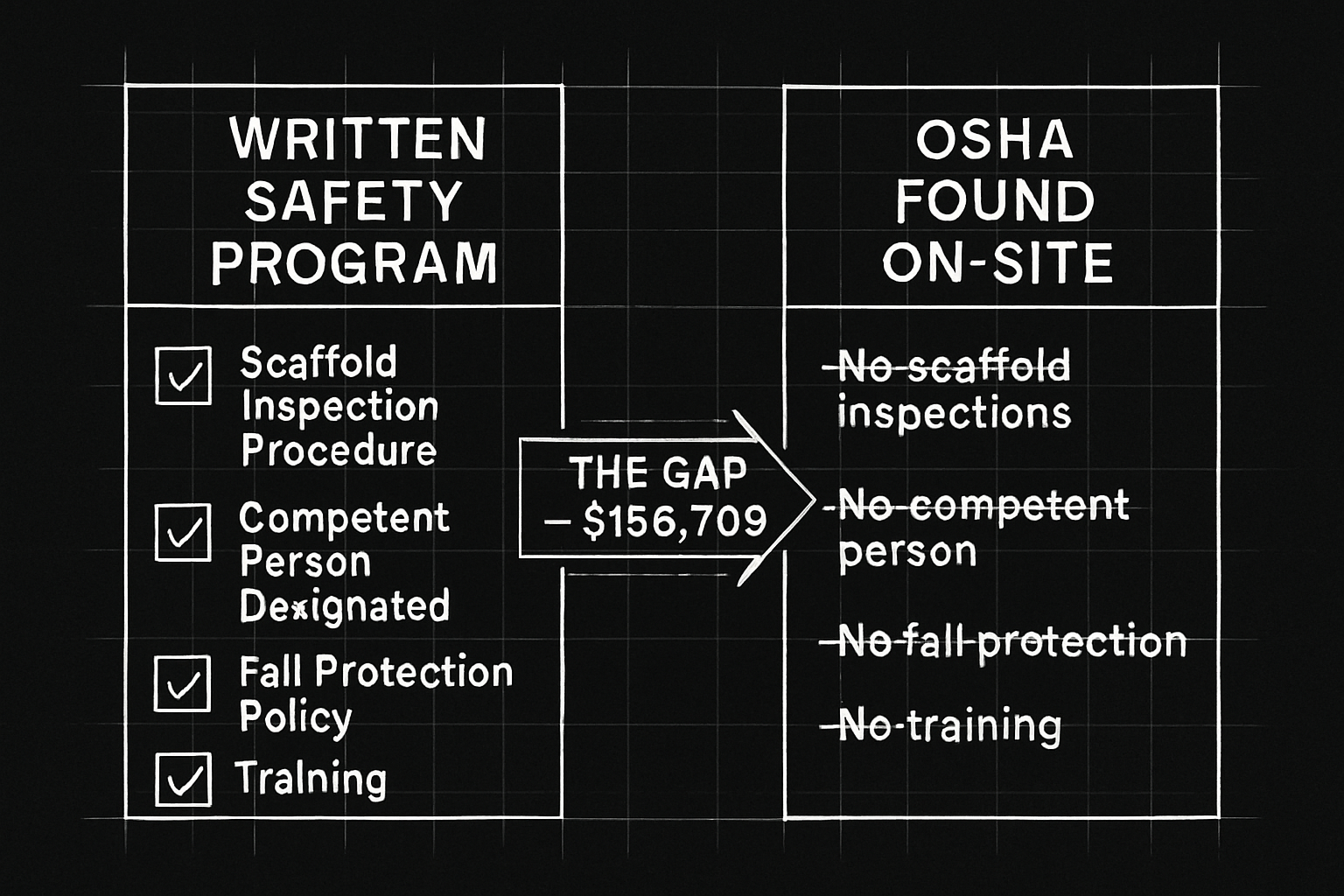
What OSHA Found On-Site vs. What the Safety Program Said: A $156K Lesson for Maintenance Contractors
The safety program was there. The written procedures existed. The binder was probably on a shelf in the field trailer with a revision date on the cover page. And yet, when OSHA showed up at Brand Energy & Infrastructure Services — one of the largest industrial maintenance and scaffolding contractors in the country — the agency found violations serious enough to generate a $156,709 penalty. The citations involved fall protection and scaffolding standards, the kind of stuff that every maintenance contractor has a written program for. The kind of stuff that kills people when the program stays in the binder.
That is the gap this post is about. Not "did you have a program?" OSHA doesn't care about your binder. They care about what they see when they walk onto your turnaround site at 7 a.m. on day three of a plant shutdown.
What OSHA Actually Found
Brand Energy's citations fell under 29 CFR 1926.502 (fall protection systems criteria) and 29 CFR 1926.451 (scaffolding). In plain English: workers were exposed to fall hazards on scaffolding that wasn't built, inspected, or used correctly. The violations were classified as willful and repeat — which is how a $15,000 citation becomes a $156,000 citation. Willful means OSHA concluded the employer knew about the hazard and either intended the violation or showed plain indifference to it. Repeat means they'd seen this before.
You can review OSHA's enforcement data directly at OSHA's enforcement database.
The Gap Nobody Talks About
Here's the counterintuitive part: most safety coordinators assume the problem is training — but the real problem is accountability between the training room and the work platform.
Brand Energy almost certainly had scaffold erectors who had sat through a competent person course. They probably had a written scaffold inspection checklist. What they didn't have — or what broke down — was a system that connected that training to what the scaffold foreman actually did at 5:30 a.m. before the day shift arrived. That is where the gap lives. Not in the curriculum. In the eleven hours between the safety meeting and the moment someone decides to start climbing before the inspection tag goes up.
During a refinery turnaround, this gap is wider than anywhere else. You have:
- Compressed schedules — the unit needs to come back online and everyone knows it
- Multi-employer sites — scaffold built by one subcontractor, accessed by three others
- Night-shift crews who weren't at the morning toolbox talk
- Competent persons who are competent persons on paper and journeymen doing something else in practice
- Scaffold tags that go up, get ignored, or disappear entirely by day two
OSHA inspectors know this. A seasoned CSHO walking a turnaround site isn't looking at your binder — they're watching who goes up the scaffold before checking the tag, whether the toe boards are actually secured, and whether the person designated as competent person is on that level or somewhere else entirely.
What the Willful/Repeat Classification Actually Costs You
The maximum penalty for a serious violation is $16,131. The maximum for a willful or repeat violation is $161,323 per violation. Brand Energy's $156,709 total wasn't one citation — it was a cluster of violations that compounded. But even one willful citation at full penalty wipes out the margin on a significant portion of a turnaround contract.
And the penalty is the smaller problem. The real cost hits when:
- Your ISNetworld grade drops because the citation shows up in your OSHA recordkeeping history
- The refinery's contractor management team pulls your prequalification status mid-turnaround
- Your next bid gets rejected before the proposal is read because your safety record disqualifies you from the approved contractor list
- Your EMR climbs following any associated recordable incident, increasing your workers' comp premium for the next three years
One willful citation doesn't just cost you money today. It follows your company through every prequalification portal for years.
What Contractors in This Industry Should Do Differently
The fix isn't another policy. The fix is closing the distance between the written program and the field behavior — specifically:
1. Make the competent person designation real, not ceremonial. In refinery turnarounds, the competent person for scaffold inspection needs to be the person who actually inspects the scaffold before each shift — not whoever has the certificate. If your competent person is also the general foreman running seven other tasks, you don't have a competent person, you have a liability.
2. Treat scaffold tags like energy isolation locks. Lockout/tagout gets enforced because the consequence of removing a lock is immediate and visible. Scaffold access before inspection gets bypassed because the consequence feels distant. Change the site culture so that tagging discipline is treated with the same weight as LOTO. The maintenance techs on your site should be able to explain why — not just follow the rule when someone's watching.
3. Do your own pre-inspection before OSHA does. Walk your own site like a CSHO. Ask your safety coordinator to write down the three things they'd cite if they were the inspector. If they can't answer that question, you have a gap. If they can answer it and the hazards are still there, you have a bigger gap.
4. Document the inspection, not just the training. OSHA will want to see that your competent person conducted pre-shift scaffold inspections. That means a record. Date, time, findings, signature. Not a blank form with a checkmark — an actual record of what was looked at and what was found. If your scaffold inspection records look like they were filled out in a batch at the end of the week, an experienced CSHO will notice.
FAQ
What OSHA standards cover scaffolding for industrial maintenance contractors?
The primary standards are 29 CFR 1926.451 (general scaffolding requirements), 29 CFR 1926.452 (additional requirements for specific scaffold types), and 29 CFR 1926.502 (fall protection systems criteria). For general industry work — like maintenance inside an operating facility — 29 CFR 1910.28 and 1910.29 also apply depending on the work environment.
What makes a violation "willful" vs. "serious"?
A serious violation exists when OSHA finds a hazard that could cause death or serious physical harm and the employer knew or should have known about it. A willful violation means the employer knew about the requirement, knew they were violating it, and chose not to fix it — or showed plain indifference. The penalty difference is substantial: up to $16,131 for serious, up to $161,323 for willful or repeat.
How does an OSHA citation affect ISNetworld prequalification?
ISNetworld pulls OSHA inspection and citation data and factors it into your company's safety grade. Willful or repeat citations are weighted heavily and can drop your grade below the threshold required by the hiring client — effectively removing you from their approved contractor list until the citation is resolved and the record improves.
What does "competent person" mean for scaffold inspections?
OSHA defines a competent person as someone who can identify existing and predictable hazards in the surroundings or working conditions, and who has the authority to take prompt corrective action. For scaffolding, the competent person must inspect the scaffold before each work shift and after any event that could affect structural integrity. The designation must be backed by actual knowledge and actual authority — not just a name on a form.
How can a safety manager close the gap between written programs and field behavior?
The most effective approach combines unannounced field audits, real-time observation with documented feedback, and accountability systems that hold supervisors — not just workers — responsible for compliance. When the foreman's performance review includes scaffold inspection compliance rates, behavior changes faster than any training course can achieve it.
If keeping your training current, your OSHA records clean, and your written programs audit-ready is eating time you should be spending on actual field safety work — that's what we handle. Download our free safety topics pack or schedule a call and we'll show you exactly what's in scope.
AW
Aaron West
Founder, EHS, Inc. — 18+ years in EHS compliance and contractor safety
Aaron West has spent over 18 years helping contractors and businesses navigate OSHA compliance, ISNetworld® certification, and workplace safety management. He founded EHS, Inc. to make enterprise-level EHS accessible to companies of all sizes — serving contractors and businesses nationwide — without long-term contracts or enterprise overhead.
Ready to simplify your EHS compliance?
Our team handles the complexity so you can focus on running your business. No long-term contracts, no learning curve.
Talk to EHSRelated Articles
MOC as a Pre-SIF Control: What Failure Looks Like Before the Report
MOC failures don't start with the incident — they start with the change nobody logged. Here's what that looks like at a refinery turnaround.
Lean Safety Staffing and SIF Exposure in Refinery Turnarounds
When headcount drops during a turnaround, critical control ownership doesn't disappear — it just becomes nobody's job.
ISO 14001 and Safety Integration: What Separate Systems Cost You
Running ISO 14001 and your safety program as separate systems isn't just inefficient — it has a specific dollar cost. Here's what it is.
Medium & Enterprise
Safety Culture System
Framework to achieve zero incidents
Get Free System →
Small Businesses
50+ Safety Topics
Stop hitting paywalls
Get Free Topics →
All Companies
Audio Safety Topics
54 topics in English & Spanish
Get Free Audio →