OSHA Recordable Rates Are Killing Your Prequalification Score
Your OSHA recordable rate isn't just a safety metric — it's costing you bids, prequalification grades, and real dollars.
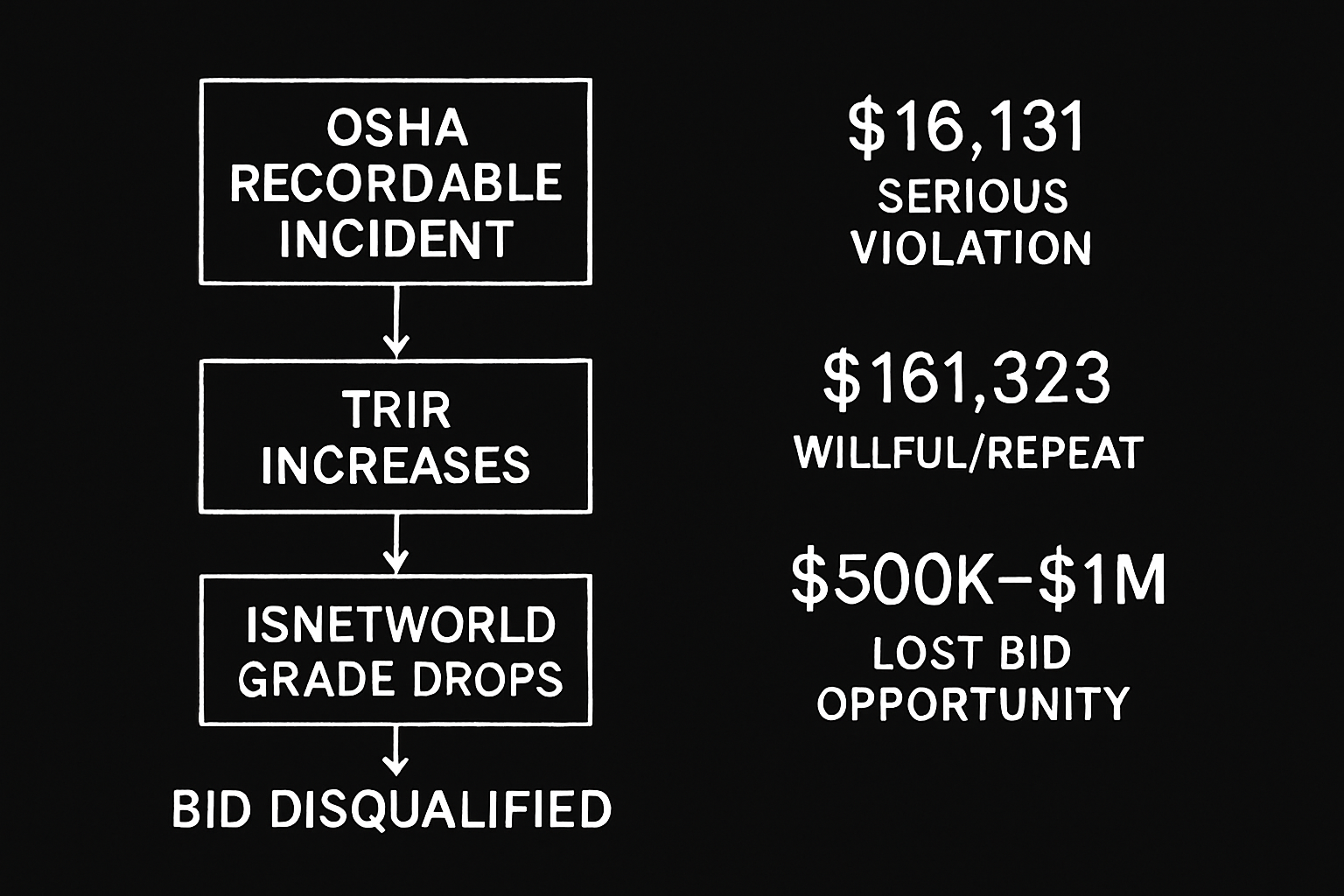
OSHA Recordable Rates and How They Tank Your Contractor Prequalification Score
Your OSHA recordable rate shows up in ISNetworld, Avetta, and every GC prequalification packet you submit. It is not a formality. It is the number that determines whether your company gets a green checkmark or a flag — and whether that flag costs you a $2M subcontract before you ever send a proposal.
Most specialty subs running 20–50 field employees don't realize their Total Recordable Incident Rate (TRIR) is being scored against industry benchmarks in real time. The GC's owner-client set a threshold. You're under it, or you're not. There's no conversation. The portal just says no.
What the Numbers Actually Mean — and What They Cost
TRIR is calculated as: (Number of recordable incidents × 200,000) ÷ total hours worked. For a 30-person framing crew working a full year, that's roughly 60,000 hours. One recordable incident puts your TRIR at 3.33. Two puts it at 6.67. The BLS average TRIR for specialty trade contractors in commercial construction runs around 2.8–3.2. Many GC prequalification programs use 2.0 or lower as a hard cutoff.
Clear that threshold and you're bidding. Miss it and you're not — regardless of your price, your schedule, or your 15-year relationship with the project manager.
And then there's the OSHA fine side of the equation. A single serious violation — an unsecured trench, a scaffold without fall protection, a competent person who wasn't — runs up to $16,131 per violation. If OSHA determines it was willful or repeat, that number jumps to $161,323 per violation. A three-citation inspection on an active commercial site can land at $40,000–$50,000 before you've even talked to an attorney. That's not the settlement number. That's the opening number.
The Counterintuitive Part Most Safety Coordinators Miss
Most safety coordinators assume the problem is the incident itself — the laceration that sent the ironworker to urgent care, the back strain from the concrete form lift. Fix the hazard, done.
The real problem is the recordkeeping that happens after.
Here's the scenario that plays out constantly on commercial sites: a laborer tweaks his shoulder moving rebar on a Thursday afternoon. The foreman tells him to take some ibuprofen from the first aid kit and come back Monday. Nobody fills out a first report. The injury doesn't go on the OSHA 300 log. Come ISNetworld renewal in March, the safety coordinator certifies zero recordables — because that's what the paperwork says.
Then the worker files a workers' comp claim in April. The claim gets coded. The carrier reports it. ISNetworld's data validation catches the discrepancy between your certified zero and the carrier data. Your grade tanks — not because of the injury, but because the recordkeeping didn't match reality. Now you're defending a potential falsification issue on top of a recordable.
That's how a $300 urgent care visit becomes a prequalification suspension and a potential willful violation citation.
What a Failed Prequalification Grade Actually Costs
Specialty subs — electrical, mechanical, concrete, steel erection — typically carry 3–8 active prequalification profiles across ISNetworld, Avetta, and GC-specific portals. A grade drop in one doesn't stay contained. The same TRIR data feeds every profile.
Here's a realistic dollar picture for a 35-person commercial electrical sub:
- Average subcontract value: $800,000–$1.5M per project
- Projects lost per year due to prequalification failure: even one is significant
- ISNetworld grade remediation timeline after TRIR normalization: 12–36 months (the 3-year lookback doesn't forgive fast)
- Cost of an OSHA serious citation cluster during an inspection that follows an incident: $30,000–$80,000 in fines, plus attorney fees, plus the distraction tax on your operations team for the next six months
A single bad year — two recordables, one OSHA inspection, one prequalification suspension — can easily represent $500,000 to $1M in lost bid opportunity and direct costs for a company in this size range. That's not a hypothetical. That's what it looks like when the dominos fall.
The 300 Log Is a Legal Document, Not a Spreadsheet
The OSHA 300 log, 300-A summary, and 301 incident reports are required to be retained for five years. They're subject to inspection — by OSHA, by your insurance carrier, and increasingly by ISNetworld and Avetta during document audits. A safety coordinator who doesn't understand the recording criteria for restricted work cases versus medical treatment cases is making judgment calls that directly affect your TRIR.
The distinction between first aid (not recordable) and medical treatment beyond first aid (recordable) is not obvious on a busy site. A physician-directed work restriction — even a temporary one — triggers a recordable. A competent person doing a job hazard analysis incorrectly classifying a cut as first aid when stitches were recommended? That's an underreported recordable waiting to surface at the worst possible time. See OSHA's recordkeeping requirements for the full criteria.
What Fixing This Actually Requires
You need three things working in parallel: accurate real-time recordkeeping on the 300 log, TRIR calculation that matches what ISNetworld will calculate (they use the same formula, but they use your submitted hours — get those wrong and your TRIR is wrong), and a prequalification profile that reflects your actual rate before someone else's data does it for you.
Most commercial subs this size don't have a dedicated safety coordinator. The foreman is running the job, the office manager is doing payroll, and nobody owns the 300 log until renewal season. That's the gap. That's where the damage happens.
Frequently Asked Questions
What is a good TRIR for a commercial construction specialty sub?
Most GC and owner prequalification programs in commercial construction use 1.0–2.0 as a benchmark for acceptable TRIR. The BLS industry average for specialty trade contractors runs around 2.8–3.2, so being near average isn't good enough for selective programs. Target below 1.5 if you want to stay competitive on larger projects.
How does OSHA TRIR affect ISNetworld grades?
ISNetworld scores your safety history — including TRIR, DART rate, and EMR — against your industry's NAICS code benchmark. A TRIR above the industry threshold typically triggers a red or yellow grade, which can disqualify you from working with certain owner-clients entirely. The grade reflects a rolling 3-year average, so one bad year follows you for a long time.
Can OSHA fine you for recordkeeping errors alone?
Yes. Failure to maintain accurate OSHA 300 logs, failure to post the 300-A summary from February 1 through April 30, and failure to retain records for five years are all citable violations. Intentional underreporting can be cited as a willful violation, carrying penalties up to $161,323 per instance.
What incidents are OSHA recordable for a construction crew?
Any work-related injury or illness that results in days away from work, restricted duty, job transfer, medical treatment beyond first aid, loss of consciousness, or diagnosis of a significant condition by a healthcare professional. First aid only — meaning cleaning and bandaging a minor cut, over-the-counter medication — is not recordable. The line between the two is where most recording errors happen.
How do I fix my TRIR before the next prequalification renewal?
You can't retroactively lower your TRIR for closed years. What you can do: audit your 300 log for correctly recorded incidents (some recorded injuries may qualify for removal under OSHA's criteria), ensure your hours worked are accurately reported (underreported hours inflate your rate), and begin the zero-incident work that shifts your 3-year average forward. Faster path: get someone managing this full-time before the next renewal cycle.
If your OSHA recordable rate is eating your prequalification scores and you don't have the bandwidth to manage this internally, that's exactly what we handle. Talk to EHS, Inc. — we manage recordkeeping, ISNetworld/Avetta profiles, and OSHA compliance so it stops being the thing that costs you bids.
AW
Aaron West
Founder, EHS, Inc. — 18+ years in EHS compliance and contractor safety
Aaron West has spent over 18 years helping contractors and businesses navigate OSHA compliance, ISNetworld® certification, and workplace safety management. He founded EHS, Inc. to make enterprise-level EHS accessible to companies of all sizes — serving contractors and businesses nationwide — without long-term contracts or enterprise overhead.
Ready to simplify your EHS compliance?
Our team handles the complexity so you can focus on running your business. No long-term contracts, no learning curve.
Talk to EHSRelated Articles
Your Avetta Score After Winning a Large Public Contract
Winning a large public contract can crater your Avetta score overnight — here's what that costs and how to stop it.
ISNetworld Grade Drop: When Insurance Limits Fall Short
Your ISNetworld grade can crater overnight when your renewed policy carries lower limits than your operator contract requires — here's exactly how it happens.
Avetta Score After a New Contract Win: What Changes and Why
Winning a new utility contract can silently tank your Avetta score — here's what in-house safety managers miss until the damage is done.
Medium & Enterprise
Safety Culture System
Framework to achieve zero incidents
Get Free System →
Small Businesses
50+ Safety Topics
Stop hitting paywalls
Get Free Topics →
All Companies
Audio Safety Topics
54 topics in English & Spanish
Get Free Audio →