ISNetworld Approved Status at Risk When a Key Employee Leaves
When your safety coordinator walks out the door, your ISNetworld grade can follow — here's exactly how the paperwork failure unfolds.
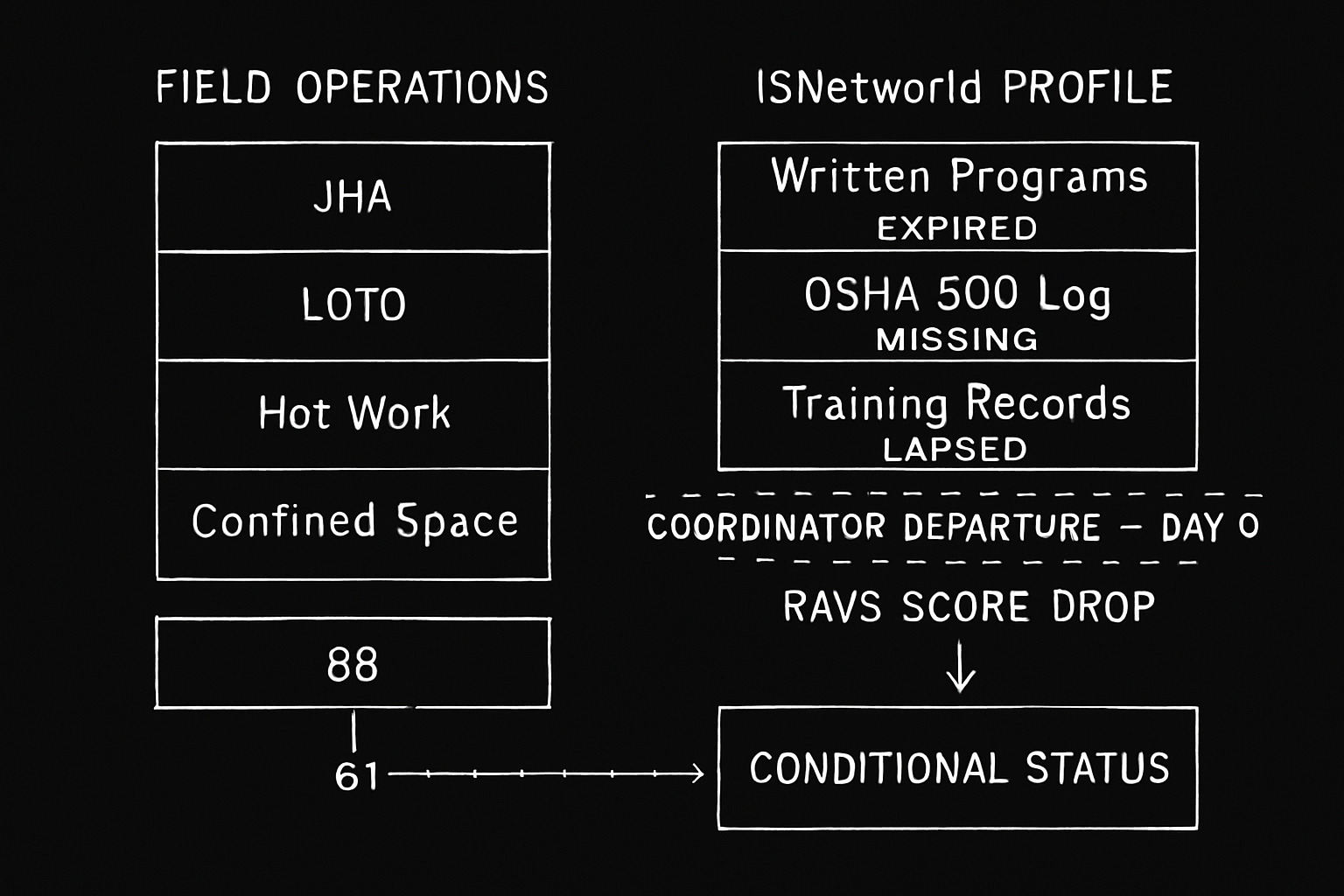
What Happens to an ISNetworld Contractor's Approved Vendor Status When a Key Employee Leaves and Takes the Safety Program With Them
Your safety coordinator gave two weeks' notice on a Friday afternoon. By Monday you were already behind. Not on the hazard identification, not on the JHA completion rate, not on the toolbox talk schedule — on the paperwork that proves you were doing all of that in the first place. That's the part that kills your ISNetworld approved vendor status, and it almost never gets discussed until it's too late.
The Failure Nobody Expects
In upstream oil and gas — drilling, pipeline, and well servicing — the safety coordinator is usually the single person who knows the ISNetworld login, knows when the annual program updates are due, knows which written programs need operator-specific language and which ones are just sitting there as placeholders from three years ago. When that person leaves, all of that institutional knowledge walks out with them.
What stays behind is a partially completed ISNetworld profile, a written safety program that may or may not reflect current operations, and a pile of OSHA 300 logs and training records that nobody else knows how to reconcile. The hazards on your well site didn't change. The H2S is still there. The snubbing unit still requires a documented competent person. But the documentation that proves you're managing those hazards correctly? That's the gap that drops your grade.
ISNetworld's RAVS (Review and Verification Services) reviewers evaluate your submitted documents against your stated scope of work. When a pipeline contractor lists confined space entry and hot work as in-scope operations and then fails to upload a current written permit-required confined space program — or uploads one that's dated four years ago with a previous company name in the header — the grade takes a hit. Not because anyone was actually working in an uncontrolled space. Because the form was wrong.
The Counterintuitive Part
Most safety coordinators assume that if the work is being done safely on site, the prequalification grade will hold. That assumption is wrong in a specific and expensive way. ISNetworld does not send an auditor to your wellhead. They review what you submitted. A well servicing company with an excellent field safety culture and a 0.8 TRIR can still lose approved status because their management of change procedure wasn't updated after they added a new coiled tubing crew, or because the competent person designation log for confined space wasn't re-uploaded after it expired.
The real problem isn't your safety program. The real problem is that nobody has been maintaining the evidence of your safety program inside the portal.
What the Grade Drop Actually Costs
When an upstream drilling contractor drops below an operator's minimum ISNetworld threshold — often a score in the 80s or higher, depending on the client — they move off the approved vendor list. That doesn't mean they get a warning letter and a chance to catch up. It means they are ineligible to bid on new work until the score is restored. For a well servicing company billing $400,000 a month to a single operator, being removed from that client's approved vendor list while you scramble to rebuild your ISNetworld profile is not a paperwork inconvenience. It's a revenue problem with a very short fuse.
Add to that the OSHA exposure. If the written programs that lapsed during the transition included required elements — a written respiratory protection program under 29 CFR 1910.134, a written hazard communication program, a documented energy control procedure — an OSHA inspection triggered during that gap period can turn into serious violations at up to $16,131 each. If the inspector finds that the deficiency wasn't new — that the written program had been inadequate for years and the company knew it — the willful or repeat classification brings that number to $161,323 per violation. The paperwork is not the inconvenience. The paperwork is the legal defense.
A Scenario That Plays Out Constantly
A pipeline contractor in the Permian Basin has twelve crews running inline inspection and hydrostatic testing work. Their safety coordinator managed every written program, every ISNetworld document upload, every annual OSHA 300 summary submission, and every training record in their LMS. She leaves in March. By June, ISNetworld has flagged two expired documents — the contractor's written lockout/tagout program and their hot work permit procedure — because the annual review deadline passed and nobody knew it existed. The RAVS score drops. The operator they've worked with for six years sends a form letter: conditional status, 60 days to remediate.
The field crews didn't change anything. The maintenance techs were still doing LOTO correctly on every isolation point. The hot work permits were still being signed and posted. None of that shows up in the ISNetworld grade. What shows up is that the written procedure document had a 2021 revision date and should have been updated in 2023.
What Has to Happen Before Someone Walks Out the Door
The ISNetworld profile needs to be treated as a living document with assigned ownership that doesn't live in one person's head. That means a documented renewal calendar for every written program, a secondary login with admin access held by ownership or an outside party, a current copy of every submitted document stored somewhere other than the departing coordinator's laptop, and a clear handoff checklist that covers OSHA recordkeeping, training record maintenance, and open ISNetworld action items.
Most well servicing and drilling contractors don't have any of that. They have one person who figured it out over time and handled it quietly until they didn't.
Frequently Asked Questions
How quickly can an ISNetworld grade drop after a document expires?
RAVS reviewers flag expired or missing documents during the next review cycle, which can be triggered by your anniversary date or by a client audit request. Grade impacts can appear within 30 to 60 days of a missed update — faster if a client manually requests a review of your profile.
Can an oil and gas contractor recover their ISNetworld approved status after a grade drop?
Yes, but the timeline depends on how many documents are out of compliance and how quickly accurate, current versions can be submitted and reviewed. RAVS review turnaround is typically 5 to 10 business days per submission, so multiple deficiencies compound into weeks of exposure.
What documents are most commonly flagged after a safety coordinator leaves?
Written safety programs with annual review requirements top the list — hazard communication, respiratory protection, LOTO, and confined space are the most common. OSHA 300/300A logs and training records in the LMS are close behind, especially when the departing employee was the only person who knew how to run the reports.
Does ISNetworld notify the contractor before dropping their grade?
ISNetworld sends automated expiration notices to the account email on file. If that email belonged to the safety coordinator who just left and was never updated, those notices go unread. The grade drops. The contractor finds out when a client calls.
This Is Exactly What We Handle
EHS, Inc. manages ISNetworld prequalification, written safety programs, OSHA recordkeeping, and safety training for oil and gas contractors who don't want to find out their approved vendor status expired when a client calls. There's no single point of failure, no institutional knowledge that lives in one person's inbox, and no annual renewal that gets missed because someone left in March.
Find out where your ISNetworld profile actually stands right now — take the free 2-minute ISNetworld & Avetta Readiness Check.
AW
Aaron West
Founder, EHS, Inc. — 18+ years in EHS compliance and contractor safety
Aaron West has spent over 18 years helping contractors and businesses navigate OSHA compliance, ISNetworld® certification, and workplace safety management. He founded EHS, Inc. to make enterprise-level EHS accessible to companies of all sizes — serving contractors and businesses nationwide — without long-term contracts or enterprise overhead.
Ready to simplify your EHS compliance?
Our team handles the complexity so you can focus on running your business. No long-term contracts, no learning curve.
Talk to EHSRelated Articles
Your Avetta Score After Winning a Large Public Contract
Winning a large public contract can crater your Avetta score overnight — here's what that costs and how to stop it.
ISNetworld Grade Drop: When Insurance Limits Fall Short
Your ISNetworld grade can crater overnight when your renewed policy carries lower limits than your operator contract requires — here's exactly how it happens.
Avetta Score After a New Contract Win: What Changes and Why
Winning a new utility contract can silently tank your Avetta score — here's what in-house safety managers miss until the damage is done.
Medium & Enterprise
Safety Culture System
Framework to achieve zero incidents
Get Free System →
Small Businesses
50+ Safety Topics
Stop hitting paywalls
Get Free Topics →
All Companies
Audio Safety Topics
54 topics in English & Spanish
Get Free Audio →