What an ISNetworld Grade Drop Actually Costs a Contractor
Your safety program looks fine on paper. Here's what it costs when OSHA shows up and finds out what's actually happening on the turnaround floor.
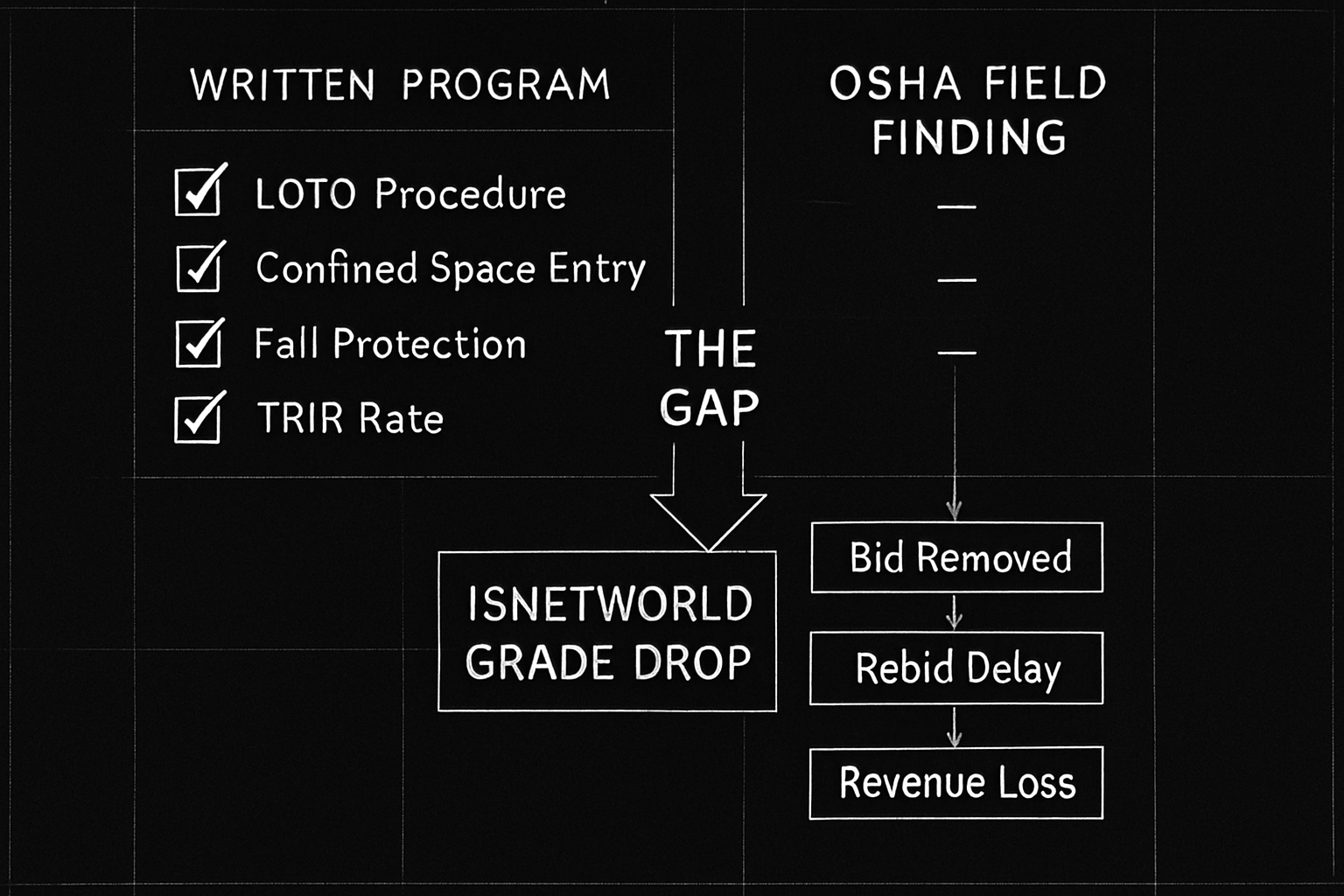
What an ISNetworld Grade Drop Actually Costs a Contractor in Lost Contracts and Rebidding Delays
Your written confined space entry program is 47 pages. It covers atmospheric testing, standby personnel, rescue procedures, permit requirements — the works. A compliance officer would be proud of it. Then a refinery turnaround starts, your maintenance techs are pulling heat exchanger bundles on a 12-hour shift rotation, and someone hands a permit to an attendant who hasn't been trained to the updated procedure since the document was revised eight months ago. OSHA walks onto that site, and suddenly the 47-page program is irrelevant. What matters is what they observe.
That gap — between what the program says and what OSHA finds — is exactly where ISNetworld grades go to die. And when the grade drops, the financial damage doesn't show up as a single line item. It compounds quietly until a bid cycle comes around and you're not on the approved vendor list anymore.
How the Grade Drop Actually Happens
ISNetworld grades pull from multiple inputs: your OSHA recordables, your TRIR and DART rates, your written program submissions, and third-party audits. The written programs are the easiest part — most contractors hire someone to write them once and assume they're covered. The audit is where things unravel.
For industrial maintenance contractors doing refinery turnarounds and plant shutdowns, the audit findings that trigger grade drops are almost never about missing paperwork. They're about procedures that exist in the binder but don't exist in practice. Competent persons who are designated on paper but haven't done a formal inspection in two months. Energy isolation lockout/tagout procedures that list the steps correctly but don't match the actual equipment configuration in the field — because the plant modified that system six months ago and nobody updated the written procedure.
That last one triggers a Management of Change failure on top of a LOTO deficiency. Two findings, one incident. Your recordable rate goes up, your ISNetworld grade goes down, and the refinery's contractor management team gets an automated flag before you've even finished your close-out report.
The Real Cost: Bid Eligibility, Not Just Fines
Most contractors fixate on the OSHA citation dollar amounts — and those are real. A serious violation runs up to $16,131 per citation. A willful or repeat violation climbs to $161,323. If OSHA finds that your competent person conducting atmospheric testing during a confined space entry wasn't actually trained to do it — and that person was the designated attendant on a job where someone was exposed — you're looking at a willful characterization and a number with six digits.
But the OSHA fine is the part you can see. The part most contractors miss is the bid pipeline damage that follows a grade drop on ISNetworld.
Here's how it plays out in practice: A major refinery operates on a preferred contractor list. Getting on that list required hitting a minimum ISNetworld grade — typically a "B" or better, sometimes an "A" for high-hazard work categories. You qualified two years ago, you've been doing turnaround work, and everything felt stable. Then a recordable happens during a shutdown — a maintenance tech on a scaffold crew takes a laceration that meets the threshold, medical treatment beyond first aid, logged on the 300. Your TRIR ticks up. ISNetworld recalculates. Your grade slips from a B to a C.
The refinery's contractor management software — which pulls directly from ISNetworld — flags the change. You don't get a call. You just notice, three months later, that you weren't included in the RFP for the next turnaround cycle. When you ask, the answer is some version of "your current prequalification status doesn't meet our requirements for this scope."
Rebidding after a grade drop isn't just a paperwork exercise. You need to clear the new grade threshold, which means demonstrating an improved TRIR over the trailing 12-to-36-month window — a window you cannot accelerate. You're waiting out the calendar. In the meantime, your competitors are doing the work you should be doing.
The Counterintuitive Part
Most safety coordinators assume the biggest ISNetworld risk is failing to submit updated documents on time. Miss a renewal window, grade drops — that's the mental model. But the real problem is the document that gets submitted and accepted with no issues, while the field operation it describes has quietly drifted away from what the document says.
A written fall protection program that references 100% tie-off on elevated work surfaces looks great in an ISNetworld portal. It looks significantly worse when an OSHA compliance officer walks a scaffold deck at your turnaround site and watches two ironworkers working at elevation without lanyards connected — because they're moving equipment and it "slows them down." That gap between the written program and observed behavior is not a training problem. It's a verification problem. And ISNetworld's audit process is specifically designed to find it.
The OSHA contractor safety resources make clear that written programs are the floor, not the ceiling. The moment a compliance officer or third-party auditor sees that your field execution doesn't match your documentation, the written program stops being an asset and becomes evidence of what you knew and didn't enforce.
What This Looks Like in a Real Turnaround Scenario
Call it a Gulf Coast refinery, crude unit turnaround, 14-day window. Your crew includes scaffolding subcontractors, insulation crews, and your own maintenance techs handling vessel inspections and exchanger pulls. You've got a safety coordinator on-site — one person managing roughly 80 workers across multiple active work fronts during peak days.
Your LOTO program requires equipment-specific procedures. You have them written for the standard configurations. But this refinery made modifications to three heat exchangers in the last turnaround, and the isolation point locations changed. The updated P&IDs are in the control room. The LOTO procedures your crew is using are the old ones. Your coordinator is dealing with a scaffold inspection backlog and hasn't caught the discrepancy.
An OSHA inspection triggered by an unrelated complaint finds the mismatch. You're cited for an inadequate energy control procedure — serious violation, $16,131. The recordable incident log from a prior event gets reviewed. They find a misclassification. Another citation. By the time the inspection closes, you have a citation record that flows directly into your ISNetworld profile update, and you're having a conversation with your insurance carrier about your EMR trajectory.
That's not a hypothetical. That's a Tuesday on a refinery turnaround.
What It Actually Takes to Hold a Grade
Holding an ISNetworld grade through an active turnaround season means your written programs match what's happening in the field — not what was happening when the programs were written. It means your competent persons are current, documented, and actually performing the inspections the program describes. It means your OSHA 300 log is accurate, your recordable classifications are defensible, and someone is watching the trailing TRIR number before ISNetworld recalculates it.
Most contractors don't have the bandwidth to manage all of that while also running the job. The safety coordinator is on the scaffold deck. The office admin doesn't know what an ISNetworld RAVS audit requires. The written programs were updated two years ago and haven't been touched since.
Frequently Asked Questions
How much can an ISNetworld grade drop affect contract eligibility?
Significantly. Many refineries and large industrial operators set minimum ISNetworld grade thresholds — often a "B" or higher — for high-hazard work categories like confined space entry, scaffold erection, and LOTO-intensive maintenance. A drop to a "C" can remove a contractor from an approved vendor list entirely, without a direct notification. The contractor simply stops receiving RFPs.
How long does it take to recover an ISNetworld grade after a recordable incident?
TRIR and DART calculations use a trailing 36-month window in most ISNetworld assessments. A recordable incident logged today will affect your metrics for up to three years. Grade recovery depends on improving your incident rate over that window — there's no shortcut. Administrative accuracy (correct classification, accurate hours worked) is the only lever you can pull immediately.
Can OSHA citations directly affect an ISNetworld score?
Yes. ISNetworld collects OSHA inspection history and citation data. A willful or repeat citation — which can reach $161,323 per violation — flags in the system and can trigger manual review by the hiring client's contractor management team, independent of the grade calculation itself.
What's the most common reason ISNetworld audits find gaps in written programs?
Equipment and procedure changes that never make it into the written program. A plant modifies an isolation point, a new chemical gets introduced to the process, a piece of equipment gets reconfigured — and the written LOTO, confined space, or hazard communication program still reflects the old configuration. The document is accepted on submission. The field doesn't match it. That's the gap auditors find.
How does EHS, Inc. help contractors maintain ISNetworld grades during active turnaround seasons?
EHS, Inc. manages the ISNetworld portal, keeps written programs current with field conditions, tracks TRIR and DART in real time, handles OSHA recordkeeping, and flags grade risks before they become bid eligibility problems — so contractors can run the job without also running the compliance operation from the trailer.
If your ISNetworld grade is holding right now but you're not sure it'll survive your next turnaround season, that's worth finding out before the RFP comes out. Take the free 2-minute ISNetworld & Avetta Readiness Check — find out where you actually stand.
AW
Aaron West
Founder, EHS, Inc. — 18+ years in EHS compliance and contractor safety
Aaron West has spent over 18 years helping contractors and businesses navigate OSHA compliance, ISNetworld® certification, and workplace safety management. He founded EHS, Inc. to make enterprise-level EHS accessible to companies of all sizes — serving contractors and businesses nationwide — without long-term contracts or enterprise overhead.
Ready to simplify your EHS compliance?
Our team handles the complexity so you can focus on running your business. No long-term contracts, no learning curve.
Talk to EHSRelated Articles
Your Avetta Score After Winning a Large Public Contract
Winning a large public contract can crater your Avetta score overnight — here's what that costs and how to stop it.
ISNetworld Grade Drop: When Insurance Limits Fall Short
Your ISNetworld grade can crater overnight when your renewed policy carries lower limits than your operator contract requires — here's exactly how it happens.
Avetta Score After a New Contract Win: What Changes and Why
Winning a new utility contract can silently tank your Avetta score — here's what in-house safety managers miss until the damage is done.
Medium & Enterprise
Safety Culture System
Framework to achieve zero incidents
Get Free System →
Small Businesses
50+ Safety Topics
Stop hitting paywalls
Get Free Topics →
All Companies
Audio Safety Topics
54 topics in English & Spanish
Get Free Audio →