Turning Near-Miss Reporting Into a Cultural Strength
Near-miss reporting works best when it builds trust — here's how to make it a cultural asset, not a blame exercise.
Turning Near-Miss Reporting Into a Cultural Strength — Not a Blame Exercise
Near-miss reporting is one of the most powerful leading indicators a safety team can use — but only if people actually report. And the single biggest reason they don't? They don't trust what happens next. Building a genuine near-miss reporting culture isn't about adding a new form or a new policy. It's about changing what reporting feels like to the people doing the work.
Why Near-Miss Reporting Falls Apart in Practice
Picture a concrete crew working a commercial foundation pour. A form brace shifts unexpectedly — nobody gets hurt, work continues. The lead hand mentions it to his foreman at the end of the shift. The foreman files a report. Two days later, the crew hears that management is "looking into who set up the bracing." The next near-miss on that site? It never gets reported.
This is the pattern most safety managers recognize. The reporting system exists. The culture doesn't. When workers believe that reporting a near-miss leads to an investigation of them rather than an investigation of the hazard, the information stops flowing — and you lose your best early-warning system.
The Shift: From Blame to Signal
The most effective safety cultures treat near-miss reports the way a good engineering team treats a system alert — as a signal worth understanding, not a failure worth punishing. That reframe has to be visible and consistent, not just stated in a policy document.
A few practices that actually move the needle:
- Close the loop publicly. When a near-miss gets reported, communicate back to the crew what changed as a result. Even a short toolbox talk that says "last week someone flagged a tripping hazard near the compressor — here's what we fixed" does more for reporting culture than any poster on the wall.
- Separate the report from the personnel file. Near-miss reports should feed hazard tracking, not performance reviews. Workers need to know — and see — that this distinction is real.
- Recognize the reporter, not just the incident. Some teams have found that briefly acknowledging the person who submitted a near-miss (with their permission) helps normalize reporting as a professional contribution, not an admission of wrongdoing.
- Make reporting frictionless. If the process takes 20 minutes and requires a supervisor's signature before anything happens, you've already lost most of the reports. Streamlined, accessible reporting — whether on paper or digital — removes the activation energy barrier.
Near-Miss Data as a Leading Indicator System
Here's where near-miss reporting becomes genuinely strategic: when you start tracking patterns instead of just logging events. A single near-miss is useful. Twelve near-misses over three months involving the same task type, the same shift, or the same site location tells you something your lagging indicators never will — before an incident occurs.
Safety managers at mid-size companies often tell us they have the data sitting in spreadsheets or paper logs, but no practical way to see the pattern. That's a systems problem, not a people problem. When near-miss data flows into a consistent format and gets reviewed regularly, it becomes one of the strongest custom leading indicators available — the kind that gets noticed by insurers and clients alike.
OSHA's guidance on incident investigation and near-miss reporting supports building proactive reporting systems as part of a broader safety management approach — reinforcing that near-miss programs are fundamentally about hazard prevention, not fault-finding.
What Good Near-Miss Culture Looks Like at Scale
When near-miss reporting is working well, a few things become noticeable. Report volume goes up — and that's a good sign, not a red flag. Workers bring near-misses up in pre-shift conversations without being prompted. Supervisors start using near-miss patterns to drive toolbox talk topics. And over time, the incident rate trends down, because the hazards that would have caused those incidents are getting addressed earlier in the chain.
This is the safety culture outcome that insurers and clients respond to. Not a zero-incident claim (which can actually signal under-reporting), but a documented, functioning system that shows continuous hazard identification and response. That's a story worth telling when it comes time to renew coverage or pursue a new client relationship.
FAQ: Near-Miss Reporting and Safety Culture
What counts as a near-miss?
A near-miss is any unplanned event that could have resulted in injury, illness, or property damage but didn't — due to timing, chance, or a quick response. It includes close calls, unsafe conditions noticed before contact, and situations where the outcome was better than it could have been.
How do you get workers to actually report near-misses?
Consistent, visible follow-through is the most important factor. Workers report when they believe the information will be used to fix something — and when they've seen that reporting doesn't lead to blame. Leadership behavior matters more than policy language here.
Should near-miss reports be anonymous?
Anonymous reporting can increase volume early in a program, especially in environments where trust is still being built. Over time, the goal is a culture where named reporting feels safe — but anonymous options can be a useful bridge while that trust develops.
How does near-miss data connect to work comp costs?
Near-miss reporting feeds leading indicator data, which helps you identify and address hazards before they result in injuries. Fewer injuries typically means fewer claims, better experience modification rates, and lower premiums over time — outcomes that insurers pay attention to.
How often should near-miss data be reviewed?
Most teams benefit from a monthly review at minimum — looking for patterns by task type, location, time of day, or work category. Quarterly trend reviews with department leads can help connect near-miss data to training priorities and operational changes.
A Practical Starting Point
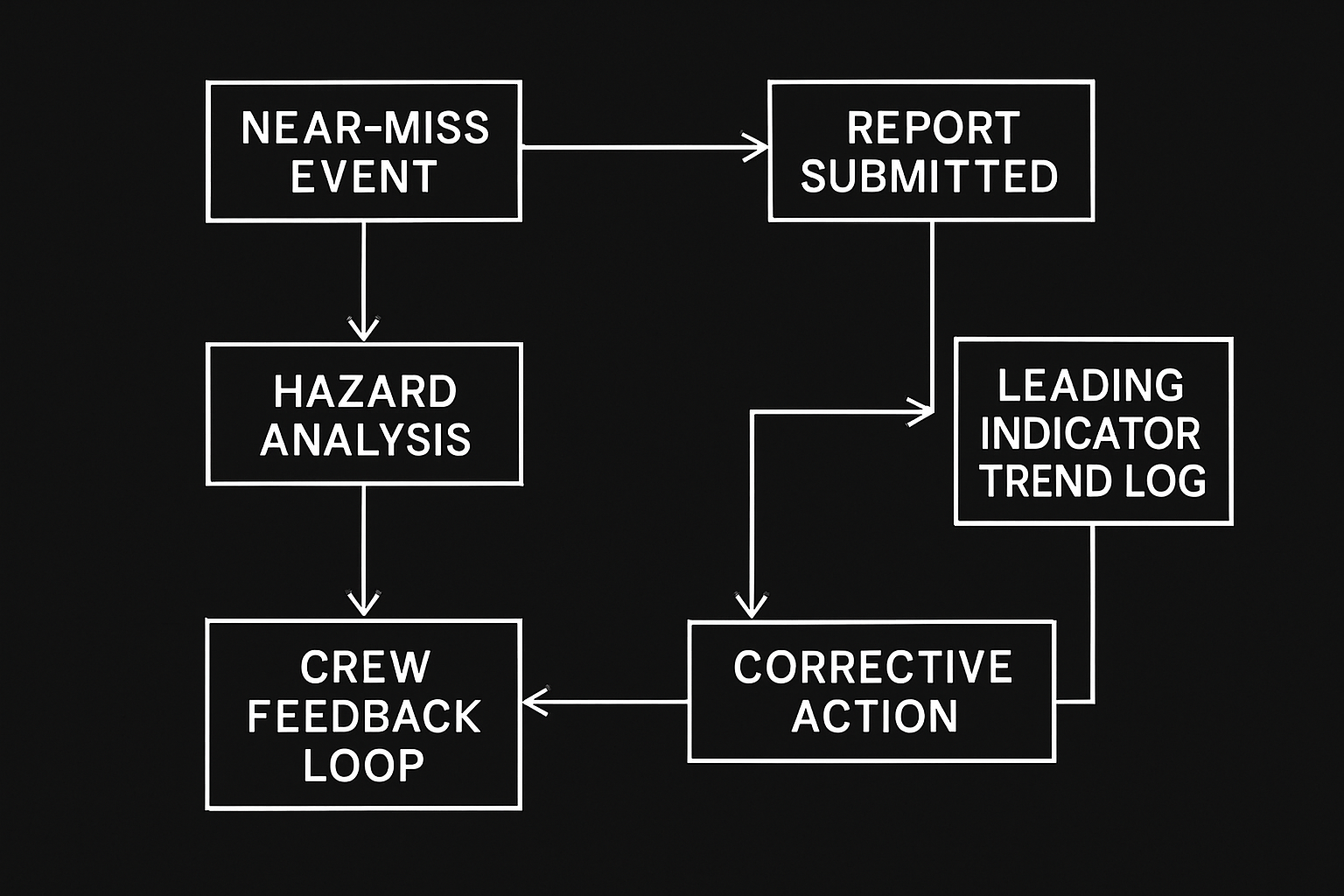
If your near-miss program feels like it's running on fumes — low report volume, no visible follow-through, workers who shrug when you mention it — the fix usually isn't a new form. It's rebuilding the signal loop: report → response → visible change → more reports.
If you're working on building or strengthening the culture side of your safety system, the Awesome Safety Culture System (free download) is worth a look. It's a practical framework we put together for safety managers who want to build something real — not just check a box. No pitch, just useful structure.
AW
Aaron West
Founder, EHS, Inc. — 18+ years in EHS compliance and contractor safety
Aaron West has spent over 18 years helping contractors and businesses navigate OSHA compliance, ISNetworld® certification, and workplace safety management. He founded EHS, Inc. to make enterprise-level EHS accessible to companies of all sizes — serving contractors and businesses nationwide — without long-term contracts or enterprise overhead.
Ready to simplify your EHS compliance?
Our team handles the complexity so you can focus on running your business. No long-term contracts, no learning curve.
Talk to EHSRelated Articles
Lean Safety Staffing and SIF Exposure in Refinery Turnarounds
When headcount drops during a turnaround, critical control ownership doesn't disappear — it just becomes nobody's job.
ISO 14001 and Safety Integration: What Separate Systems Cost You
Running ISO 14001 and your safety program as separate systems isn't just inefficient — it has a specific dollar cost. Here's what it is.
ISO 45001 Clause 7.4 & 8.1: When Paperwork Gaps Become OSHA Citations
In upstream drilling and pipeline work, OSHA doesn't cite the hazard — they cite the missing communication record. Here's what that looks like.
Medium & Enterprise
Safety Culture System
Framework to achieve zero incidents
Get Free System →
Small Businesses
50+ Safety Topics
Stop hitting paywalls
Get Free Topics →
All Companies
Audio Safety Topics
54 topics in English & Spanish
Get Free Audio →