First 30 Days: Fixing a Broken Manufacturing Safety Program
When you inherit a broken manufacturing safety program, turnover and subcontractor layering are usually what broke it — here's how to fix it fast.
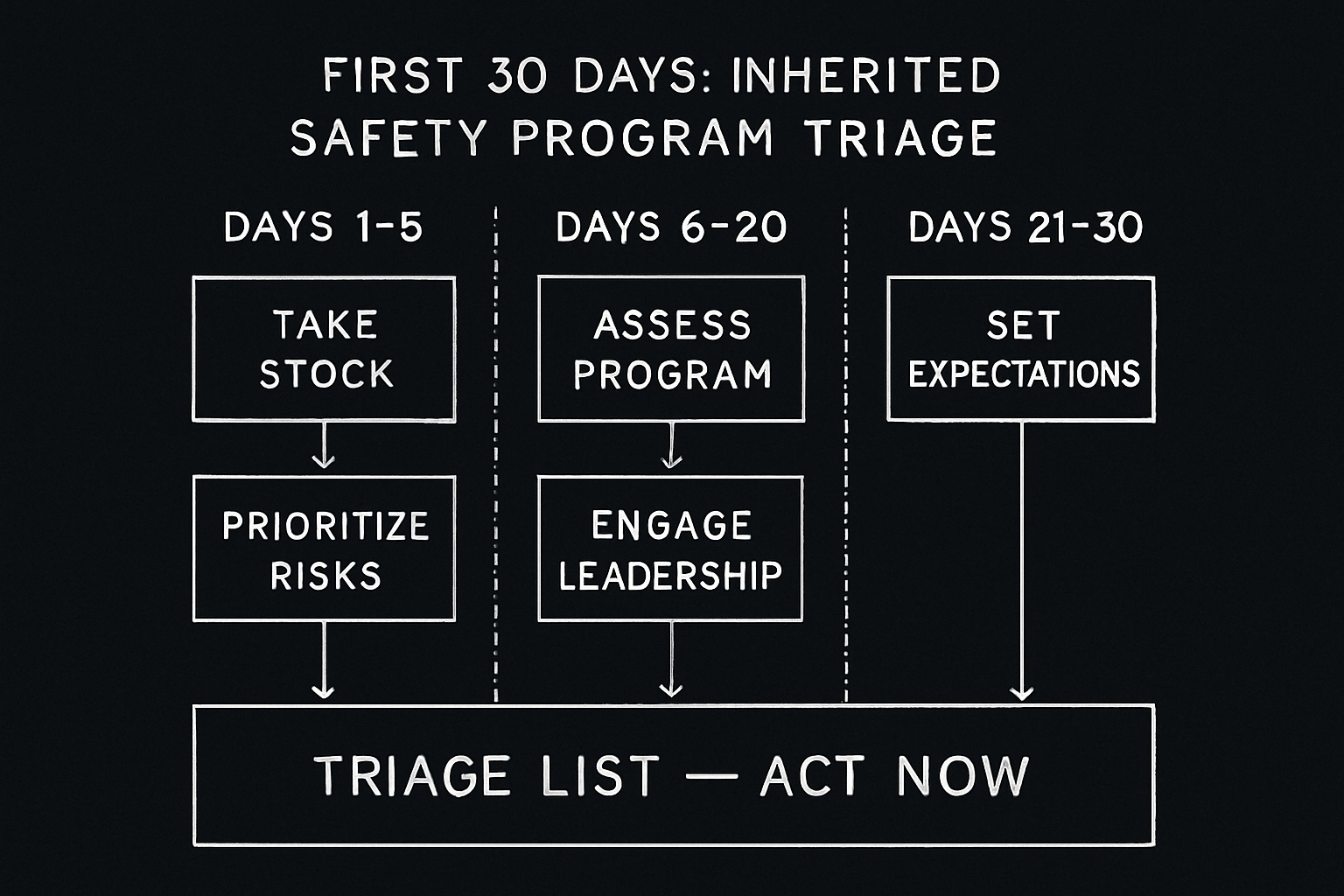
What a Safety Manager Should Do in the First 30 Days When They Inherit a Broken Safety Program
You walked into a manufacturing plant — somewhere between 80 and 250 employees, general industry, probably stamping, fabrication, assembly, or some combination — and within the first week you realized the previous safety manager either burned out, quit without notice, or was quietly let go. The OSHA 300 log hasn't been touched in four months. The lockout/tagout procedures reference equipment that was sold two years ago. Half the maintenance techs hired during last year's production ramp haven't completed their annual forklift refresher. And somewhere in a filing cabinet is a binder labeled "Written Programs" that was last updated during the Obama administration.
This is not a worst-case scenario. This is Tuesday in mid-size manufacturing.
The good news: the first 30 days aren't about fixing everything. They're about finding out what can actually hurt someone — or get you cited — before you can fix it. Here's how to work it.
Day 1–5: Stop Assuming the Records Mean Anything
The first instinct most incoming safety managers have is to audit the training records. That's the right instinct for the wrong reason. Most assume the gap is incomplete records — but the real problem is that the records that exist are often fabricated, duplicated from a template someone filled in for a whole crew at once, or tied to employees who have since left and been replaced by three different people none of whom appear anywhere in the LMS.
In a plant that's been through high turnover — say, 40% annual churn on the production floor, which is not unusual in general industry right now — you'll find training certificates for names that don't match current headcount, sign-in sheets with handwriting that belongs to maybe two people, and online completions timestamped at 11:47 PM on a Sunday, which means a supervisor was clicking through modules for his entire shift to get compliance numbers green before a corporate visit.
Pull the OSHA 300 and 301 logs first. Cross-reference them against workers' comp claims. Discrepancies here are your first red flag — and they're exactly what a compliance officer will look for if OSHA walks in. A single missed recordable is a $16,131 serious violation. A pattern of them starts looking willful, and willful citations run up to $161,323 per instance. You did not create this problem, but you now own it.
Day 6–10: Walk the Floor With the Maintenance Lead, Not HR
HR will tell you about the org chart. The maintenance lead will show you what's actually happening. Walk the plant with your lead maintenance tech. Ask them to show you every piece of equipment that's been modified, bypassed, or "temporarily" fixed in the last 12 months. In a plant that's been staffed with subcontractors or temp-to-hire workers cycling through — which is exactly how turnover breaks a safety program — you'll find energy isolation points that were relabeled, machine guards that were removed and not reinstalled, and LOTO procedures that don't match the actual equipment anymore because a control panel was replaced and nobody updated the procedure.
This is Management of Change failure in its most common form. Nobody triggered a formal review when the equipment changed because there was no formal MOC process — and there was no formal MOC process because the last safety manager inherited the same mess and never had time to build one.
Day 11–20: Identify Your Highest-Exposure Job Tasks, Not Your Highest-Risk Departments
The counterintuitive move here: most safety managers focus on the department with the most injuries. The real risk usually lives in the job tasks that rotate through multiple departments and multiple worker classifications — tasks like crane picks during line changeover, battery charging in the warehouse bay, confined space entry for maintenance on the dust collection system, or hot work performed by a subcontractor brought in three weeks ago who has never seen your permit system.
Subcontractor layering is one of the most reliable ways a safety program falls apart in mid-size manufacturing. Your direct employees might be fully trained. But the electrical sub's apprentice who showed up Monday under a project contractor who is under your Tier 1 vendor? That person has never attended your site orientation, has no record in your system, and is working six feet from an unguarded secondary conveyor while your safety coordinator is in a training session on the other side of the building.
Map out every job task that touches subcontractors, temps, or recently hired production workers who came in during a hiring surge. Those are your Job Hazard Analyses that need to be rebuilt from scratch — or in many cases, built for the first time.
Day 21–30: Build a Triage List, Not a Master Safety Plan
You do not have time in 30 days to write a new safety program from scratch. What you have time to do is identify the five to eight things that will get someone killed or trigger an OSHA inspection if left alone, and start moving on those. The rest gets a timeline.
Your triage list should include: incomplete LOTO procedures for active equipment, any confined spaces that aren't on a permit program, forklift operators with expired certifications (and yes, the new hires from the Q1 ramp who got two hours of "on-the-job" training from a lead operator who is himself overdue for a refresher), emergency action plan that still lists the old assembly point from before the south expansion, and written programs that reference regulations you're no longer covered by — or regulations you are covered by but the program doesn't actually address.
A written program that exists but doesn't reflect actual conditions is not a defense. It's evidence. OSHA compliance officers know the difference between a program that was built by someone who understood the operation and one that was downloaded from the internet and put in a binder.
The Training Backlog Is a Symptom, Not the Problem
Every incoming safety manager finds a training backlog. What they don't always find is the reason it exists. In plants with high turnover or rapid hiring, the failure isn't that safety managers forgot to schedule training — it's that there's no system that automatically flags new hires, no process that connects onboarding to the LMS, and no one accountable for tracking completion when the safety manager position is vacant for 60 days between transitions.
That's the structural problem. The overdue completions are just what it looks like.
Fixing it means building a process that works when you're not watching — because there will be stretches when no one is watching. See OSHA's training requirements by standard to confirm which tasks carry mandatory training obligations before you prioritize your rebuild.
FAQ
What should a safety manager prioritize in the first 30 days of a new job at a manufacturing plant?
Focus on life-safety gaps first: LOTO procedures, confined space programs, forklift certifications, and emergency action plans. Cross-reference OSHA 300 logs against workers' comp records to find recording failures before anyone else does. Don't try to fix everything — triage what can hurt someone or trigger a citation in the near term.
How does employee turnover break a manufacturing safety program?
High turnover creates gaps in training records, breaks the chain of competent persons for high-hazard tasks, and floods the floor with new hires who received informal on-the-job orientation instead of documented OSHA-required training. When a plant runs three or four hiring cycles in 18 months, the LMS rarely keeps up — and the records that exist are often inaccurate.
What's the biggest compliance risk when subcontractors are on site at a manufacturing plant?
Subcontractors operating without site-specific orientation, no record in the plant's safety system, and no documentation connecting them to the host employer's written programs. OSHA holds the host employer responsible for hazardous conditions that affect subcontractor employees working on-site. A subcontractor injury with no orientation record is not a subcontractor problem — it's your citation.
How long does it take to fix a broken safety program in manufacturing?
A triage of the highest-risk gaps can be completed in 30 days. A functional, documented, auditable safety program typically takes six to twelve months to build from a degraded state — longer if the underlying culture was also damaged by the same turnover that broke the program.
Can EHS, Inc. help manage training and compliance for a manufacturing plant?
Yes. EHS, Inc. handles safety training, LMS management, OSHA recordkeeping, written programs, and prequalification maintenance so safety managers can focus on the floor instead of the filing cabinet. If the admin backlog is the bottleneck, that's exactly what the service is built for.
If you're staring at a training backlog that built up while the position was vacant — or while you were too buried in other fires to address it — grab the free safety topics pack and see what's there. Or just call us and describe the situation. Download the free safety topics pack or schedule a call here.
AW
Aaron West
Founder, EHS, Inc. — 18+ years in EHS compliance and contractor safety
Aaron West has spent over 18 years helping contractors and businesses navigate OSHA compliance, ISNetworld® certification, and workplace safety management. He founded EHS, Inc. to make enterprise-level EHS accessible to companies of all sizes — serving contractors and businesses nationwide — without long-term contracts or enterprise overhead.
Ready to simplify your EHS compliance?
Our team handles the complexity so you can focus on running your business. No long-term contracts, no learning curve.
Talk to EHSRelated Articles
What Happens to Your LMS When Your Workforce Doubles Overnight
Winning a new contract and doubling your workforce sounds like a win — until your LMS becomes the reason an OSHA inspector writes you up.
What Happens to an LMS When the Safety Manager Who Built It Leaves
When the safety manager who built your LMS walks out the door, OSHA doesn't care who's responsible — they just write citations.
What Your LMS Must Show OSHA When They Walk In Unannounced
When OSHA shows up at your commercial construction site, what's in your LMS either saves you or costs you — here's exactly what they want.
Medium & Enterprise
Safety Culture System
Framework to achieve zero incidents
Get Free System →
Small Businesses
50+ Safety Topics
Stop hitting paywalls
Get Free Topics →
All Companies
Audio Safety Topics
54 topics in English & Spanish
Get Free Audio →