ISNetworld Grade Drop: When New Contract Insurance Falls Short
Win a contract at a manufacturing plant and your insurance limits don't match—here's exactly what happens to your ISNetworld grade.
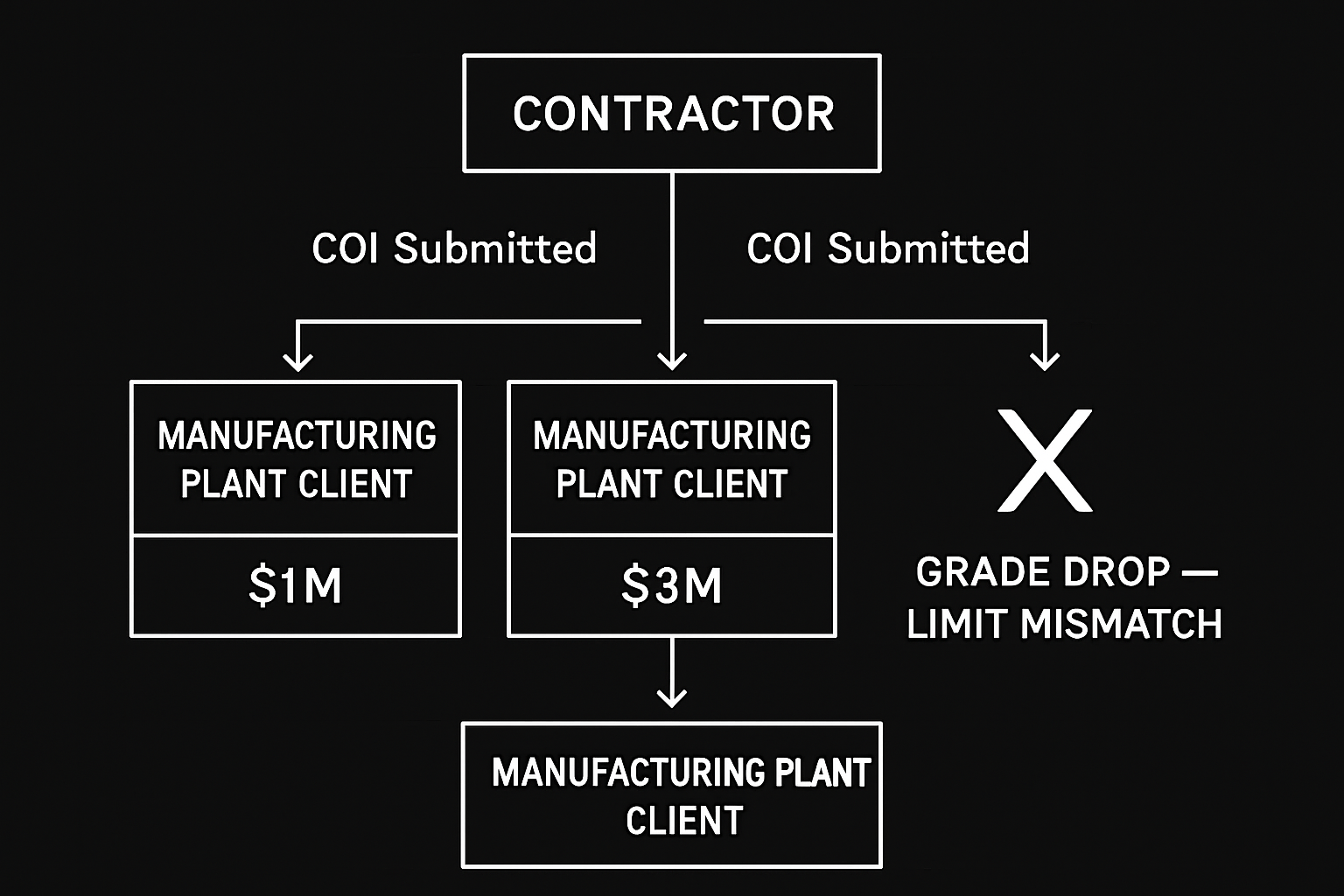
What Happens to Your ISNetworld Grade When You Win a New Contract and Your Insurance Limits Are Too Low
You land a contract at a mid-size manufacturing plant — 150 employees, stamping presses, forklift traffic, chemical storage. The hiring client runs ISNetworld. You've worked with ISNetworld before. Your grade was a B last time you checked. You hand the new COI to your account manager and find out three days before mobilization that you're flagged. Your coverage limits don't meet this plant's specific requirements. Your grade just dropped, and the job is on hold.
This is not a fringe scenario. This is Tuesday at most contractor companies that do business across more than one client in general industry manufacturing. And the way turnover, rapid hiring, and subcontractor layering make it worse — that's the part nobody talks about until they're already standing in it.
Why Insurance Limits Aren't One-Size-Fits-All in ISNetworld
ISNetworld doesn't have one standard insurance requirement. Each hiring client sets its own thresholds — general liability limits, auto liability, workers' comp, umbrella/excess — and those thresholds are coded into the system against your account. A general contractor working maintenance shutdowns at a plastics extrusion facility might need $2M general liability per occurrence. The stamping plant down the road that runs automotive parts might require $5M umbrella. Both are in ISNetworld. Both will score your account differently based on what your COI actually shows.
When your certificate of insurance doesn't meet a specific hiring client's threshold, ISNetworld flags it. Your grade for that client relationship drops — sometimes to a D or an outright fail — regardless of what your grade looks like for every other client in your profile. According to ISNetworld's own documentation, grades are client-specific, not account-wide averages. That distinction matters enormously when you're working across multiple facilities.
How Rapid Hiring Breaks This — Specifically
Here's where it gets worse. A mechanical contractor wins a new 12-month maintenance agreement at a 200-employee metal fabrication plant. To staff it, they bring on eight new field employees inside 30 days — pipe fitters, millwrights, two maintenance techs pulled from a staffing agency. The safety coordinator who normally handles ISNetworld updates is now spending her time onboarding those eight people: OSHA 10 cards, site-specific orientations, respirator fit tests, the whole stack.
Nobody touched the ISNetworld account. Nobody checked whether this new plant's insurance requirements matched the existing policy. The COI on file was updated six months ago for a different client — a lighter-duty packaging facility that needed $1M general liability. The new plant requires $3M. The discrepancy sits in the system, the grade drops, and the client's procurement team gets the notification before the contractor does.
Most safety coordinators assume the insurance broker handles ISNetworld updates automatically. The real problem is that brokers issue certificates — they don't log into prequalification portals. That step belongs to someone at the contractor company, and during a hiring surge, it falls through the floor every single time.
Subcontractor Layering Makes It Worse at Scale
A mid-size general contractor managing a facility expansion at a 250-employee plastics manufacturer brings in three subcontractors — an electrical crew, an insulation crew, and a rigging company. The GC is ISNetworld-qualified. The subs may or may not be, depending on whether the hiring client requires sub-tier compliance.
More manufacturing plants are requiring sub-tier compliance now. When they do, each subcontractor's insurance limits get evaluated independently. The rigging company — four employees, owner-operator — carries $1M general liability because that's what they've always carried. The plant requires $2M. The GC finds this out after the rigging crew is already scheduled for overhead work in the press room. Now the GC either pays to add the sub to their own policy as an additional insured (expensive, and the timeline is tight), or the rigging crew sits on the bench while the schedule slips.
Every day of schedule delay at a manufacturing plant has a dollar cost attached to it — downtime on a press line, delayed preventive maintenance on conveyor systems, a production run that can't start. That cost lands on the GC, not the rigging company.
What a Dropped Grade Actually Costs
A D grade or a failed insurance section in ISNetworld doesn't just mean paperwork. Many hiring clients have a hard-stop policy: below a C, you're removed from the approved vendor list. At a manufacturing plant running tight vendor approval windows, getting removed means you may not get back on the approved list in time for the next maintenance window — which might be six months out.
And if the client discovers a COI gap after work has already started — after your maintenance techs are already on the press floor — you're now potentially working uninsured relative to the client's contractual requirements. That exposure, depending on the incident, can strip indemnification protections you thought you had. An OSHA serious violation at that site runs up to $16,131 per violation. A willful or repeat citation — the kind that follows a pattern of documented non-compliance — goes up to $161,323. A gap in your coverage documentation doesn't cause the citation, but it absolutely makes the aftermath worse.
The Fix Is a Process, Not a One-Time Update
Every time a new contract is confirmed — before mobilization — someone needs to pull the hiring client's insurance requirements from ISNetworld and compare them line by line against the current COI. Not annually. Not whenever the policy renews. Every. New. Contract.
That comparison needs to include umbrella and excess limits, not just primary. Manufacturing plants frequently require umbrella stacking that smaller contractors haven't priced into their policy structure.
If limits need to increase, that request goes to the broker with enough lead time to get an updated certificate issued and uploaded to ISNetworld before the grade gets flagged. Two weeks minimum. During a hiring surge — when the safety coordinator is already running hot — that two-week window disappears fast.
Frequently Asked Questions
Does my ISNetworld grade drop the moment my insurance limits don't match a new client's requirements?
Yes. ISNetworld evaluates your account against each hiring client's specific requirements. If your COI doesn't meet that client's thresholds, your grade for that client relationship drops immediately — independent of your grade with other clients in your profile.
Is my broker responsible for updating ISNetworld when my COI changes?
No. Your broker issues the certificate of insurance. Uploading it to ISNetworld and verifying it clears the client's requirements is your responsibility — or your safety/compliance team's. Brokers don't have access to your ISNetworld account and typically don't know your clients' specific platform requirements.
Can I still mobilize to a job site if my ISNetworld grade is flagged?
That depends entirely on the hiring client's policy. Some will issue a temporary waiver while you resolve the discrepancy. Others have hard-stop rules — no approved status, no site access. Assume the latter until you hear otherwise, and don't send your maintenance techs to the gate until you've confirmed in writing.
How does rapid hiring specifically hurt ISNetworld compliance?
Rapid hiring concentrates your safety coordinator's time on onboarding — orientations, training records, OSHA documentation — right at the moment when a new client relationship most needs compliance attention. ISNetworld account maintenance falls through the cracks because it doesn't have a hard deadline the way a first-day safety orientation does.
What should I check in ISNetworld before signing a new contract?
Pull the new hiring client's insurance requirements from ISNetworld before you sign, not after. Compare general liability per occurrence and aggregate, auto liability, workers' comp, and umbrella/excess limits against your current policy. If anything is short, get the endorsement request to your broker before the contract is executed.
If you're running contracts across multiple manufacturing clients and managing ISNetworld on top of everything else, this is exactly the kind of thing that gets missed during a hiring push. EHS, Inc. manages your ISNetworld account — insurance tracking, document uploads, grade monitoring — so your safety coordinator can stay on the floor where she belongs.
Find out if your company qualifies — take the free 2-minute ISNetworld & Avetta Readiness Check.
AW
Aaron West
Founder, EHS, Inc. — 18+ years in EHS compliance and contractor safety
Aaron West has spent over 18 years helping contractors and businesses navigate OSHA compliance, ISNetworld® certification, and workplace safety management. He founded EHS, Inc. to make enterprise-level EHS accessible to companies of all sizes — serving contractors and businesses nationwide — without long-term contracts or enterprise overhead.
Ready to simplify your EHS compliance?
Our team handles the complexity so you can focus on running your business. No long-term contracts, no learning curve.
Talk to EHSRelated Articles
Your Avetta Score After Winning a Large Public Contract
Winning a large public contract can crater your Avetta score overnight — here's what that costs and how to stop it.
ISNetworld Grade Drop: When Insurance Limits Fall Short
Your ISNetworld grade can crater overnight when your renewed policy carries lower limits than your operator contract requires — here's exactly how it happens.
Avetta Score After a New Contract Win: What Changes and Why
Winning a new utility contract can silently tank your Avetta score — here's what in-house safety managers miss until the damage is done.
Medium & Enterprise
Safety Culture System
Framework to achieve zero incidents
Get Free System →
Small Businesses
50+ Safety Topics
Stop hitting paywalls
Get Free Topics →
All Companies
Audio Safety Topics
54 topics in English & Spanish
Get Free Audio →