Removed from an Approved Vendor List Over One Expired Document
Missing a single document renewal can get a commercial contractor pulled from an approved vendor list — here's what that actually costs.
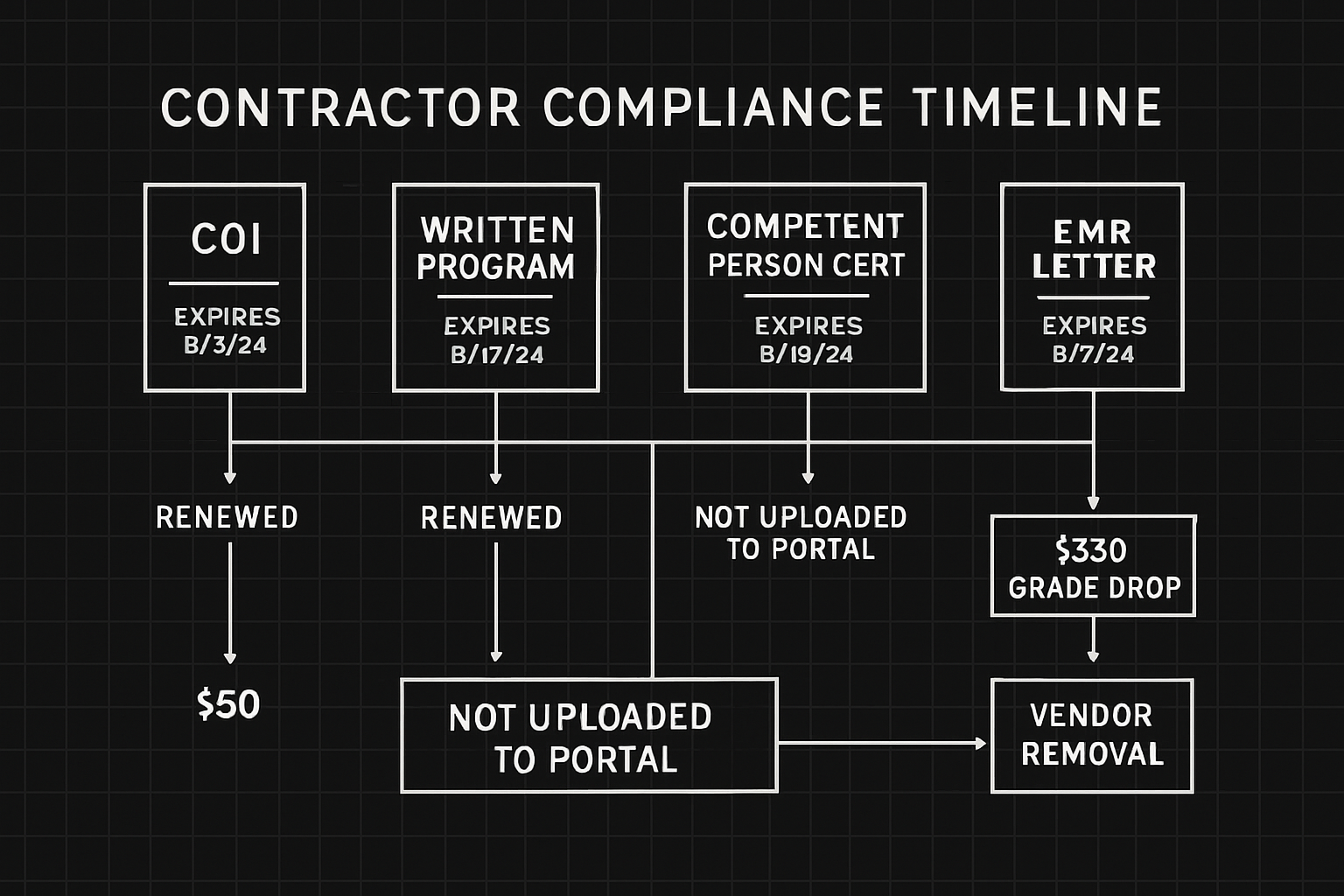
How a Contractor Gets Removed from an Approved Vendor List for Missing a Single Document Renewal — and What to Do Before It Happens
A 35-person electrical subcontractor in the Dallas-Fort Worth market spent eight months working their way onto a national GC's approved vendor list. ISNetworld grade: A. Safety program: documented. EMR: 0.82. Then their general liability certificate expired on a Thursday. By Monday, the GC's procurement team had flagged them in Avetta. By Wednesday, they were suspended from two active projects. The project manager found out when a superintendent called asking why they couldn't pull a permit.
That's not a horror story. That's a Tuesday in commercial construction.
What "Removed from the Approved Vendor List" Actually Means in Dollars
Losing approved vendor status isn't an administrative inconvenience — it's a revenue event. Here's what it looks like for a specialty sub running $3–8M in annual commercial work:
- Project suspension: If you're already mobilized and get flagged mid-project, the GC can require you to demobilize. Remobilization costs — equipment, crew scheduling, material staging — run $8,000–$25,000 depending on project size and trade.
- Lost bid eligibility: Most GCs won't accept bids from vendors outside active approved status. If prequalification lapses during bid season, you're out. A single missed commercial project bid for a 20-person framing sub can represent $400,000–$1.2M in lost contract opportunity.
- ISNetworld grade penalty: A lapsed certificate of insurance or expired safety program document can drop an ISNetworld grade from A to C or D within one reporting cycle. Grade recovery takes 30–90 days minimum after documents are re-uploaded and verified. Some GC procurement systems auto-reject any vendor below a B grade — no human review.
- OSHA exposure during the gap: If a compliance document lapse coincides with an OSHA inspection — say, an expired written Hazard Communication program or an outdated OSHA 300 log — you're looking at serious violation citations starting at $16,131 per violation. Willful or repeat violations go to $161,323 per violation. A safety coordinator who hasn't updated a written program in 18 months because "it's close enough" is sitting on that exposure every single day.
The Document That Gets Missed (It's Never the One You're Watching)
Most safety coordinators at commercial subs track their OSHA 300 logs, their training records, their EMR letters. Those get attention because they come up in conversations with GCs. The documents that expire quietly are the ones tied to annual renewals with no built-in reminder: certificates of insurance, motor vehicle records for field supervisors, drug testing consortium enrollments, written program review attestations, and — the one that surprises people — competent person designations for specific tasks like excavation or fall protection.
A 45-person masonry contractor in the Southeast lost prequalification status on a $2.1M school project because their competent person for scaffold erection — a foreperson who'd held that designation for six years — had let his certification lapse. Nobody checked. It wasn't in the tracking spreadsheet. The GC's Avetta account flagged it during a routine document audit two weeks into the project.
The Counterintuitive Part Most Safety Coordinators Get Wrong
Most safety coordinators assume the problem is document expiration — so they build expiration trackers. Spreadsheets, calendar reminders, tickler systems. That's not the real problem.
The real problem is that nobody owns the gap between expiration and re-upload.
A certificate of insurance can be renewed by the broker on day one. But if nobody uploads it to ISNetworld or Avetta within the 15-day grace period — and then the portal flags a deficiency — and then the safety coordinator is on a project site for two weeks — the grade tanks before anyone catches it. The document existed. It was current. It just wasn't in the portal. That distinction matters zero to the GC's procurement system. Automated compliance platforms don't call you to check.
The fix isn't a better spreadsheet. It's dedicated ownership of portal management by someone whose only job is keeping those portals current. For a 20-person roofing sub without a full-time safety coordinator, that doesn't exist internally. Which is exactly why it fails.
What the Re-Qualification Process Actually Looks Like
Getting back onto an approved vendor list after removal is not a simple re-upload. For ISNetworld, a grade recovery after a compliance lapse requires document re-submission, reviewer verification (which runs 5–15 business days depending on queue), and sometimes a written response to the GC's procurement team explaining the lapse. Some GCs require a corrective action plan. Some require a third-party audit before reinstatement.
For Avetta, the process is similar — and some owner-clients have a zero-tolerance policy. One lapse, one removal, and you're reapplying from scratch. That process can take 60–90 days. If you're a specialty sub whose primary revenue source is one or two large GC relationships, 60 days off an approved vendor list is an existential problem — not a paperwork annoyance.
The OSHA 1926 construction standards don't pause while you sort out your Avetta portal. Neither does the job schedule.
What to Do Before It Happens
The operational fix has three components:
- Build a master document register — every compliance document, renewal date, owner, and portal it needs to live in. Not a spreadsheet with one column. A working system with assigned accountability.
- Separate the renewal trigger from the upload trigger — renewing a document and getting it into ISNetworld or Avetta are two different tasks, often owned by two different people (broker vs. safety coordinator). That handoff is where documents die.
- Run a portal audit quarterly, not annually — most commercial subs audit their prequalification status once a year, usually right before bid season. GC procurement systems run continuous compliance checks. Your audit cadence needs to match theirs, not your fiscal calendar.
Frequently Asked Questions
How long does it take to recover an ISNetworld grade after a document lapse?
Typically 15–45 business days, depending on document type, reviewer queue, and whether the GC requires a corrective action response. During that window, most GC procurement systems will not accept bids or allow active work from vendors below minimum grade thresholds.
Can a contractor be removed from an approved vendor list mid-project?
Yes. Automated compliance platforms like ISNetworld and Avetta run continuous document checks. A lapse identified during an active project can trigger a work suspension notice from the GC, requiring demobilization until compliance is restored.
What documents expire most often without contractors noticing?
Certificates of insurance (especially when broker renewals aren't auto-uploaded), competent person certifications, drug testing consortium enrollment confirmations, written safety program annual review attestations, and motor vehicle records for drivers of company vehicles.
Does an ISNetworld grade drop affect bid eligibility automatically?
For most large commercial GCs and owner-clients, yes. Minimum grade thresholds are set in procurement systems. A contractor who drops from a B to a D grade may be automatically filtered out of bid pools without any manual review by a person.
What's the difference between ISNetworld and Avetta for contractor prequalification?
Both are third-party prequalification platforms used by GCs and owner-clients to verify contractor compliance before awarding work. ISNetworld is more common in oil and gas and heavy industrial; Avetta has broader commercial construction penetration. Many specialty subs maintain active accounts on both simultaneously — which doubles the document management burden.
If your company is on ISNetworld, Avetta, or both — and document management is currently living in someone's inbox or a shared Google Sheet — the gap is already there. You just haven't hit it yet.
Find out if your company qualifies for managed prequalification support — take the free 2-minute ISNetworld & Avetta Readiness Check.
https://ehs.inc/qualify
AW
Aaron West
Founder, EHS, Inc. — 18+ years in EHS compliance and contractor safety
Aaron West has spent over 18 years helping contractors and businesses navigate OSHA compliance, ISNetworld® certification, and workplace safety management. He founded EHS, Inc. to make enterprise-level EHS accessible to companies of all sizes — serving contractors and businesses nationwide — without long-term contracts or enterprise overhead.
Ready to simplify your EHS compliance?
Our team handles the complexity so you can focus on running your business. No long-term contracts, no learning curve.
Talk to EHSRelated Articles
Your Avetta Score After Winning a Large Public Contract
Winning a large public contract can crater your Avetta score overnight — here's what that costs and how to stop it.
ISNetworld Grade Drop: When Insurance Limits Fall Short
Your ISNetworld grade can crater overnight when your renewed policy carries lower limits than your operator contract requires — here's exactly how it happens.
Avetta Score After a New Contract Win: What Changes and Why
Winning a new utility contract can silently tank your Avetta score — here's what in-house safety managers miss until the damage is done.
Medium & Enterprise
Safety Culture System
Framework to achieve zero incidents
Get Free System →
Small Businesses
50+ Safety Topics
Stop hitting paywalls
Get Free Topics →
All Companies
Audio Safety Topics
54 topics in English & Spanish
Get Free Audio →