Todd Conklin's HOP principles and your near-miss reporting gap
When near-miss reports drop after an incident, HOP principle #5 explains exactly why—and how your response killed future reporting.
Todd Conklin's HOP principles and your near-miss reporting gap
Your near-miss reports dropped 40% in the three months after your last recordable injury. Your safety manager thinks it means people are being more careful. It doesn't. It means they watched what happened to the last guy who reported something and decided silence is safer than honesty.
This is HOP principle #5 in action: response matters. How leadership responds to bad news determines whether they keep hearing it. And most safety programs—even the ones tracking leading indicators and talking about psychological safety—fail this test every single time.
The pattern that kills near-miss reporting
A foreman on a pipeline project reports a near-miss: a flange wasn't torqued to spec during a tie-in, caught during QC before pressure test. Good catch. Exactly what you want.
What happens next:
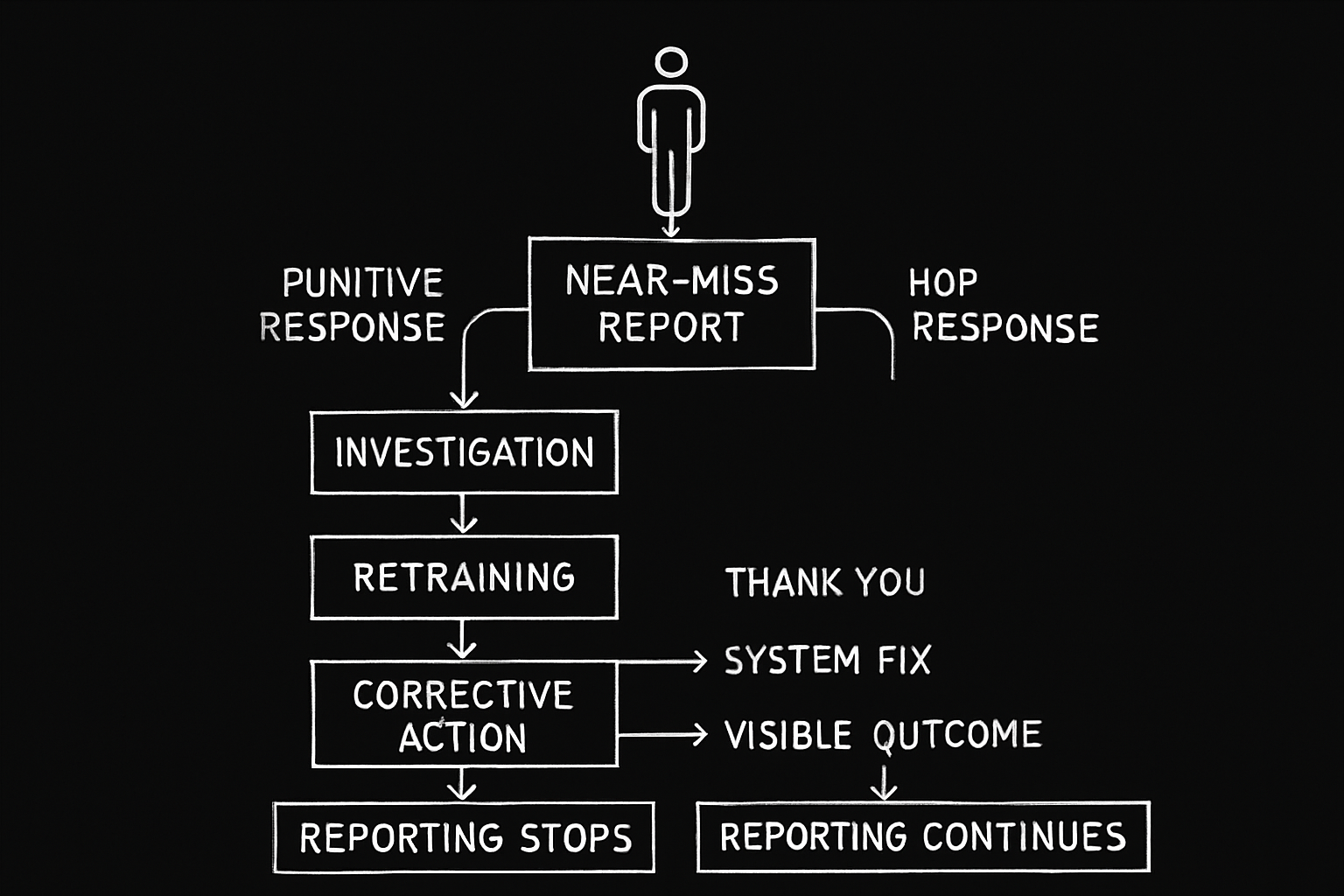
- The safety manager launches an investigation—treats it like an actual incident
- The foreman spends two hours being interviewed about why the error happened
- The crew gets retrained on torque procedures they already know
- A corrective action gets opened and the foreman owns it
- The incident gets discussed in the next safety meeting with the foreman's name attached
Three months later, near-miss reports from that crew: zero. Not because nothing went wrong. Because reporting something means you just bought yourself a week of paperwork and your name in front of the safety committee.
You didn't punish him. You thanked him, probably. But you made reporting painful enough that nobody wants to do it twice.
HOP principle #5: Response determines signal
Todd Conklin's fifth principle of Human and Organizational Performance is simple: how you respond to someone telling you bad news determines whether anyone tells you bad news again.
Most safety programs say they want near-miss reporting. They build the forms, track the metrics, put it on the leading indicator dashboard. Then someone reports a near-miss and the system treats them like they caused an OSHA recordable.
The response sends a message louder than any toolbox talk: reporting is risk.
This is where HOP principle #2 connects: blame fixes nothing. Even if you're not blaming the reporter, if your process feels like blame—investigation, retraining, corrective actions with their name on it—the outcome is identical. The reports stop coming.
What your near-miss trend actually measures
A flat or declining near-miss report rate doesn't mean your workplace is getting safer. It means one of two things:
Option 1: Nothing is going wrong. (Statistically impossible. Heinrich's triangle says for every recordable injury, there are 300 near-misses. If you're not seeing them, they're happening anyway—you're just not hearing about them.)
Option 2: Your response to previous reports trained people to stay quiet.
The DuPont Bradley Curve puts this in context. Companies stuck at Stage 2—Dependent safety culture—see near-miss reporting controlled by supervision. Reports go up when the safety manager is on site. They disappear when he's not. The behavior isn't internalized; it's performed.
Moving to Stage 3—Independent—requires that workers report near-misses because they care about safety, not because they're being watched. But you can't get there if reporting a near-miss results in an hour-long interview and a corrective action with your name on it.
Stage 4—Interdependent—is where near-miss reporting is highest, because the team trusts the system. They've seen the organization respond to bad news by fixing the system, not the person. That trust is built one response at a time. And it collapses just as fast.
The investigation process that kills the signal
Most near-miss investigations follow the same template as actual incident investigations: root cause analysis, corrective actions, someone owns the follow-up. It makes sense from a process standpoint—you're using a proven framework.
But it misses HOP principle #3: context drives behavior. The context of a near-miss report is fundamentally different from the context of an actual injury. A near-miss is a gift—someone handed you free information about a latent risk before it became a recordable. Treating it like an incident investigation changes the context from "thank you" to "you're in trouble."
Here's the failure mode nobody talks about: your investigation process is designed to find who did something wrong. Even if you say you're looking for system failures, the questions still start with "Why did you..." and "What were you thinking when..."
The Swiss Cheese Model says accidents happen when holes in multiple layers of defense align. Near-misses are when the holes almost aligned. The person reporting it isn't the problem—they're showing you where the holes are. But if your investigation puts them at the center of the analysis, they'll stop showing you.
How to fix your response
If your near-miss reports are flat or declining, audit your response process:
- Time cost to the reporter: How long does it take them to report? If it's more than 5 minutes, you've made it too expensive.
- Follow-up burden: Does the reporter get pulled into meetings, interviews, corrective action ownership? Every hour you take from them is an hour they'll remember next time.
- Visibility: Does their name get attached to the report in safety meetings or dashboards? Anonymity isn't about hiding—it's about removing risk from honesty.
- Corrective action ownership: Who owns the fix—the reporter, or the system owner? If the person who reported the problem has to fix it, you've just made reporting a part-time job.
The fastest fix: when someone reports a near-miss, the only response they should hear is "thank you" and "here's what we're going to do about it." No interview. No corrective action with their name on it. No retraining they've already completed. Just: acknowledged, logged, fixed.
The leading indicator you're not tracking
Near-miss report rate is a lagging indicator. By the time you see it drop, the damage is done—trust is already gone.
The real leading indicator: time from report to closure, and whether the reporter saw the outcome.
If someone reports a tripping hazard and it's still there two weeks later, they'll stop reporting. If they report a procedure gap and never hear what changed, they'll stop reporting. The speed and visibility of your response is the variable that controls whether the next report happens.
Track this: reports per month, time to closure, and percentage of reports where the outcome was communicated back to the reporter. If closure time is growing or communication rate is dropping, your near-miss program is dying in real time.
FAQ
What is HOP principle #5 and why does it matter for near-miss reporting?
HOP principle #5 states that how leadership responds to bad news determines whether they continue to receive it. In near-miss reporting, if your response makes reporting painful—through lengthy investigations, retraining, or public visibility—workers will stop reporting. The principle matters because near-miss data is your earliest warning system for serious incidents, and losing that signal means you're flying blind.
How do I know if my near-miss reporting process is broken?
Three signals: (1) near-miss reports are flat or declining over time, (2) reports spike only when leadership is on site, or (3) the same people report everything while most of the workforce reports nothing. A healthy near-miss program shows steady or increasing reports distributed across the workforce, not concentrated in a few "safety champions."
What should a near-miss investigation look like if not a full root cause analysis?
A near-miss review should focus on system factors, not individual behavior. Ask: what condition allowed this to almost happen? What defense layer failed? Who owns fixing it? The reporter should spend less than 10 minutes involved, and the corrective action should be owned by the system (supervisor, engineer, program manager), not the person who reported it. Speed and simplicity are more important than thoroughness—you're trying to encourage volume, not litigation-proof documentation.
If the admin is eating your time, we handle it
Managing near-miss programs, investigating incidents, tracking corrective actions, and keeping your leading indicator dashboard updated—it's all necessary, and it all takes time you don't have. EHS Inc handles the administrative load so you can focus on the actual safety work: talking to crews, fixing systems, and building the culture that makes people want to report in the first place.
If you're spending more time managing paperwork than managing risk, let's talk. Schedule a call here.
AW
Aaron West
Founder, EHS, Inc. — 18+ years in EHS compliance and contractor safety
Aaron West has spent over 18 years helping contractors and businesses navigate OSHA compliance, ISNetworld® certification, and workplace safety management. He founded EHS, Inc. to make enterprise-level EHS accessible to companies of all sizes — serving contractors and businesses nationwide — without long-term contracts or enterprise overhead.
Ready to simplify your EHS compliance?
Our team handles the complexity so you can focus on running your business. No long-term contracts, no learning curve.
Talk to EHSRelated Articles
EMR as an Executive Risk Signal: What the Number Tells Leadership
Your EMR isn't just an insurance number — for utility contractors, it's the signal executives see before the next incident happens.
BBS Observation Data: When Rates Stay High but Incidents Don't Drop
High BBS observation rates with flat incident numbers aren't a paradox — in manufacturing, they're usually a turnover problem wearing a data mask.
How HOP Learning Teams Surface Leading Indicators BBS Misses
BBS programs count behaviors. HOP learning teams find the conditions that make those behaviors inevitable — and that's where your leading indicators actually live.
Medium & Enterprise
Safety Culture System
Framework to achieve zero incidents
Get Free System →
Small Businesses
50+ Safety Topics
Stop hitting paywalls
Get Free Topics →
All Companies
Audio Safety Topics
54 topics in English & Spanish
Get Free Audio →