ISNetworld Grade Drops When Your Safety Manager Leaves
When your safety manager walks out the door, your ISNetworld grade often follows. Here's what that costs in real dollars.
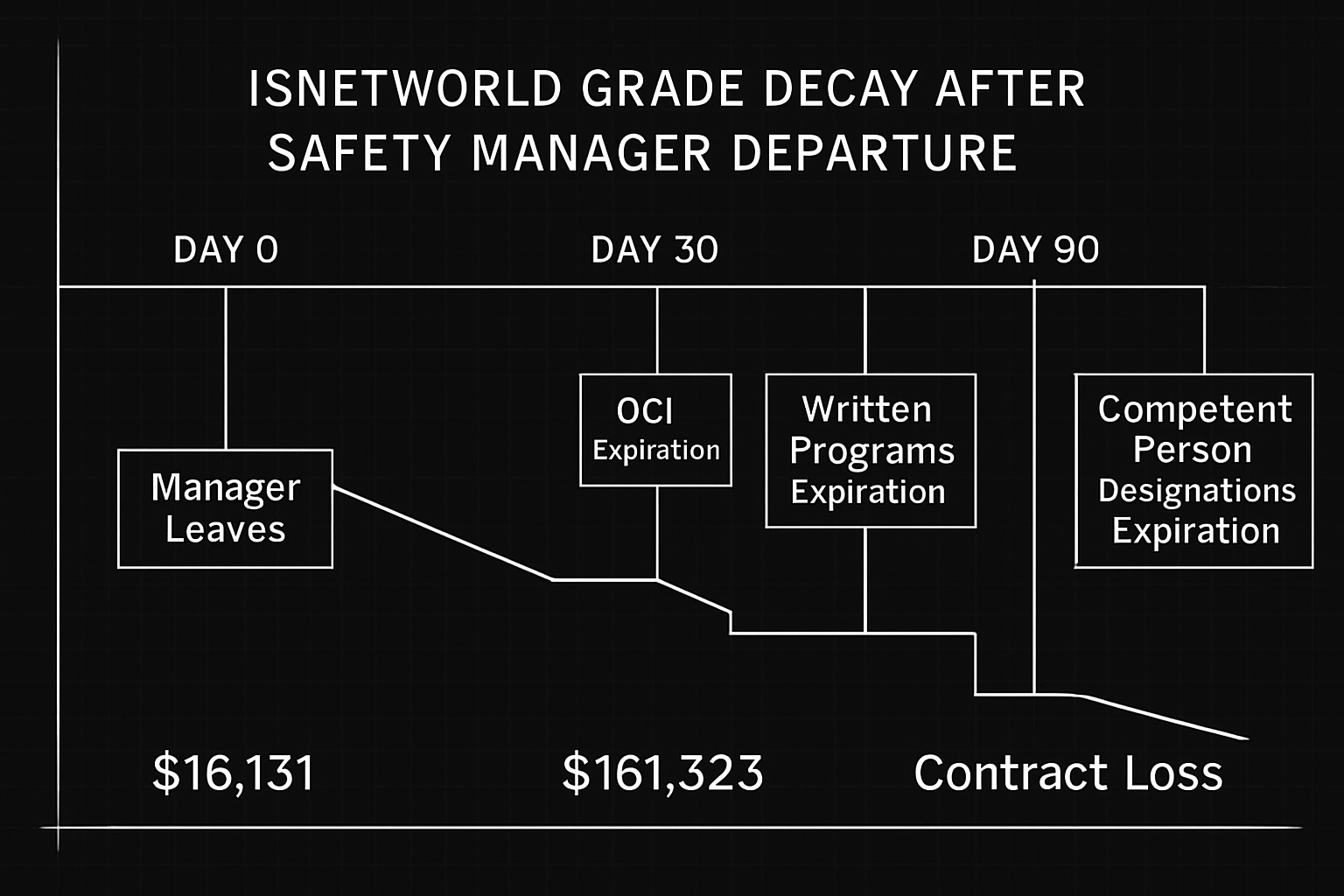
What Happens to an ISNetworld Grade When the Safety Manager Who Built the Program Leaves and No One Knows Where Anything Is
Your safety manager gave two weeks' notice on a Friday. By the following Monday, three things were already true: nobody knew the ISNetworld login credentials, the written programs were buried somewhere on a laptop that left with her, and your grade was about to start decaying in real time — you just didn't know it yet.
This is not a hypothetical. For commercial construction GCs and specialty subs in the 10–75 employee range, this is one of the most expensive and completely avoidable situations in the industry. The ISNetworld grade that took 18 months to build can be functionally destroyed in 90 days of neglect — and the financial consequences are not abstract.
What Actually Breaks, and When
ISNetworld grades are not static. They decay. Required documents expire — written programs, certificates of insurance, OSHA 300 logs, training records for competent persons and operators. Miss a renewal window and your grade drops. Miss several and you can fall below the minimum threshold your GC clients have set, which is typically a C or better. Fall below that and you are automatically flagged as non-compliant in the system.
For a specialty sub — say a concrete forming crew or a structural steel contractor working under a general — that flag means one thing operationally: your prequalification is suspended. You cannot be approved for new project bids until it is resolved. The GC's procurement team doesn't call to warn you. The system just stops approving you, and you find out when a project coordinator asks why your company is showing red in the portal.
A 30-day prequalification suspension on a project with $400,000 in scheduled work doesn't cost you $400,000 — but it can cost you $40,000 to $80,000 in delayed mobilization, lost subcontract award, or re-bid requirements, depending on the contract terms. That's before you account for the staff time to rebuild the ISNetworld account from scratch, which is a 40- to 60-hour process if the documentation is disorganized.
The Part Nobody Accounts For: The OSHA Exposure Window
Most project managers and operations leads assume the ISNetworld problem is just an administrative headache. The real problem is what the documentation gap reveals.
Here's the counterintuitive insight most project managers miss: they think the risk is the grade drop — but the actual risk is that the grade drop signals to OSHA that your written programs, competent person designations, and training records are not current. If an OSHA inspection lands during that gap, the agency doesn't grade on a curve because your safety manager left.
A single serious violation under 29 CFR 1926 — say, a fall protection program that can't be produced because it was on the departed manager's laptop — carries a penalty of up to $16,131 per violation. A willful or repeat violation goes to $161,323. On a commercial construction site with 25 field workers and an incomplete competent person log for excavation or scaffolding, you are not looking at one citation. You are looking at five to twelve, which puts you in the $80,000 to $160,000 range before any informal settlement.
According to OSHA's current penalty structure, these numbers adjust annually and have been climbing. A documentation gap that costs you a C-grade in ISNetworld can simultaneously be a six-figure OSHA exposure. Both outcomes come from the same root cause: nobody knew where anything was.
The Specific Things That Fall Apart First
On a commercial construction site, the documentation that expires fastest is also the documentation that triggers the most severe ISNetworld grade penalties:
- OSHA 300/300A logs — must be current, signed, and uploaded. A missing or unsigned 300A is an immediate grade hit and a recordable violation if inspected.
- Competent person designations — scaffolding, excavation, fall protection, and steel erection all require a named, documented competent person. If the safety manager was the designated competent person and she's gone, that designation is void.
- Written programs — Hazard Communication, Respiratory Protection, Fall Protection, Excavation — most ISNetworld clients require these to be dated within the current year. A program dated 2022 that nobody has touched will start failing verification.
- Training records for operators and foremen — scissor lift, boom lift, and telehandler certifications for your equipment operators expire. If the tracking spreadsheet was on the safety manager's local drive, nobody knows whose cards are current.
- Certificate of Insurance renewals — ISNetworld pulls these separately, but they require someone to upload updated certs when policies renew. If nobody knows to do it, the grade drops automatically.
What Rebuilding Actually Costs
A mid-size concrete sub — 40 field employees, working under two or three GCs who all require ISNetworld — trying to rebuild a collapsed grade from scratch faces this math:
- 40 to 60 hours of internal staff time to locate, recreate, or request documentation — typically falling to a project manager or office administrator who has never touched ISNetworld before
- 3 to 6 weeks of grade suppression while documents are re-uploaded and verified
- One or two delayed contract awards during that window, each worth $150,000 to $500,000 in subcontract value
- Potential retraining costs if operator certifications lapsed — typically $200 to $600 per employee for third-party certification renewal
None of that includes the cost of whatever actually caused the safety manager to leave — a hiring process, a gap in coverage, onboarding a replacement who then has to learn the ISNetworld system from scratch.
The Fix Is Not Hiring Faster
The instinct after losing a safety manager is to replace the person. That's understandable but structurally wrong. The problem was never that one person knew how to manage ISNetworld — the problem is that ISNetworld was managed inside one person's head, and when that person left, the institutional knowledge left with them.
A managed compliance service keeps the ISNetworld account independent of any single employee. Renewals are tracked externally. Written programs are maintained on a documented schedule. Training records are stored in a system that doesn't leave when someone does. The grade holds because the process isn't attached to a person.
FAQ
How fast does an ISNetworld grade drop after a safety manager leaves?
It depends on what's expiring. A Certificate of Insurance that renews during the transition will trigger a grade drop within days if nobody uploads the updated cert. Written programs and OSHA logs typically have a longer decay window — 30 to 90 days — but once they expire in the system, the grade drop is automatic and immediate.
Can a commercial construction sub lose a contract because of an ISNetworld grade?
Yes. Most general contractors set a minimum grade threshold — commonly a C or 70% — in their prequalification requirements. A sub whose grade drops below that threshold is ineligible for bid award on that GC's projects until the grade is restored. There is no grace period built into the system.
Who is responsible for ISNetworld compliance when there's no safety manager?
Nobody — which is exactly the problem. ISNetworld doesn't care about your org chart. The grade reflects the documents in the system. If no one is maintaining those documents, the grade drops regardless of who is technically responsible.
Is it possible to dispute a grade drop caused by a documentation gap?
ISNetworld has a dispute process, but it requires re-uploading current, valid documentation. The grade doesn't get restored retroactively — you have to earn it back. That process takes two to four weeks under normal circumstances.
What's the fastest way to stabilize an ISNetworld grade after turnover?
Audit the account immediately for anything expiring in the next 90 days, prioritize COI and OSHA 300A uploads, and get written programs re-dated and re-uploaded. If that's not something your current staff can handle, a managed compliance service can do it faster than building internal capacity from scratch.
If your ISNetworld grade is held together by one person's institutional knowledge, it's already fragile. Find out where you actually stand — take the free 2-minute ISNetworld & Avetta Readiness Check.
AW
Aaron West
Founder, EHS, Inc. — 18+ years in EHS compliance and contractor safety
Aaron West has spent over 18 years helping contractors and businesses navigate OSHA compliance, ISNetworld® certification, and workplace safety management. He founded EHS, Inc. to make enterprise-level EHS accessible to companies of all sizes — serving contractors and businesses nationwide — without long-term contracts or enterprise overhead.
Ready to simplify your EHS compliance?
Our team handles the complexity so you can focus on running your business. No long-term contracts, no learning curve.
Talk to EHSRelated Articles
Your Avetta Score After Winning a Large Public Contract
Winning a large public contract can crater your Avetta score overnight — here's what that costs and how to stop it.
ISNetworld Grade Drop: When Insurance Limits Fall Short
Your ISNetworld grade can crater overnight when your renewed policy carries lower limits than your operator contract requires — here's exactly how it happens.
Avetta Score After a New Contract Win: What Changes and Why
Winning a new utility contract can silently tank your Avetta score — here's what in-house safety managers miss until the damage is done.
Medium & Enterprise
Safety Culture System
Framework to achieve zero incidents
Get Free System →
Small Businesses
50+ Safety Topics
Stop hitting paywalls
Get Free Topics →
All Companies
Audio Safety Topics
54 topics in English & Spanish
Get Free Audio →