Maintaining an ISNetworld A Grade When Your Crew Changes Every Quarter
Quarterly crew turnover doesn't drop your ISNetworld grade — missing the paperwork that proves the new crew is trained does.
Maintaining an ISNetworld A Grade When Your Crew Changes Every Quarter
Your crew turns over. That's the business. In upstream drilling and well servicing, a driller who ran your rig through Q1 might be on a competitor's pad by Q2. A pipeline welder finishes a tie-in and is gone before the pressure test. You bring in a new lease operator, two floorhands, and a crane operator — and none of their documentation is in ISNetworld yet. Your grade hasn't moved. Then it does. And you get a call from the operator's compliance team.
The hazard didn't change. The wellbore is the same. The equipment is the same. What changed is the paper trail — and that's what ISNetworld is actually grading you on.
The Real Citation Isn't the Hazard — It's the Missing Document
Most safety coordinators working for upstream oil and gas contractors focus on the physical hazard: H2S exposure, dropped objects, struck-by incidents during tubular handling. That's where their attention is, and honestly, that's where it should be. But that's not why grades drop.
Grades drop because a well site supervisor was added to the crew in March, completed his confined space entry training in February, and nobody uploaded the certificate. Or because a pipeline contractor brought on three new valve technicians mid-project, those technicians completed their OSHA 10 two weeks ago, and the LMS hasn't synced that data to ISNetworld. The training happened. Nobody disputes it. But ISNetworld doesn't know that — and in the prequalification world, if it's not documented, it didn't happen.
Most safety coordinators assume the problem is that crews aren't trained. The real problem is that trained crews have documentation that lives in three different places — a paper sign-in sheet on the wellsite trailer, a PDF in someone's email, and a partially-completed profile in the LMS — and none of it makes it into ISNetworld before the next quarterly audit.
What a Quarterly Crew Change Actually Looks Like — on Paper
Here's a scenario that happens constantly in well servicing: a workover crew of eight rotates out at the end of Q1. The incoming crew includes a new tool pusher, a replacement derrickhand, and two contract roustabouts sourced through a local oilfield staffing firm. The safety coordinator — who is also the one writing JSAs, running tailgate meetings, maintaining the OSHA 300 log, and handling the customer's contractor management portal — has to get those four people into ISNetworld with current, matching documentation before the next verification window.
That means verifying OSHA 10 or 30 cards, H2S Alive or ERCB ID numbers depending on the basin, driver's license copies if they're operating vehicles on a lease road, drug and alcohol program enrollment confirmation, and any operator-specific orientation certificates. For the staffing firm contractors, half of that documentation is held by the agency — not the safety coordinator — and getting it transferred is a two-week email chain that nobody has time for.
By the time everything is uploaded and verified, the audit window has passed and the grade has already taken a hit.
What ISNetworld Is Actually Scoring
ISNetworld's grading algorithm weighs several factors, but document completeness and training currency are where quarterly turnover creates the most exposure. When a worker profile is added but required training certificates are missing or expired, that gap counts against your score. When your written programs haven't been reviewed and re-attested within the required window — which for some operators is annual, for others it's every six months — that counts too. ISNetworld's requirements vary by hiring client, which means a pipeline contractor working for three different operators may have three slightly different compliance checklists running simultaneously.
An OSHA serious violation for a training recordkeeping failure can run up to $16,131 per citation item. A willful or repeat violation — say, a pattern of inadequately documented competent person designations for excavation or confined space work — can reach $161,323. But before any of that, the ISNetworld grade drops, the operator's compliance team flags the account, and the next bid invitation doesn't come. The financial consequence shows up long before an OSHA inspector does.
The Admin Failure Nobody Talks About: Competent Person Designation
OSHA requires a designated competent person for excavation, confined space, scaffolding, and fall protection work. In pipeline construction and upstream operations, this isn't theoretical — a competent person has to be on-site and identifiable. When a crew changes and the previous competent person rotates off, the incoming supervisor has to be designated and that designation has to be documented. Not just trained — designated in writing, with the training records to back it up, tied to the specific hazard categories on that job.
When an operator's compliance auditor pulls the ISNetworld account and sees a new site supervisor listed with no corresponding competent person documentation, that's a flag. And flags become conversations. And conversations become delayed mobilizations.
The Fix Isn't More Training — It's a Faster Documentation Pipeline
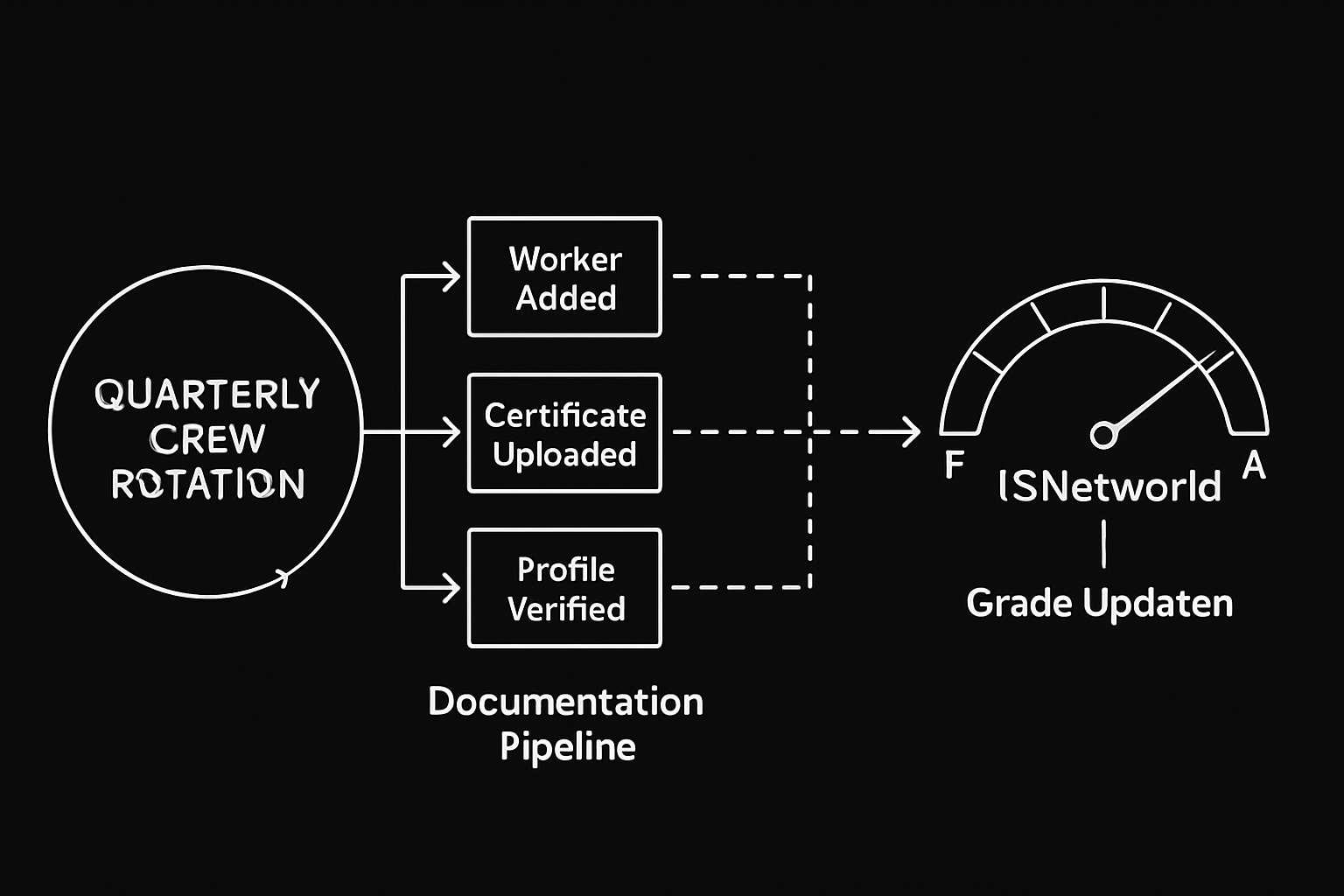
The training is usually happening. The problem is the lag between when training occurs and when it appears in ISNetworld — and that lag expands every time a crew rotates. The documentation pipeline has to be shorter than the turnover cycle. That means:
- New worker profiles in ISNetworld built within 48 hours of mobilization — not at end of month
- Training certificates uploaded the same day they're issued, not held in a folder for batch processing
- Written programs reviewed and re-attested on a calendar trigger, not when someone notices they're expiring
- A single owner for ISNetworld compliance — not "whoever has time this week"
- Staffing agency documentation requirements spelled out in the subcontractor agreement, not chased after the fact
Most drilling and well servicing contractors manage this with one safety coordinator who also does everything else. The documentation falls behind not because anyone is careless, but because there are only so many hours before the next morning safety meeting.
FAQ
How often does ISNetworld check training documentation for individual workers?
ISNetworld continuously tracks document expiration dates against your worker profiles. When a certificate expires or a new worker is added without required documentation, it affects your score in real time — not just at annual review. Operators can pull your grade at any point, which means the window between "crew changed" and "documentation updated" is exactly the window your grade is exposed.
What happens to an ISNetworld grade when a crew rotates mid-project?
If incoming workers are added to your ISNetworld account without matching, current training documentation, those profiles create open compliance gaps. The grade drops proportionally to the number and severity of those gaps. In upstream oil and gas, where operators often set minimum grade thresholds for mobilization approval, even a temporary grade drop can pause work or delay the next contract award.
Does ISNetworld care who did the training, or just that it happened?
Both. The training has to meet the hiring client's approved provider list — in many upstream oil and gas accounts, that means specific H2S certification providers, specific OSHA card formats, or operator-specific orientation records. A training certificate from a non-approved provider gets flagged the same as a missing certificate. This is one of the most common surprises contractors face when onboarding workers sourced from other basins.
Can a subcontractor's missing documentation affect the prime contractor's ISNetworld grade?
Yes. If your account structure includes subcontractors or if you're responsible for managing their compliance documentation under the operator's program, gaps in their records can roll up to your grade. This is particularly common in pipeline construction, where multiple specialty subcontractors — welding crews, coating applicators, hydrotesting teams — cycle through under the prime.
If This Is Eating Your Time, We'll Take It Off Your Plate
EHS, Inc. manages ISNetworld compliance, training documentation, OSHA recordkeeping, and written programs for oil and gas contractors — completely handled, so your safety coordinator can be on-site instead of chasing certificates. If your grade moves every time your crew does, that's a documentation pipeline problem, and it's fixable.
AW
Aaron West
Founder, EHS, Inc. — 18+ years in EHS compliance and contractor safety
Aaron West has spent over 18 years helping contractors and businesses navigate OSHA compliance, ISNetworld® certification, and workplace safety management. He founded EHS, Inc. to make enterprise-level EHS accessible to companies of all sizes — serving contractors and businesses nationwide — without long-term contracts or enterprise overhead.
Ready to simplify your EHS compliance?
Our team handles the complexity so you can focus on running your business. No long-term contracts, no learning curve.
Talk to EHSRelated Articles
Your Avetta Score After Winning a Large Public Contract
Winning a large public contract can crater your Avetta score overnight — here's what that costs and how to stop it.
ISNetworld Grade Drop: When Insurance Limits Fall Short
Your ISNetworld grade can crater overnight when your renewed policy carries lower limits than your operator contract requires — here's exactly how it happens.
Avetta Score After a New Contract Win: What Changes and Why
Winning a new utility contract can silently tank your Avetta score — here's what in-house safety managers miss until the damage is done.
Medium & Enterprise
Safety Culture System
Framework to achieve zero incidents
Get Free System →
Small Businesses
50+ Safety Topics
Stop hitting paywalls
Get Free Topics →
All Companies
Audio Safety Topics
54 topics in English & Spanish
Get Free Audio →