Custom Leading Indicators for a 200-Person Operation
Learn which custom leading indicators actually matter at a 200-person operation — and how to track them before incidents happen.
Custom Leading Indicators: What to Track Before Incidents Happen at a 200-Person Operation
If you're managing safety at a company with around 200 employees, you already know the difference between custom leading indicators and lagging ones — but knowing the difference and actually building a system around leading data are two very different things. Recordable rates and DART numbers tell you what already went wrong. Leading indicators tell you where things are heading. At a 200-person operation, that distinction can shape your entire safety culture.
Why Generic Leading Indicators Usually Fall Flat
Most safety resources hand you a standard list: near-miss reports submitted, toolbox talks completed, inspections conducted. These aren't bad metrics — but they're not built for your operation. A fabrication shop running two shifts with a mix of tenured welders and newer helpers has a very different risk profile than a roofing contractor with five crews spread across three counties.
Generic leading indicators measure activity. Custom leading indicators measure your risk exposure. That's the shift worth making.
A Real Scenario: The Crew That Looked Fine on Paper
Consider a 210-person utility contractor. Their safety numbers looked solid — low recordable rate, inspections happening on schedule, training completions at 94%. But one supervisor kept having the same three guys show up to pre-job briefings without their PPE. Every time, the fix was the same: loan them gear, note it in a logbook, move on.
Nobody was tracking that pattern as a data point. It wasn't connected to anything. Six months later, two of those three workers were involved in separate hand injuries — different jobs, same department, same supervisor.
The behavior was visible long before the incidents. But no one had designed a system to surface it.
What Custom Leading Indicators Actually Look Like
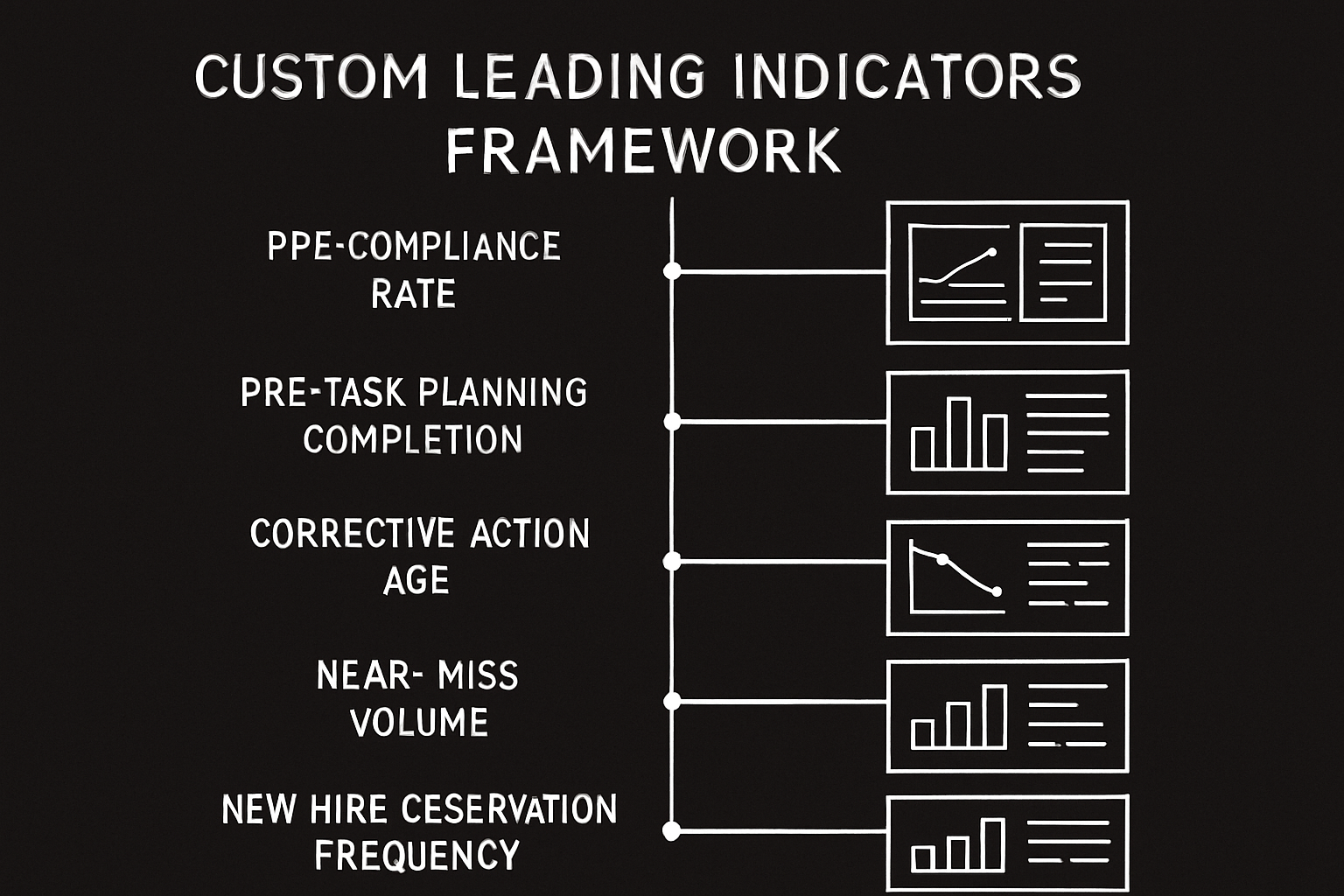
Here's a practical framework for a 200-person operation. These aren't universal — they're starting points you adapt to your specific work:
- PPE compliance rate by crew or supervisor — not company-wide, but at the crew level, where behavioral patterns actually live
- Pre-task planning completion rate — are crews filling out JSAs or just signing them? Track who's doing them versus who's skipping the conversation
- Corrective action close-out rate — how long are open hazards sitting unresolved? Aging action items are a real leading indicator of drift
- Near-miss report volume by department — a sudden drop in near-miss reports is often a culture signal, not a safety improvement
- New hire observation frequency — workers in their first 90 days carry elevated risk; are they being checked on at a higher rate?
- Equipment pre-use inspection completion — not just "was the form submitted" but "was it submitted before work started"
Notice that each of these is measurable, specific, and tied to a behavior your team can actually influence.
How to Build the Tracking System Without Drowning in It
The biggest mistake mid-size operations make is trying to track too many things at once. Start with three to five custom indicators that directly map to your highest-risk exposures. Review them monthly at minimum — weekly if you're in a high-hazard environment.
Assign ownership. Someone should be accountable for each indicator — not just "EHS" as a department, but a named person. If nobody owns it, nobody watches it.
And connect the data to conversation. Numbers that only live in a spreadsheet don't change culture. Bring your leading indicator results into supervisor meetings, crew briefings, and management reviews. When front-line supervisors understand what you're measuring and why, they start paying attention to it differently.
OSHA's guidance on injury and illness prevention programs reinforces this approach — proactive hazard identification and correction is consistently associated with lower incident rates across industries. You can review that framework at osha.gov/safety-management.
The Work Comp and Culture Payoff
When you shift your safety program toward custom leading indicators, two things tend to happen over time. First, your incident frequency drops — not because you got lucky, but because you're catching drift earlier. Second, your work comp experience modifier starts to reflect that improvement, which has real premium implications for a 200-person operation.
Customers and insurers increasingly want to see how you manage safety proactively, not just what your recordable rate was last year. A well-documented leading indicator program is the kind of evidence that builds long-term credibility with both.
FAQ: Custom Leading Indicators for Mid-Size Operations
What's the difference between a leading indicator and a lagging indicator?
A lagging indicator measures outcomes that have already occurred — recordable injuries, lost-time cases, near-misses. A leading indicator measures behaviors and conditions upstream of those outcomes, giving you a chance to intervene before something happens.
How many leading indicators should a 200-person operation track?
Most operations do well starting with three to five indicators tied to their highest-risk work types. More than that becomes difficult to sustain and dilutes focus. Quality and consistency of tracking matters more than volume.
How do you get supervisors to actually use leading indicator data?
The most effective approach is to involve supervisors in choosing the indicators in the first place. When they've had input on what gets tracked and understand why it matters, compliance and engagement follow naturally.
Can leading indicators help with work comp premiums?
Typically, yes. A consistent track record of proactive safety management — documented through leading indicator data — can support lower experience modifier rates over time and strengthen your position during insurance reviews.
Do I need special software to track leading indicators?
Not necessarily to start. A simple spreadsheet with consistent weekly inputs can work. That said, as your operation scales or spreads across sites, automated reminders, digital inspections, and centralized reporting become significantly easier to manage through purpose-built tools.
A Good Next Step
If you're building or rebuilding your safety culture system and want a practical framework to work from, the Awesome Safety Culture System is a free download we put together for exactly this kind of work. It's the kind of resource worth having on hand when you're thinking through how to structure data, accountability, and culture at a mid-size operation.
AW
Aaron West
Founder, EHS, Inc. — 18+ years in EHS compliance and contractor safety
Aaron West has spent over 18 years helping contractors and businesses navigate OSHA compliance, ISNetworld® certification, and workplace safety management. He founded EHS, Inc. to make enterprise-level EHS accessible to companies of all sizes — serving contractors and businesses nationwide — without long-term contracts or enterprise overhead.
Ready to simplify your EHS compliance?
Our team handles the complexity so you can focus on running your business. No long-term contracts, no learning curve.
Talk to EHSRelated Articles
MOC as a Pre-SIF Control: What Failure Looks Like Before the Report
MOC failures don't start with the incident — they start with the change nobody logged. Here's what that looks like at a refinery turnaround.
Lean Safety Staffing and SIF Exposure in Refinery Turnarounds
When headcount drops during a turnaround, critical control ownership doesn't disappear — it just becomes nobody's job.
ISO 14001 and Safety Integration: What Separate Systems Cost You
Running ISO 14001 and your safety program as separate systems isn't just inefficient — it has a specific dollar cost. Here's what it is.
Medium & Enterprise
Safety Culture System
Framework to achieve zero incidents
Get Free System →
Small Businesses
50+ Safety Topics
Stop hitting paywalls
Get Free Topics →
All Companies
Audio Safety Topics
54 topics in English & Spanish
Get Free Audio →