Avetta Audit Prep: What Contractors Get Dinged For in 2026
Utility contractors keep failing Avetta audits for the same reasons — and most in-house safety managers never see it coming.
Avetta Audit Prep: What Utility Contractors Actually Get Dinged For in 2026
Most in-house safety managers at electrical T&D and gas distribution companies prep for Avetta audits by pulling up the standard, checking their written programs against the checklist, and calling it done. The programs look clean. The binders are organized. And then the audit score comes back and something got dinged that wasn't even on their radar.
That gap — between what the standard says and what auditors actually flag — is almost always where contractors lose prequalification grades, delay contract awards, and get locked out of work they've already bid. This isn't a document problem. It's a field problem that people are trying to solve at a desk.
The Written Program That Doesn't Match What the Crew Is Actually Doing
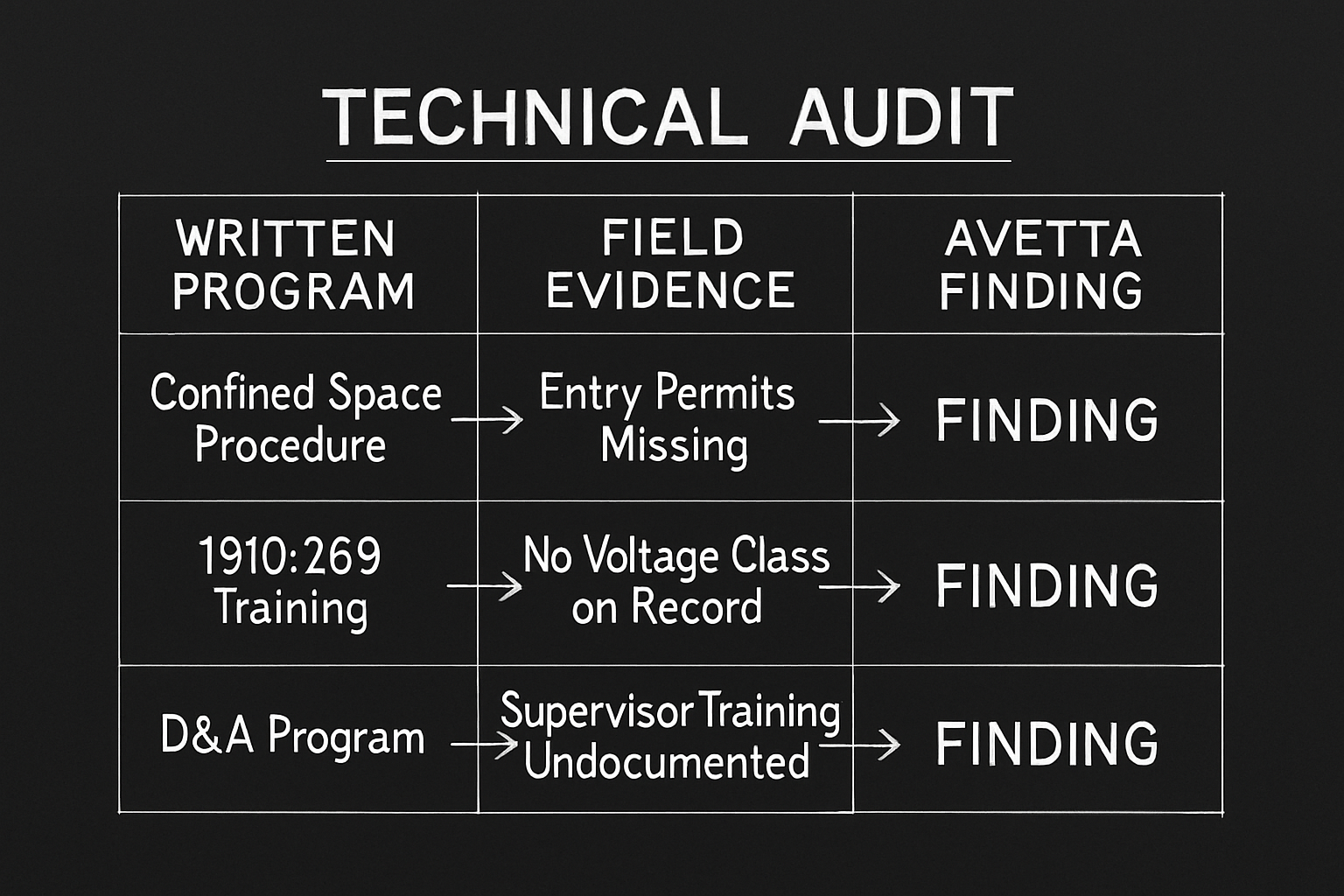
Here's the version of this that plays out on gas distribution crews constantly: the safety manager wrote a confined space program that references atmospheric monitoring with a 4-gas meter before entry into vaults. The program is current, signed, and uploaded to Avetta. The competent person on the crew has been doing vault work for 11 years and uses a single-gas CO monitor because "it's always been fine."
The written program says one thing. The field says another. Avetta's auditor doesn't just review the document — they ask for records. Training sign-offs, equipment inspection logs, completed entry permits. When the permits don't match the procedure, that's a finding. When the training records show the competent person was never verified on the 4-gas meter specified in the program, that's another finding.
Two findings like that, and the contractor's Avetta score drops. The utility client sees it before the next contract cycle. The phone call you get is not a good one.
The Counterintuitive One: Your OSHA 300 Log Is Working Against You
Most safety coordinators assume a clean 300 log — low recordable count, no fatalities, nothing alarming — is an asset going into an Avetta audit. The real problem is that a suspiciously clean log on a crew running energized T&D work raises flags, not confidence.
Avetta's auditors are experienced enough to know what exposure looks like for linemen working distribution lines and underground gas crews doing hot tap work. If your crew ran 40,000 man-hours last year on energized infrastructure and reported two recordables with zero near-misses, that's not a safe crew — that's a crew that isn't reporting. The near-miss reporting gap reads as a culture problem, not a safety success. Auditors note it. Clients notice it.
The OSHA 300 log is a lagging indicator. What Avetta increasingly wants to see is evidence that you're running a program that catches problems before they become recordables — toolbox talk logs with actual sign-offs, JHA completion records before new tasks, documented safety observations. If those don't exist, a clean 300 log tells the wrong story.
Training Records That Technically Exist But Don't Hold Up
An electrical T&D contractor gets flagged on their Avetta audit because their qualified electrical worker training records don't include the specific voltage class the crew works. The LMS shows completion. The certificate exists. But OSHA 1910.269 requires training be documented to the specific voltages, equipment types, and tasks — and the generic "electrical safety" course the safety manager loaded into the system doesn't meet that bar.
This comes up constantly in utility work and it's expensive to miss. OSHA serious violations run up to $16,131 per instance. Willful or repeat violations hit up to $161,323. But the Avetta consequence often lands first — a downgraded prequalification score means the contractor doesn't make the approved vendor list for the next transmission project, and that contract gap costs more than any single citation.
The fix isn't more training — it's training that documents the right specifics. Qualified person status under 1910.269 is task- and voltage-specific. The records have to reflect that. Most off-the-shelf LMS content doesn't, and most safety managers don't catch it until an auditor does.
Drug and Alcohol Program Documentation Gaps
For utility contractors working under DOT or client-mandated programs, Avetta auditors pull the drug and alcohol program and check for specific elements: random testing rates, who administers the program, what the MRO process is, and whether supervisors have completed reasonable suspicion training. Supervisor reasonable suspicion training — with documented completion, not just a policy that says supervisors should do it — gets missed more than almost anything else.
A foreman on a gas distribution crew supervises five people. He's been with the company eight years. Nobody ever got him through the required 60-minute reasonable suspicion training. The policy exists. The training didn't happen. That's a finding.
What the Audit Actually Tests
Avetta's prequalification process isn't checking whether you have programs — it's checking whether your programs are real. The difference is evidence: records that show the program runs in the field, not just in the binder. For more on what Avetta evaluates, Avetta's resource library outlines the framework, but the gap between the framework and a passing audit score is always in the documentation.
The contractors who hold strong Avetta scores consistently — and who don't scramble every audit cycle — are running systems that generate evidence automatically. Inspection records, training completions, corrective action close-outs. Not because an audit is coming. Because the system runs that way every week.
How EHS, Inc. Helps Utility Contractors Stay Audit-Ready
At EHS, Inc., we work with electrical T&D and gas distribution contractors to build the documentation infrastructure that holds up when an Avetta auditor is in the room. That means written programs that match field practice, training records that document the right specifics, and leading indicator data that tells the story your lagging numbers can't.
AW
Aaron West
Founder, EHS, Inc. — 18+ years in EHS compliance and contractor safety
Aaron West has spent over 18 years helping contractors and businesses navigate OSHA compliance, ISNetworld® certification, and workplace safety management. He founded EHS, Inc. to make enterprise-level EHS accessible to companies of all sizes — serving contractors and businesses nationwide — without long-term contracts or enterprise overhead.
Ready to simplify your EHS compliance?
Our team handles the complexity so you can focus on running your business. No long-term contracts, no learning curve.
Talk to EHSRelated Articles
Your Avetta Score After Winning a Large Public Contract
Winning a large public contract can crater your Avetta score overnight — here's what that costs and how to stop it.
ISNetworld Grade Drop: When Insurance Limits Fall Short
Your ISNetworld grade can crater overnight when your renewed policy carries lower limits than your operator contract requires — here's exactly how it happens.
Avetta Score After a New Contract Win: What Changes and Why
Winning a new utility contract can silently tank your Avetta score — here's what in-house safety managers miss until the damage is done.
Medium & Enterprise
Safety Culture System
Framework to achieve zero incidents
Get Free System →
Small Businesses
50+ Safety Topics
Stop hitting paywalls
Get Free Topics →
All Companies
Audio Safety Topics
54 topics in English & Spanish
Get Free Audio →