Why Your Foreman Gets Blamed When Training Was Never Updated
Most incident investigations stop at operator error. The real failure happened six months earlier in the office.
Why Your Foreman Gets Blamed When Training Was Never Updated
A foreman skips the lockout step. An operator bypasses a guard. A crew lead signs off on a confined space entry without atmospheric testing. The incident report writes itself: "failure to follow procedure." Case closed.
Except the procedure referenced a piece of equipment that was replaced four months ago. And the training module still shows the old system. And the competent person certification expired in January but nobody's calendar flagged it.
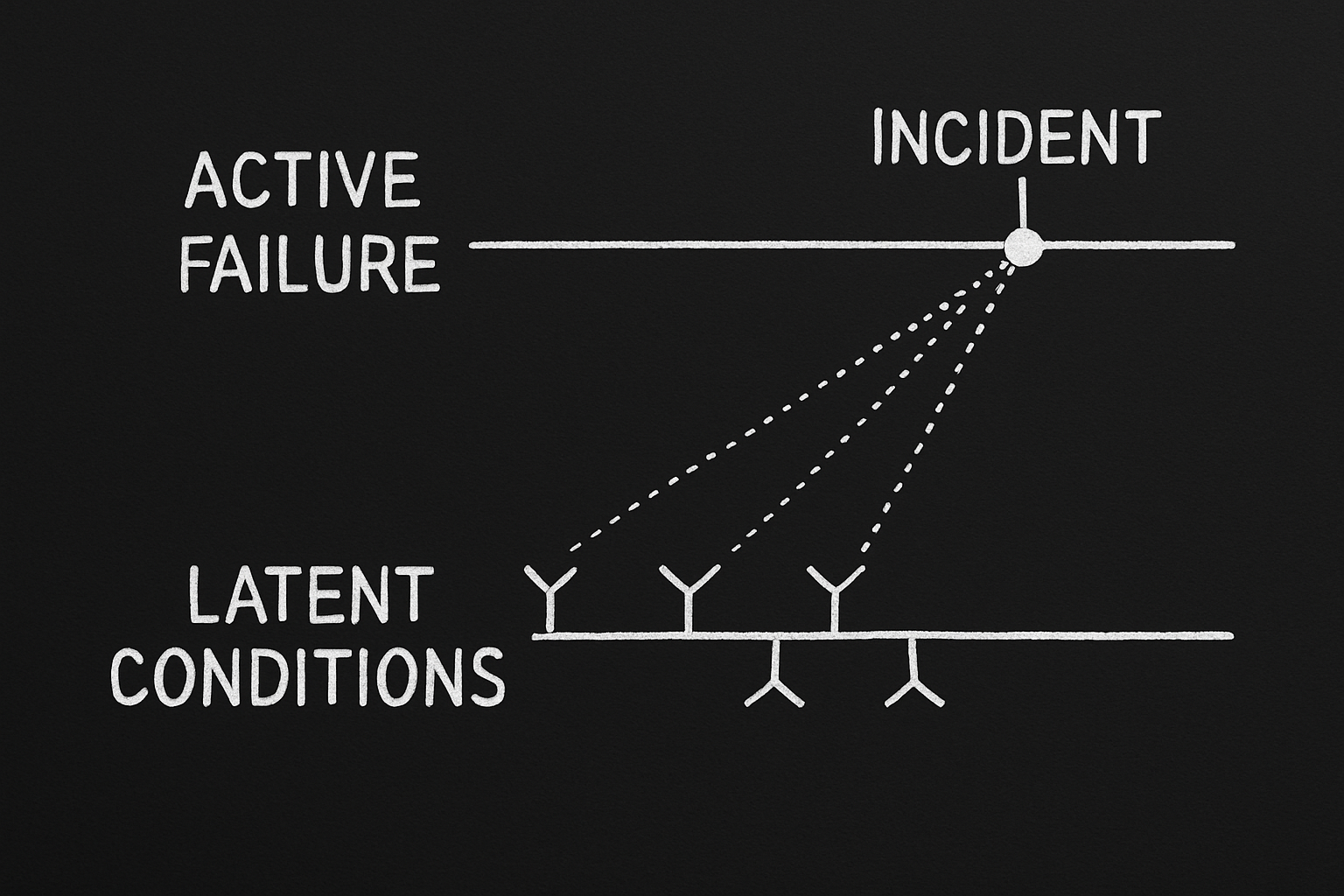
This is the gap most companies never investigate: the difference between the active failure—what the worker did wrong—and the latent condition that made that failure inevitable.
The Failure Mode Nobody Documents
Here's what actually happened on a site in Odessa last year:
A journeyman electrician was seriously injured working on a panel that should have been de-energized. The initial report blamed him for not testing before touching. Fair enough. But the investigation stopped there.
What they didn't document: the LOTO procedure for that panel was written in 2019 for the original installation. The panel was upgraded in 2023. The new configuration required three lockout points instead of two. But nobody updated the written procedure. Nobody revised the training. The foreman who supervised the work had been through LOTO training that still referenced the old setup.
The electrician wasn't reckless. He followed a procedure that was three years out of date. That's not an active failure. That's a latent condition that sat in your safety management system waiting for someone to get hurt.
Why Supervisors Become Scapegoats
When you don't trace incidents back to latent conditions, the investigation defaults to the most visible person in the chain. That's almost always the foreman, crew lead, or front-line supervisor.
They're the ones who signed the permit. They're the ones who were on site. They're the ones who "should have known better."
But if your JSA template hasn't been revised since 2021, if your equipment inventory in the safety software doesn't match what's actually in the yard, if your competent person list includes two people who quit last summer—your foreman never had a chance. You built a system designed to fail and then blamed the person working inside it.
The Question That Changes Everything
Here's the question most companies never ask during an incident investigation:
"What organizational failure made this individual failure possible?"
Not: "Why didn't they follow the procedure?"
But: "Why was the procedure wrong, outdated, or impossible to follow correctly?"
Not: "Why didn't the supervisor catch this?"
But: "What system failure prevented the supervisor from having accurate information?"
This isn't about removing accountability from workers. It's about expanding accountability to the people who design, maintain, and update the systems workers rely on.
What Latent Conditions Actually Look Like
If you've never actively looked for latent conditions, here's what to hunt for in your next investigation:
- Procedures that reference equipment, tools, or controls that no longer exist on site
- Training materials that haven't been updated after process changes, new hires in leadership, or regulatory updates
- Permit templates with fields that don't match current operational reality
- Competent person rosters that include people who've been promoted, transferred, or terminated
- Software systems where the data hasn't been validated in over six months
- Communication gaps between procurement, operations, and safety when equipment changes
Every single one of these is a ticking time bomb. And every single one gets created in an office, not on a job site.
How to Investigate for Latent Conditions
Add these steps to your next incident investigation:
Step 1: Pull the written procedure the worker was supposed to follow. Walk the actual task with that procedure in hand. Does it match reality?
Step 2: Check the revision date on every document referenced in the investigation—permits, JSAs, SOPs, training records. If anything is older than your last equipment change or site modification, you've found a latent condition.
Step 3: Interview the supervisor about their last training refresh. If they can't remember it or if it happened more than a year ago, that's your answer.
Step 4: Ask the injured worker what they were taught versus what they were expected to do. The gap between those two things is where your liability lives.
Frequently Asked Questions
What's the difference between a latent condition and a root cause?
A root cause is the fundamental reason an incident occurred. A latent condition is a pre-existing weakness in your system that allowed the root cause to result in an actual incident. Root cause might be "inadequate training." Latent condition is "training materials not updated after equipment change."
Does focusing on latent conditions mean workers aren't accountable?
No. Workers are still accountable for willful violations and reckless behavior. But if your procedures, training, and systems set them up to fail, that accountability belongs higher up the chain. Latent condition investigations expand accountability, they don't eliminate it.
How far back should we look for latent conditions?
Look back to the last time the task, equipment, or environment changed in any meaningful way. If you upgraded equipment, changed a supplier, hired new leadership, or revised a process—that's your starting point. Latent conditions often originate at transition points.
Can latent conditions be found before an incident happens?
Yes. Audit your procedures against current site conditions quarterly. Compare training content to actual operational steps. Verify competent person lists monthly. Latent conditions are invisible until you go looking for them—but they're always there.
Stop Blaming the Last Person to Touch It
If your incident investigations keep landing on "operator error" or "supervisor negligence," you're not investigating—you're scapegoating. The real failure happened weeks or months earlier, in an office, when someone didn't update a document, didn't revise a training, didn't sync the software with the site.
Your foreman didn't fail you. Your system did.
If you're tired of playing investigator after the fact and want to fix the conditions before someone gets hurt, Talk to EHS. We'll help you find the gaps you didn't know were there.
AW
Aaron West
Founder, EHS, Inc. — 18+ years in EHS compliance and contractor safety
Aaron West has spent over 18 years helping contractors and businesses navigate OSHA compliance, ISNetworld® certification, and workplace safety management. He founded EHS, Inc. to make enterprise-level EHS accessible to companies of all sizes — serving contractors and businesses nationwide — without long-term contracts or enterprise overhead.
Ready to simplify your EHS compliance?
Our team handles the complexity so you can focus on running your business. No long-term contracts, no learning curve.
Talk to EHSRelated Articles
EMR as an Executive Risk Signal: What the Number Tells Leadership
Your EMR isn't just an insurance number — for utility contractors, it's the signal executives see before the next incident happens.
BBS Observation Data: When Rates Stay High but Incidents Don't Drop
High BBS observation rates with flat incident numbers aren't a paradox — in manufacturing, they're usually a turnover problem wearing a data mask.
How HOP Learning Teams Surface Leading Indicators BBS Misses
BBS programs count behaviors. HOP learning teams find the conditions that make those behaviors inevitable — and that's where your leading indicators actually live.
Medium & Enterprise
Safety Culture System
Framework to achieve zero incidents
Get Free System →
Small Businesses
50+ Safety Topics
Stop hitting paywalls
Get Free Topics →
All Companies
Audio Safety Topics
54 topics in English & Spanish
Get Free Audio →