What an Avetta Audit Failure Actually Costs a Utility Contractor
Avetta audit failures cost utility contractors far more than a bad grade — here's what in-house safety managers consistently get wrong.
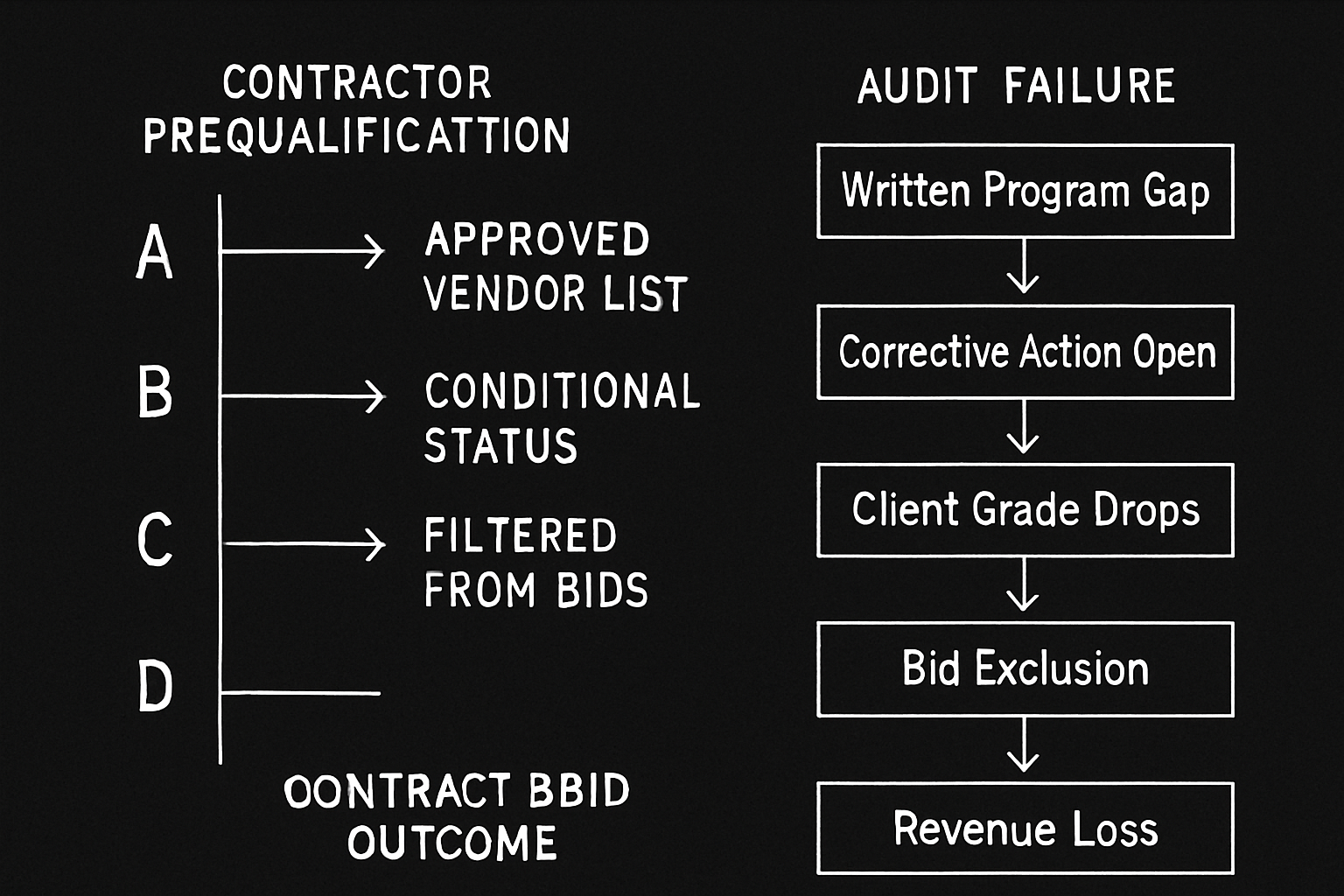
What an Avetta Audit Failure Actually Costs a Contractor in Lost Contract Revenue
An electrical T&D contractor loses their Avetta prequalification grade on a Thursday. By Monday morning, a utility client has already flagged the account and pulled them from an upcoming distribution line upgrade project. The project was worth $2.1 million. The safety coordinator found out when the project manager stopped getting emails returned.
That is not a hypothetical. That is what an Avetta audit failure actually looks like in the utility contracting world — and the cost is not a fine. There is no OSHA citation attached to it. The revenue just disappears, quietly, and the company spends the next six months trying to figure out why they keep losing bids they should be winning.
The In-House Safety Manager Problem Nobody Wants to Say Out Loud
Most in-house safety managers at utility contractors learned compliance from the standard. They read the OSHA 1910 and 1926 general industry and construction rules. Some of them have their CHST or ASP. They know what the written program is supposed to say. What they have never done is sit across from an Avetta auditor who is specifically looking for the gap between what the written program says and what the gas distribution crews are actually doing at 6 AM on a right-of-way job.
Most safety coordinators assume the biggest audit risk is a missing written program — but the real problem is that their written programs were built for the standard, not for the work. A confined space entry program that doesn't account for the specific atmospheric hazards in a gas distribution vault is technically compliant and operationally useless. Avetta's auditors are not grading your formatting. They are grading whether your program matches your actual scope of work.
Utility work has a specific hazard profile: energized conductors, excavation in congested ROW, atmospheric monitoring in gas distribution vaults, and crew compositions that change week to week based on subcontract relationships. A safety manager who built their program from a template — even a good one — has almost certainly left gaps that a prequalification auditor will find before the next bid cycle does.
What the Avetta Grade Actually Affects
Avetta's scoring system directly influences whether a utility client — think investor-owned utilities, municipal co-ops, or large gas distribution operators — will allow a contractor on their approved vendor list. A grade drop from an "A" to a "C" does not mean a contractor gets a warning. It means the client's procurement team filters them out before the RFP even lands.
For an electrical T&D contractor running 40-person crews on substation and overhead line work, that filtering is not recoverable in a week. The re-audit cycle, the corrective action documentation, the back-and-forth with Avetta's support team — realistically, that takes 60 to 90 days. During which time the contractor is not on bid lists. Projects that were in the pipeline get awarded to someone else. That revenue does not come back.
Add to that the downstream effect on EMR. If the audit failure surfaced a recordkeeping gap — say, a safety coordinator who classified a lineman's rotator cuff surgery as first aid because they misread the medical treatment threshold — that incident may need to be reclassified on the OSHA 300 log. A single reclassification can move an EMR enough to push a contractor out of eligibility for clients who require an EMR below 1.0. OSHA serious violation penalties run up to $16,131 per citation. Willful or repeat violations go up to $161,323. But those are almost secondary — the contract loss is what actually shuts the company down.
The Specific Mistakes That Trigger Avetta Failures in Utility Work
- OSHA 1910.269 coverage gaps. Electric power generation, transmission, and distribution work falls under 1910.269, not just 1926 construction. In-house safety managers who built their programs primarily from 1926 subpart V leave documented gaps that Avetta auditors flag immediately.
- Subcontractor management documentation. A general contractor running T&D crews often subs out specific tasks — underground locating, vegetation management, equipment operators. Avetta wants to see that those subcontractors are prequalified too. Most safety coordinators are managing their own documentation and have never touched their subs' Avetta profiles.
- Competent person designations that exist only on paper. The excavation competent person on the job site is whoever showed up that morning. The name on the form is someone who hasn't been on a gas distribution crew in two years. Avetta's auditors ask for competent person records by name and by job type. When those records don't match current crew assignments, it's a finding.
- Training records tied to workers who left. High turnover in electrical and gas crews means training completion records get stale fast. If 30% of your current workforce isn't in the LMS yet, the audit will surface it.
A Real Scenario — Because "Generic Examples" Don't Help Anyone
A gas distribution contractor operating in the Midwest — roughly 85 field employees running service line replacement and main extension work — went through their annual Avetta audit and came out with a corrective action on atmospheric testing documentation. Their competent persons were trained. Their equipment was calibrated. But the safety coordinator had built the written program around OSHA 1910.146 permit-required confined space entry language, and the auditor flagged that gas distribution vault entries under their specific utility client's requirements needed to reference API and utility-specific protocols, not just OSHA minimums.
That corrective action sat open for 47 days while the safety coordinator tried to rewrite the program in-house. During those 47 days, the utility client's procurement team placed the contractor in "conditional" status. Two service territory bids went out during that window. They were not invited to quote either one.
FAQ
What triggers an Avetta audit failure for a utility contractor?
Common triggers include missing or incomplete written safety programs, OSHA 300 log discrepancies, expired training records for field workers, unresolved corrective actions from prior audits, and subcontractor management gaps. For utility contractors specifically, 1910.269 compliance documentation and competent person records are frequent audit findings.
How long does it take to recover from an Avetta grade drop?
Realistically, 60 to 90 days from the time corrective actions are submitted and verified. During that window, most utility clients will not include the contractor in active bid processes. Revenue impact depends on project pipeline — for contractors with active utility client relationships, a single cycle can represent several million dollars in lost opportunity.
Can a contractor dispute an Avetta audit finding?
Yes, but the documentation burden is on the contractor. Disputes require written evidence that the finding was inaccurate, which means having audit-ready records in the first place. Most disputes take longer than simply correcting the gap — which is why pre-audit readiness matters far more than post-audit response speed.
Does Avetta share audit results with utility clients directly?
Yes. That is the point of the platform. Utility clients log in and see contractor grades in real time. A grade change is visible to every client that has connected with that contractor on the platform — simultaneously. There is no grace period and no notification before the grade appears.
The Fix Is Not Another Written Program
The contractors who stay off the corrective action list are not the ones with the most comprehensive safety manuals. They are the ones who have someone actively managing the prequalification profile year-round — updating training records as crews turn over, tracking document expiration dates, making sure the written programs match the actual scope of work, not a generic template from five years ago.
That is exactly what EHS, Inc. does. We manage Avetta and ISNetworld prequalification, maintain written programs specific to utility and electrical T&D work, and keep training records current so audit season is not a fire drill.
Find out if your company qualifies — take the free 2-minute Avetta & ISNetworld Readiness Check at ehs.inc/qualify.
For more on Avetta's contractor requirements, see Avetta's official contractor resources.
AW
Aaron West
Founder, EHS, Inc. — 18+ years in EHS compliance and contractor safety
Aaron West has spent over 18 years helping contractors and businesses navigate OSHA compliance, ISNetworld® certification, and workplace safety management. He founded EHS, Inc. to make enterprise-level EHS accessible to companies of all sizes — serving contractors and businesses nationwide — without long-term contracts or enterprise overhead.
Ready to simplify your EHS compliance?
Our team handles the complexity so you can focus on running your business. No long-term contracts, no learning curve.
Talk to EHSRelated Articles
Your Avetta Score After Winning a Large Public Contract
Winning a large public contract can crater your Avetta score overnight — here's what that costs and how to stop it.
ISNetworld Grade Drop: When Insurance Limits Fall Short
Your ISNetworld grade can crater overnight when your renewed policy carries lower limits than your operator contract requires — here's exactly how it happens.
Avetta Score After a New Contract Win: What Changes and Why
Winning a new utility contract can silently tank your Avetta score — here's what in-house safety managers miss until the damage is done.
Medium & Enterprise
Safety Culture System
Framework to achieve zero incidents
Get Free System →
Small Businesses
50+ Safety Topics
Stop hitting paywalls
Get Free Topics →
All Companies
Audio Safety Topics
54 topics in English & Spanish
Get Free Audio →