Your Avetta Score When Your Safety Manager Quits
When your safety manager walks out, your Avetta score doesn't freeze — it starts decaying. Here's exactly what that looks like for a refinery turnaround contractor.
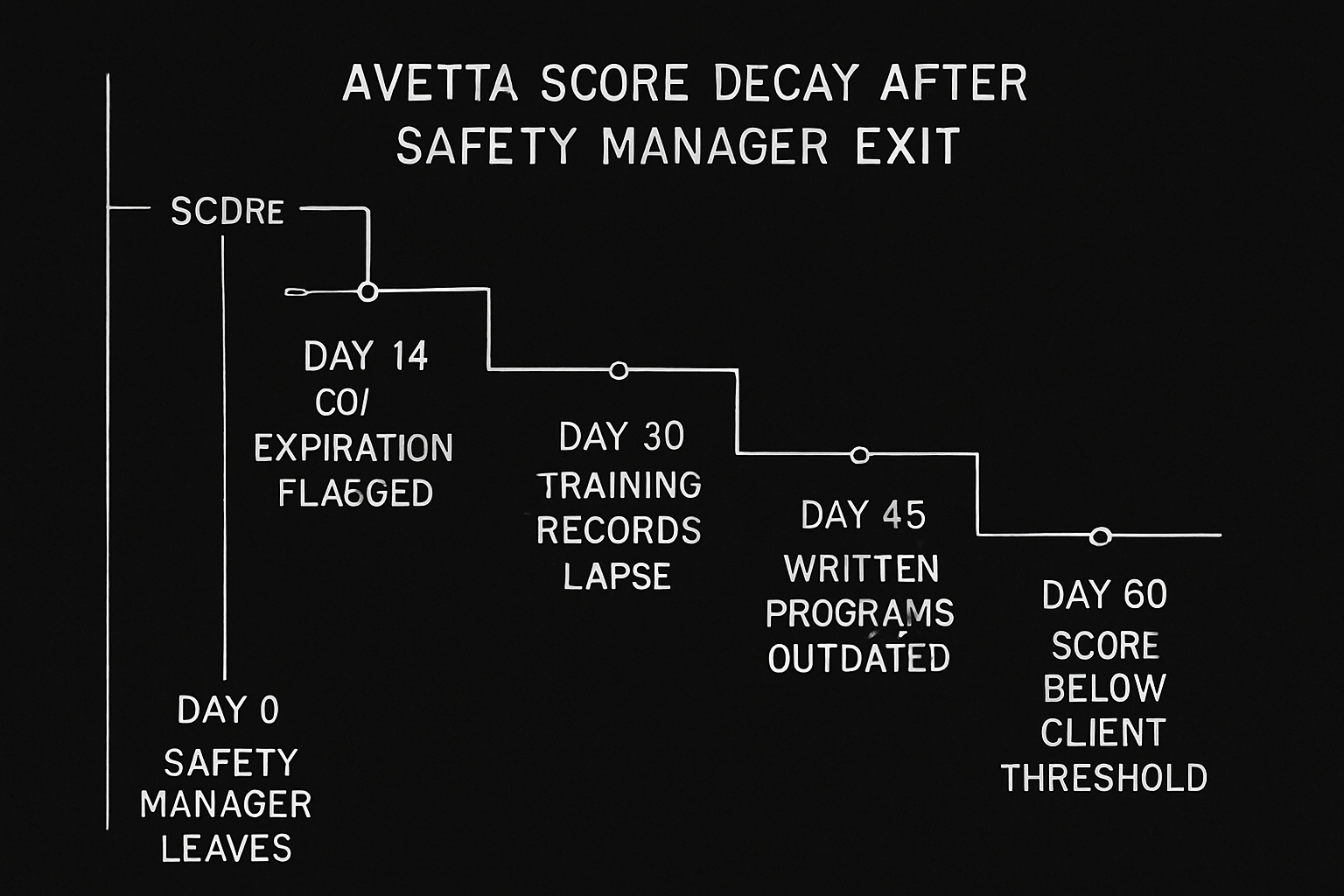
What Happens to Your Avetta Score When Your Safety Manager Leaves and No One Updates the Account
Your safety manager gave two weeks' notice on a Thursday. By Friday afternoon, the turnaround crew was back on-site at the refinery, scaffold erection was underway, and nobody had touched the Avetta portal in three days. That's not a hypothetical. That's the story I hear from industrial maintenance contractors on a pretty regular basis — and the part that hurts isn't the transition period. It's what Avetta does to your score while you're busy trying to keep the job running.
The Account Goes Stale While You're Running a Turnaround
Avetta isn't passive. The platform actively monitors expiration dates on your insurance certificates, EMR documentation, written safety programs, and training records. When a refinery turnaround contractor loses their safety manager — the person who was logging into the portal every few weeks, uploading updated COIs, renewing OSHA 300 log submissions, and keeping the training matrix current — all of that stops. The account doesn't pause. Avetta keeps checking. And when documentation lapses, your score drops.
For an industrial maintenance contractor doing refinery work, that score isn't abstract. Clients on the Avetta network use it as a prequalification filter. A score that falls below a client's threshold doesn't trigger a phone call — it just removes you from consideration. You find out when the bid invitation doesn't come.
The Gap Between Paper and Practice — And Why OSHA Finds It
Here's the counterintuitive part: most safety managers assume that what's in the Avetta portal reflects their actual safety program. The real problem is that the portal reflects what was true when someone last updated it — which is often six to eighteen months ago.
That gap is exactly where OSHA compliance officers look. During a refinery plant shutdown, when you've got maintenance techs working in confined spaces, hot work permits being issued in a blast zone, and scaffolders rigging overhead while pipefitters work below — the written program your Avetta account shows might say one thing, and the field tells a completely different story.
Your Avetta profile might show a current confined space entry program. But if the competent person who ran those entries left with your safety manager — and the new crew lead hasn't been formally designated and documented — you've got a paper program with no execution behind it. OSHA doesn't care that the PDF is uploaded. They want to talk to your competent person on-site. If that person can't demonstrate knowledge of atmospheric testing requirements under 29 CFR 1910.146, the violation is yours regardless of what the portal says.
OSHA serious violations run up to $16,131 per violation. Confined space fatalities at industrial facilities have resulted in willful citations at $161,323 per item. And those numbers don't include the refinery client terminating the contract mid-turnaround — which has happened, and is a different kind of financial event entirely.
What Actually Decays After a Safety Manager Leaves
The checklist of what goes stale is longer than most operations managers expect:
- Insurance certificates — COIs have expiration dates. Avetta flags them. Nobody's renewing them because nobody knows they need to.
- EMR documentation — the current experience modification rate has to be verified annually. A lapsed submission drops your score and can flag you as non-compliant with clients who have EMR thresholds.
- Written program updates — your hot work permit program, LOTO procedures, fall protection plan. If there was a procedure change during the turnaround — new equipment, new scope — and it wasn't reflected in the written program, you've got a Management of Change gap that OSHA will find if they show up.
- Training records — scaffold erectors need documented competency. Maintenance techs running LOTO on process equipment need annual retraining verification. When the person maintaining the LMS walks out, those records stop getting updated.
- Competent person designations — this one gets missed constantly. Avetta clients want to see named, documented competent persons for confined space, excavation, and fall protection. When that person leaves the company, the designation doesn't transfer automatically.
The Scenario That Plays Out at Every Turnaround Shop
A refinery contractor wins a major plant shutdown — twelve weeks, fifty-plus maintenance techs, combination of mechanical and electrical scope. Safety manager handles Avetta, ISNetworld, written programs, toolbox talk documentation, everything. Two months in, the safety manager takes a job at a competing firm offering a $20K bump. The operations manager assumes someone else is handling the compliance portals. Nobody is. Eight weeks later, the COI expires. Avetta flags it. The client's procurement team runs a quarterly compliance check. Your grade is now below their approved-vendor threshold. The renewal conversation goes sideways because procurement doesn't have authority to waive the grade requirement — they just have a policy. You're not getting the next shutdown invitation.
That's not a horror story. That's a Tuesday.
The Fix Isn't Hiring Faster
The instinct is to backfill the role. That takes time — posting, interviewing, onboarding — and in the industrial maintenance world, you might be looking at sixty to ninety days before a new safety manager is fully functional in the role. The Avetta account doesn't wait sixty days. Neither does OSHA if they show up for an inspection during your refinery shutdown scope.
The contractors who don't have this problem aren't the ones with the best hiring processes. They're the ones who stopped treating compliance portal management as an internal function in the first place.
FAQ
How fast does an Avetta score drop after documents expire?
Avetta calculates scores dynamically, so a lapsed insurance certificate or expired safety program can affect your score within days of the expiration date. There's no grace period built into the scoring model — the system flags what it sees in real time.
Can you dispute an Avetta score drop caused by a safety manager transition?
You can contact Avetta support to explain a documentation gap, but the client on the other end of the network sets the compliance threshold. If your score falls below their approved-vendor floor, their procurement system may automatically disqualify you regardless of any explanation you provide.
Does losing Avetta prequalification affect OSHA standing?
Not directly — they're separate systems. But the documentation gaps that drop your Avetta score are often the same ones OSHA finds on-site: outdated written programs, missing competent person designations, lapsed training records. One problem usually signals the other.
What's the minimum someone needs to maintain an Avetta account during a transition?
At minimum: active insurance certificates, current EMR documentation, and updated training records for active employees. In practice, "minimum" isn't a sustainable strategy for refinery turnaround contractors where client requirements run deep.
EHS, Inc. manages Avetta and ISNetworld accounts, written programs, training records, and OSHA documentation as a fully managed service — so a personnel change doesn't create a compliance gap. If you want to know where your account actually stands right now, find out if your company qualifies with our free 2-minute Avetta & ISNetworld Readiness Check.
AW
Aaron West
Founder, EHS, Inc. — 18+ years in EHS compliance and contractor safety
Aaron West has spent over 18 years helping contractors and businesses navigate OSHA compliance, ISNetworld® certification, and workplace safety management. He founded EHS, Inc. to make enterprise-level EHS accessible to companies of all sizes — serving contractors and businesses nationwide — without long-term contracts or enterprise overhead.
Ready to simplify your EHS compliance?
Our team handles the complexity so you can focus on running your business. No long-term contracts, no learning curve.
Talk to EHSRelated Articles
Your Avetta Score After Winning a Large Public Contract
Winning a large public contract can crater your Avetta score overnight — here's what that costs and how to stop it.
ISNetworld Grade Drop: When Insurance Limits Fall Short
Your ISNetworld grade can crater overnight when your renewed policy carries lower limits than your operator contract requires — here's exactly how it happens.
Avetta Score After a New Contract Win: What Changes and Why
Winning a new utility contract can silently tank your Avetta score — here's what in-house safety managers miss until the damage is done.
Medium & Enterprise
Safety Culture System
Framework to achieve zero incidents
Get Free System →
Small Businesses
50+ Safety Topics
Stop hitting paywalls
Get Free Topics →
All Companies
Audio Safety Topics
54 topics in English & Spanish
Get Free Audio →