OSHA Willful Violation Case Study: What Manufacturers Must Know
One willful OSHA violation cost a mid-size manufacturer $145K — and turnover is why no one caught it first.
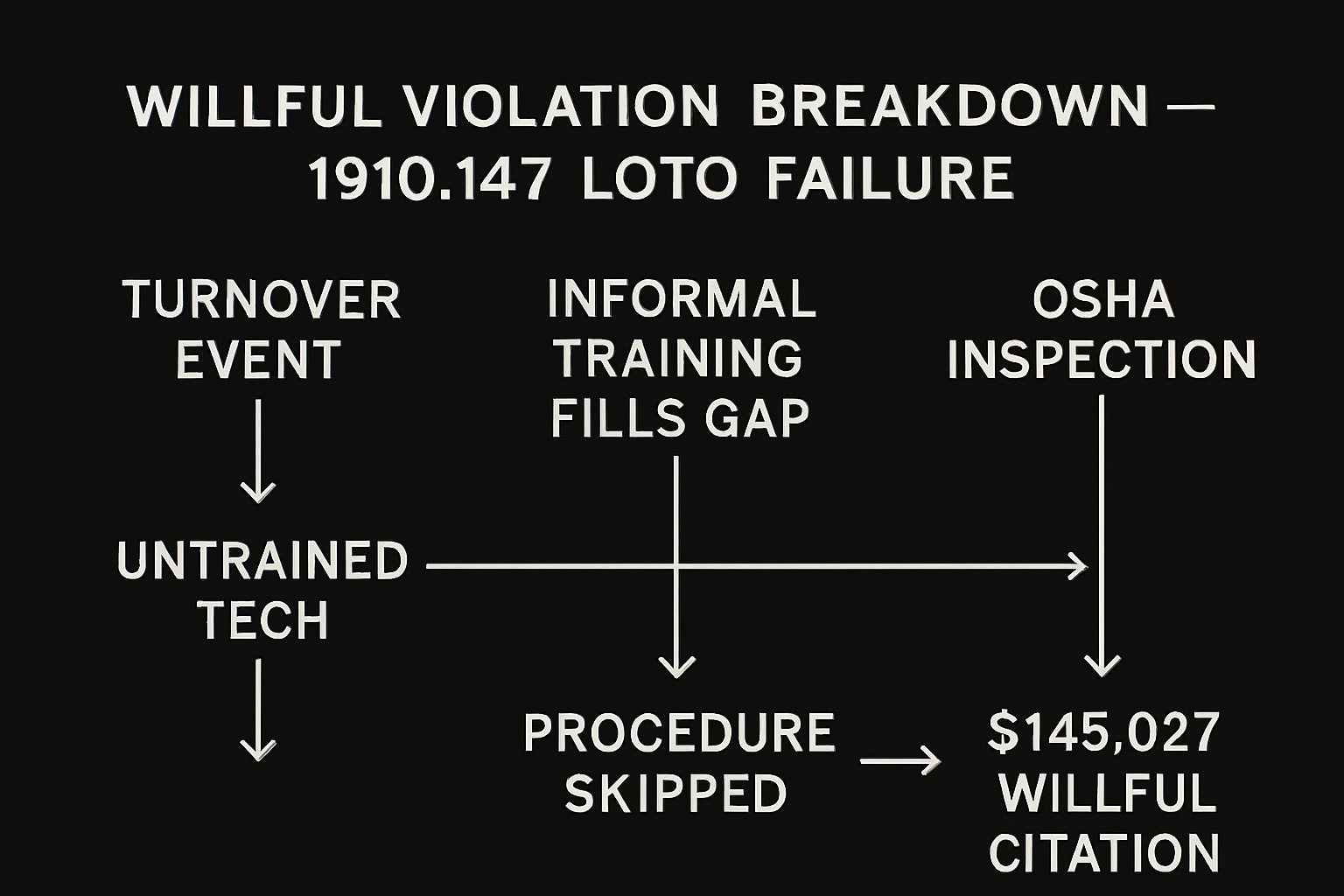
OSHA Enforcement Case Study: How Turnover and Subcontractor Layering Created a Willful Violation — and What Manufacturing Plants Must Do Differently
In 2023, OSHA cited a mid-size metal fabrication plant in Ohio — roughly 180 employees — for willful violations of 29 CFR 1910.147, the Control of Hazardous Energy standard. The penalty came in at $145,027. The plant wasn't run by reckless people. It was run by a safety coordinator who had been in the role for four months, managing a maintenance crew that had turned over almost entirely in the previous year. That's not a footnote — that's the whole story.
What the Violation Actually Was
Maintenance technicians were performing die changeovers on a 200-ton stamping press. The machine required a written lockout/tagout procedure specific to that equipment — energy sources identified, sequence documented, verification steps listed. The procedure existed. It had been written when the plant first opened. The problem: three of the four techs performing the changeover had been hired in the previous eight months and had never been trained on that specific procedure. The fourth tech — the senior guy — had been trained. He was also the one who showed the others "how we do it here," which was faster, involved skipping the stored energy verification step, and had worked fine for years.
That last part is what made it willful. When the OSHA compliance officer asked supervisors whether they were aware that newly hired maintenance techs were performing LOTO procedures without documented machine-specific training, the answer — captured in interview notes — was essentially: "We knew they hadn't been formally trained yet. We were planning to get to it."
Planning to get to it. At up to $161,323 per willful violation, that is an expensive plan.
How Turnover Created the Conditions for This Violation
Here's the counterintuitive part: most safety coordinators assume the risk of turnover is that new hires don't know the rules — but the real problem is that experienced workers teach them the shortcuts instead. Informal training fills every vacuum left by formal training. And in a manufacturing environment with high turnover, the informal curriculum is always faster, always more confident, and always based on "we've never had a problem."
This plant had lost 14 of its 22 production maintenance techs over an 18-month period — a combination of retirements, voluntary separations, and a staffing agency relationship that rotated contract workers through maintenance roles. Each new hire went through a general OSHA 10 orientation. None of them received machine-specific LOTO training documented to the standard OSHA requires under 1910.147(c)(7): authorized employees must be trained on the energy control procedure for each machine they're authorized to service.
The staffing agency relationship added another layer. Two of the four techs on the press that day were employed by the agency, not the plant. The plant's safety coordinator assumed the agency handled their LOTO training. The agency assumed the plant handled machine-specific training. Neither assumption was documented. Neither was correct. OSHA cited the plant — the host employer — because that's where the work happened and that's where the hazard existed.
The Documentation Failure That Made It Worse
When the compliance officer requested training records during the inspection, the safety coordinator pulled up a spreadsheet showing "LOTO training completed" checkboxes next to employee names. What she couldn't produce was any documentation of which procedures each tech had been trained on, who conducted the training, when retraining occurred after a procedure deviation, or how competency was verified beyond the checkbox. Under 1910.147(c)(7)(iv), OSHA requires retraining when there's reason to believe an authorized employee doesn't have the required knowledge or skill. "We were planning to get to it" is not a retraining program.
The citation included three willful items and two serious items. The serious violations — inadequate written procedures and failure to inspect energy control procedures annually — added another $32,262 to the total. The plant also triggered a follow-up programmed inspection 12 months later. They lost two bid opportunities with a Tier 1 automotive supplier during that window because their OSHA 300 log and citation history flagged in the supplier's contractor prequalification system.
What a Plant With High Turnover Has to Do Differently
This is not about adding more training. It's about changing what triggers training and who is responsible for verifying it before work starts.
- Machine-specific LOTO authorization lists: Every press, conveyor, CNC machine, and robotic cell should have a written list of who is currently authorized to perform energy isolation on that equipment. If a name isn't on the list, that person doesn't touch the machine. The list updates every time someone is hired, transferred, or trained — not quarterly, not at the next safety meeting.
- Formal contractor and agency coordination agreements: When a staffing agency places workers in maintenance roles, the host employer needs a written agreement specifying who is responsible for machine-specific LOTO training. "We assumed they handled it" ends careers and costs six figures.
- Competency verification, not just completion: A checkbox that says "LOTO training complete" doesn't satisfy 1910.147. A documented field verification — where a competent person watches the tech perform the lockout procedure on that specific machine and signs off — does. That's not paperwork for OSHA. That's the only thing that actually tells you whether the training worked.
- Onboarding holds for high-hazard tasks: New maintenance techs — whether direct hire or agency — should not be authorized to perform LOTO procedures on any equipment until machine-specific training and competency verification are complete. That's a hard stop, not a "get to it soon" item.
The Subcontractor Layering Problem
Plants that use multi-tier subcontracting — a general contractor managing specialty mechanical subs, who themselves use day-labor crews for turnarounds — face a version of this problem that's geometrically more complicated. The host employer's OSHA obligation doesn't reduce because the worker came from three layers down. If that worker is on your floor, at your equipment, your exposure is real. OSHA's 1910.147 standard doesn't have a subcontractor carve-out.
What plants tend to discover during OSHA inspections — and not before — is that their contractor management process consists of collecting certificates of insurance and maybe a general safety orientation sign-in sheet. That's not a contractor safety program. That's a file folder.
Frequently Asked Questions
What makes an OSHA violation "willful" instead of "serious"?
OSHA classifies a violation as willful when the employer knew the hazardous condition existed and either made no effort to correct it or was intentionally indifferent to the requirement. In the Ohio case, supervisors admitted they knew untrained techs were performing LOTO procedures. That's the definition. Willful penalties run up to $161,323 per violation. Serious violations cap at $16,131. The classification difference is not semantic.
Who is responsible for LOTO training when a staffing agency provides workers?
The host employer bears primary responsibility for machine-specific LOTO training for any worker performing authorized energy control procedures at that facility — regardless of who signs their paycheck. The staffing agency may share liability, but OSHA will cite the employer where the hazard exists. Get the responsibility allocation in writing before work starts, and verify that machine-specific training actually happened before that worker touches anything.
How often does OSHA require LOTO procedures to be inspected?
At least annually. Under 1910.147(c)(6), the employer must certify that an annual inspection of energy control procedures has been performed. The certification must identify the machine or equipment, the date of the inspection, the employees involved, and the name of the authorized employee who performed the inspection. A general "we reviewed our LOTO program" note in a safety meeting log does not qualify.
What should a safety coordinator do when turnover is high and training is behind?
Stop authorizing those workers to perform the high-hazard task until training is current. That's the only defensible answer. The alternative — letting untrained workers perform LOTO because you're short-staffed and planning to catch up — is the exact fact pattern that produces a willful citation. Document the restriction, document the training schedule, and close the gap before the machine gets touched.
The Administrative Problem Behind the Safety Problem
Most safety coordinators at plants this size are managing training records in a spreadsheet, tracking contractor certs manually, updating written programs when they have time, and trying to stay ahead of rapid hiring without the systems to do it. The Ohio plant's safety coordinator wasn't incompetent. She was underwater. High turnover creates a training administration load that a single safety professional with a spreadsheet cannot manage without something falling through — and what fell through here cost the plant $145K, two bids, and a year of heightened OSHA scrutiny.
If training records, written programs, and contractor compliance documentation are eating your week, that's exactly what EHS, Inc. handles. Download our free safety topics pack to see how we structure manufacturing-specific training programs — or schedule a call and we'll talk through what's falling through the cracks at your facility.
AW
Aaron West
Founder, EHS, Inc. — 18+ years in EHS compliance and contractor safety
Aaron West has spent over 18 years helping contractors and businesses navigate OSHA compliance, ISNetworld® certification, and workplace safety management. He founded EHS, Inc. to make enterprise-level EHS accessible to companies of all sizes — serving contractors and businesses nationwide — without long-term contracts or enterprise overhead.
Ready to simplify your EHS compliance?
Our team handles the complexity so you can focus on running your business. No long-term contracts, no learning curve.
Talk to EHSRelated Articles
MOC as a Pre-SIF Control: What Failure Looks Like Before the Report
MOC failures don't start with the incident — they start with the change nobody logged. Here's what that looks like at a refinery turnaround.
Lean Safety Staffing and SIF Exposure in Refinery Turnarounds
When headcount drops during a turnaround, critical control ownership doesn't disappear — it just becomes nobody's job.
ISO 14001 and Safety Integration: What Separate Systems Cost You
Running ISO 14001 and your safety program as separate systems isn't just inefficient — it has a specific dollar cost. Here's what it is.
Medium & Enterprise
Safety Culture System
Framework to achieve zero incidents
Get Free System →
Small Businesses
50+ Safety Topics
Stop hitting paywalls
Get Free Topics →
All Companies
Audio Safety Topics
54 topics in English & Spanish
Get Free Audio →