OSHA Recordkeeping in 2026: Your Compliance Survival Guide
Master OSHA recordkeeping requirements with this practical guide designed for safety managers drowning in compliance tasks.
OSHA Recordkeeping in 2026: Your Compliance Survival Guide
If you're a safety manager juggling training schedules, incident investigations, and endless paperwork, OSHA recordkeeping probably feels like one more burden on your already overflowing plate. But here's the thing: getting recordkeeping wrong can cost your organization thousands in fines and put your workers at risk.
Let's cut through the complexity and give you a practical framework for staying compliant without losing your mind.
What Actually Needs to Be Recorded?
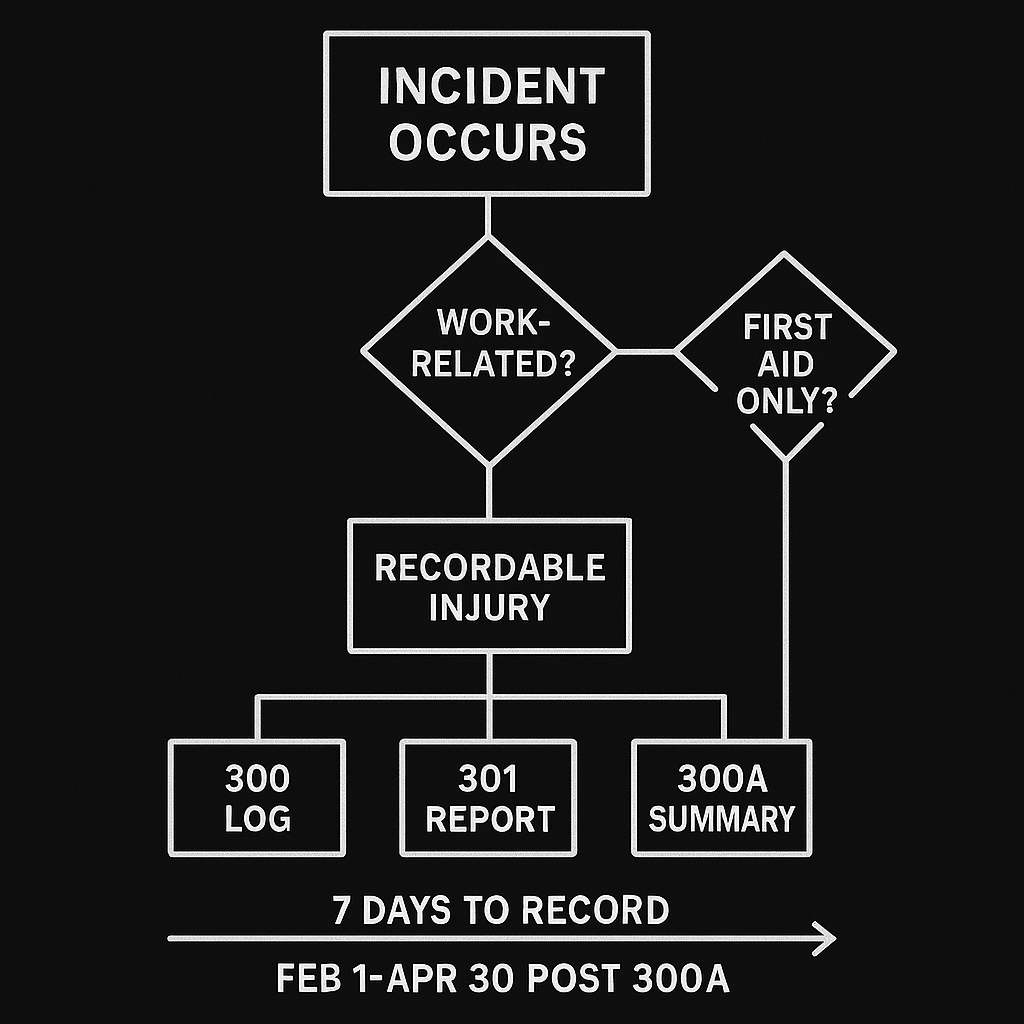
OSHA's recordkeeping requirements center on three core documents: the OSHA 300 Log, the 300A Summary, and the 301 Incident Report. But knowing what to record is where most safety managers stumble.
You must record work-related injuries and illnesses that result in:
- Death
- Days away from work
- Restricted work or job transfer
- Medical treatment beyond first aid
- Loss of consciousness
- Significant injury or illness diagnosed by a physician or licensed healthcare professional
The keyword here is "work-related." An injury or illness is presumed work-related if an event or exposure in the work environment caused or contributed to the condition or significantly aggravated a pre-existing condition.
The First Aid Exception That Trips Everyone Up
One of the most common recordkeeping mistakes? Recording incidents that qualify as first aid only. OSHA has a specific definition of first aid that includes:
- Using non-prescription medications at non-prescription strength
- Cleaning, flushing, or soaking wounds on the skin surface
- Using wound coverings such as bandages, gauze pads, or butterfly bandages
- Using hot or cold therapy
- Using non-rigid means of support like elastic bandages or wraps
If treatment goes beyond this list, it's recordable. A single stitch? Recordable. Prescription-strength ibuprofen? Recordable. This is where a clear protocol and good communication with your healthcare providers becomes essential.
The Annual Posting Requirement Nobody Remembers
Here's a deadline that catches people every year: You must post your OSHA 300A Summary from February 1 through April 30 of each year. This summary must be displayed in a common area where notices to employees are usually posted.
In 2026, establishments with 250 or more employees, plus certain high-hazard industries with 20-249 employees, must also submit their injury and illness data electronically to OSHA. The submission deadline is typically March 2.
Record Retention: The Five-Year Rule
OSHA requires you to save your 300 Log, 300A Summary, and 301 Incident Reports for five years following the year to which they pertain. And here's the catch: you must update the stored logs if you receive new information about a previously recorded injury or illness.
This means your 2021 logs must be retained and accessible through the end of 2026. If you discover in 2026 that a 2021 injury resulted in additional days away from work, you need to update that old log.
Privacy Cases and Employee Rights
Certain injuries and illnesses must be recorded as "privacy concern cases" where you don't enter the employee's name on the 300 Log. These include:
- Sexual assault
- HIV infection, hepatitis, or tuberculosis
- Needlestick injuries and cuts from sharp objects contaminated with another person's blood or potentially infectious material
- Other illnesses if the employee requests their name not be entered
Employees also have the right to review the OSHA 300 Log and can request copies of their own 301 Incident Reports.
Common Mistakes That Trigger OSHA Citations
Mistake #1: Failing to record within seven calendar days. When you learn that a recordable injury or illness has occurred, you have seven calendar days to record it.
Mistake #2: Not counting all days away or restricted. You must count all calendar days the employee was unable to work or on restricted duty, even if they wouldn't have worked those days anyway (weekends, holidays, etc.).
Mistake #3: Misclassifying establishment types. If you have multiple locations, each establishment may have different recordkeeping requirements based on industry classification and size.
Technology Can Save Your Sanity
Let's be honest: managing OSHA recordkeeping manually across multiple sites while handling everything else on your plate is unsustainable. Modern EHS management platforms can automate data collection, ensure timely recording, trigger posting reminders, and generate required reports with a few clicks.
The question isn't whether you can afford to invest in better tools—it's whether you can afford not to, especially when a single recordkeeping violation can result in a $16,131 fine per incident in 2026.
Your Next Steps
Start with an audit of your current recordkeeping practices. Review last year's logs for completeness and accuracy. Verify that your criteria for recordability align with current OSHA standards. And most importantly, create a systematic process that doesn't depend on your memory during the busiest weeks of the year.
OSHA recordkeeping doesn't have to be overwhelming. With the right framework and tools, you can ensure compliance while focusing on what really matters: keeping your people safe.
Ready to simplify your OSHA compliance program? Talk to EHS about how we're helping safety managers reclaim their time while strengthening their safety programs.
AW
Aaron West
Founder, EHS, Inc. — 18+ years in EHS compliance and contractor safety
Aaron West has spent over 18 years helping contractors and businesses navigate OSHA compliance, ISNetworld® certification, and workplace safety management. He founded EHS, Inc. to make enterprise-level EHS accessible to companies of all sizes — serving contractors and businesses nationwide — without long-term contracts or enterprise overhead.
Ready to simplify your EHS compliance?
Our team handles the complexity so you can focus on running your business. No long-term contracts, no learning curve.
Talk to EHSRelated Articles
BBS vs. HOP: Where Behavior-Based Safety Breaks Down
When OSHA shows up during a refinery turnaround, they don't grade your program on paper — they grade what they find in the field.
MOC Process: What It Costs When Operations Shift Without It
Skipping Management of Change on a commercial construction site doesn't just create hazards — it creates five-figure OSHA citations and lost bid opportunities.
ISNetworld Grade Drop: New Contract, Outdated COI
Win a new utility contract and forget to update your certificate of insurance? Your ISNetworld grade already dropped before the first crew hit the field.
Medium & Enterprise
Safety Culture System
Framework to achieve zero incidents
Get Free System →
Small Businesses
50+ Safety Topics
Stop hitting paywalls
Get Free Topics →
All Companies
Audio Safety Topics
54 topics in English & Spanish
Get Free Audio →