What an ISNetworld Grade Drop Costs a Contractor in Real Dollars
Your ISNetworld grade didn't drop because of a hazard. It dropped because a document expired and nobody caught it in time.
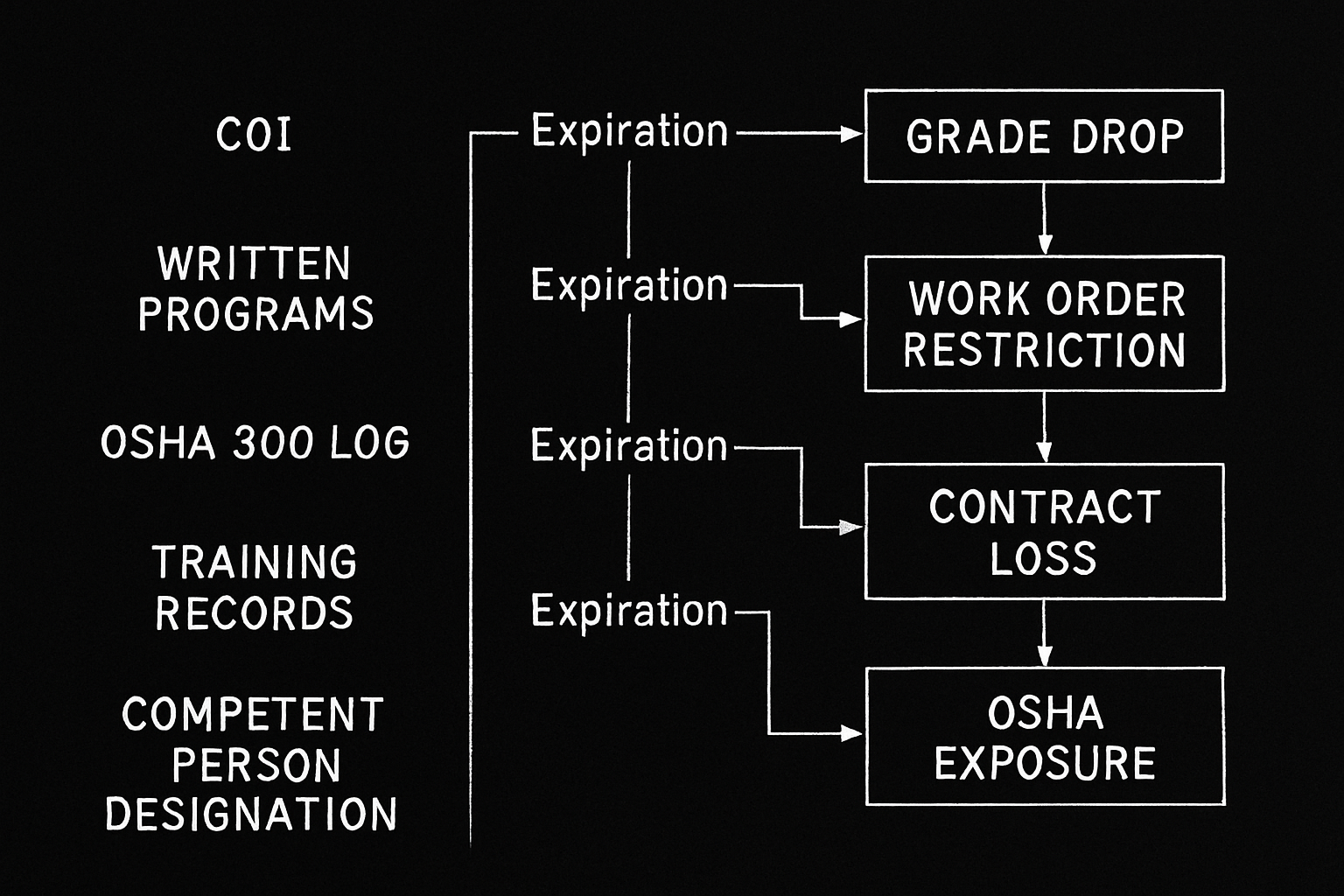
What an ISNetworld Grade Drop Costs a Contractor in Real Dollars — Not Just Points
Your ISNetworld grade didn't drop because someone got hurt on a rig. It dropped because a certificate of insurance expired on a Tuesday and your safety coordinator was out of the office. Or because the competent person designation for your confined space entry program wasn't updated after your last field supervisor quit. Or because a written respiratory protection program was still sitting in a folder dated 2021 and nobody re-uploaded it after the annual review. The hazard wasn't the problem. The paperwork was.
That's the part that frustrates upstream drilling and pipeline contractors the most — and it's the part that costs real money.
The Admin Failure Nobody Talks About
Here's what actually happens in the field: a well servicing contractor wins a new operator relationship, gets added to ISNetworld, and spends two weeks uploading documents to get to a C-grade or better. They make it. They get approved. Then six months later, the safety coordinator who managed all of it takes a job with a competing company, and the person who replaces them doesn't know what ISNetworld is, let alone what's about to expire.
The RAVS® reviewer doesn't care about your turnover situation. They flag what's missing. Your grade drops. And the operator's system automatically restricts your access to new work orders.
Most drilling supervisors assume the grade drop will be caught before it matters. The real problem is that the operator's procurement system found out before you did.
What a Grade Drop Actually Costs a Pipeline Contractor
Run the math on a mid-size pipeline contractor running three crews on a gathering system build in the Permian Basin. Average daily revenue per crew: $18,000–$22,000. If an ISNetworld grade suspension removes you from an approved contractor list and you lose two weeks of billable work while you scramble to fix documentation, that's $180,000–$220,000 in lost revenue. Not because of a recordable incident. Because your OSHA 300 log wasn't uploaded for the current year or your written hazard communication program still referenced the old GHS label format.
That's before you factor in the contract penalty clauses that some operators now include for prequalification lapses. And before you account for the cost of emergency remediation — hiring a consultant at $200/hour to rebuild written programs under deadline pressure when you could have maintained them for a fraction of that cost year-round.
The Documents That Expire Without Anyone Noticing
In the oil and gas contractor world, these are the specific documents that cause ISNetworld grade drops most often — not because they're hard to maintain, but because nobody owns the renewal calendar:
- Certificates of Insurance: General liability, auto, workers' comp, and umbrella policies all have annual renewals. One expired cert and you're flagged before your broker even sends the updated binder.
- Written Safety Programs: Confined space entry, lockout/tagout, H2S, respiratory protection, hot work, and fall protection programs all need annual review signatures. ISNetworld's RAVS® auditors check the review date. If it's more than 12 months old, it's non-conforming.
- Competent Person Designations: For upstream drilling and well servicing, your competent persons for excavation, rigging, and confined space need to be named and current. Personnel changes are the most common reason this document goes stale.
- OSHA 300/300A Logs: The 300A summary must be posted February 1 through April 30. ISNetworld wants to see it uploaded. If your safety coordinator didn't pull it from your recordkeeping system and attach it to the portal, it's missing — even if it exists somewhere on a server.
- Training Records: H2S awareness, STOP work authority, and JSA/JHA completion records for your field crews. The document exists. It's just not in the portal. That gap is indistinguishable from the training never happening.
The OSHA Exposure That Comes With the Grade Drop
When an operator's HSE team or a third-party auditor comes to your location after a grade flag — and they do — they're not just checking ISNetworld documents. They're looking at actual recordkeeping. An OSHA serious violation for a recordkeeping failure runs up to $16,131 per violation. Willful or repeat violations hit $161,323. If your 300 log has misclassified incidents or your written programs haven't been updated to reflect current regulatory language, both of those numbers are in play at the same time. See OSHA's current penalty structure here.
The counterintuitive part: the OSHA citation isn't usually triggered by the incident itself. It's triggered by the documentation review that happens after the operator's HSE team notices your grade slipped and decides to take a closer look.
Why Self-Managing This Breaks Down in the Field
Upstream drilling and well servicing companies are not desk operations. Your safety coordinator is also the person running tailgate meetings at the pad site, doing pre-tour inspections, and filing incident reports when a floor hand tweaks a shoulder on a joint stand. Asking that same person to maintain a 12-month document renewal calendar across ISNetworld, track insurance cert expiration dates, update written programs annually, and manage training records for a rotating crew roster — while doing actual safety work in the field — is how document lapses happen. It's not negligence. It's math.
The admin failure is predictable. It happens at every contractor that tries to manage ISNetworld in-house without dedicated administrative support. The grade drop is just when it becomes visible.
What Fixing It Actually Looks Like
EHS, Inc. manages ISNetworld prequalification, written program maintenance, OSHA recordkeeping, and safety training for oil and gas contractors — completely off your plate. Your safety coordinator stays in the field. Nothing expires without someone catching it first. Your grade stays where it needs to be to keep work flowing.
If your grade has already slipped, or you're not sure what's about to expire, start with the free readiness check.
Find out if your company qualifies — take the free 2-minute ISNetworld & Avetta Readiness Check.
Frequently Asked Questions
How fast can an ISNetworld grade drop after a document expires?
Immediately. ISNetworld's RAVS® system flags expired or missing documents in real time. Once flagged, your grade recalculates — and operators with automated prequalification systems can restrict your work access before you've even been notified. For upstream drilling contractors, that can mean a work stoppage within 24–48 hours of an expiration date passing.
Which ISNetworld documents expire most often for oil and gas contractors?
Certificates of insurance, annual written program reviews (confined space, LOTO, H2S, respiratory protection), competent person designations, and OSHA 300/300A logs. The most common miss is the annual review signature on written programs — the program exists, but the review date is 18 months old and RAVS® flags it as non-conforming.
Does a grade drop actually affect contract access, or is it just a rating?
It directly affects contract access. Most major operators in the Permian, Eagle Ford, and Bakken require a minimum ISNetworld grade — often a C or higher — as a condition of being on the approved contractor list. A grade drop below that threshold can remove you from eligibility for new work orders until the grade is restored.
Can a contractor recover an ISNetworld grade quickly?
Yes — if the missing documents are available and ready to upload. The problem is that under deadline pressure, contractors often discover the documents don't exist, are outdated, or were never formalized in the first place. A written H2S program that was never properly authored can't be uploaded in an afternoon. Recovery timelines typically run one to three weeks when documents need to be created or substantially revised.
How does EHS, Inc. help contractors maintain their ISNetworld grade?
EHS, Inc. manages the entire prequalification process as an ongoing service — document renewals, written program updates, insurance cert tracking, OSHA log management, and training records. Nothing falls through the cracks because someone owns the calendar full-time. Contractors keep their grade without pulling their safety coordinator off field work to manage a compliance portal.
AW
Aaron West
Founder, EHS, Inc. — 18+ years in EHS compliance and contractor safety
Aaron West has spent over 18 years helping contractors and businesses navigate OSHA compliance, ISNetworld® certification, and workplace safety management. He founded EHS, Inc. to make enterprise-level EHS accessible to companies of all sizes — serving contractors and businesses nationwide — without long-term contracts or enterprise overhead.
Ready to simplify your EHS compliance?
Our team handles the complexity so you can focus on running your business. No long-term contracts, no learning curve.
Talk to EHSRelated Articles
Your Avetta Score After Winning a Large Public Contract
Winning a large public contract can crater your Avetta score overnight — here's what that costs and how to stop it.
ISNetworld Grade Drop: When Insurance Limits Fall Short
Your ISNetworld grade can crater overnight when your renewed policy carries lower limits than your operator contract requires — here's exactly how it happens.
Avetta Score After a New Contract Win: What Changes and Why
Winning a new utility contract can silently tank your Avetta score — here's what in-house safety managers miss until the damage is done.
Medium & Enterprise
Safety Culture System
Framework to achieve zero incidents
Get Free System →
Small Businesses
50+ Safety Topics
Stop hitting paywalls
Get Free Topics →
All Companies
Audio Safety Topics
54 topics in English & Spanish
Get Free Audio →