Prequalification Renewals: Documents Contractors Forget
Turnover and subcontractor layering quietly destroy your ISNetworld grade. Here's exactly which documents expire while you're not watching.
Prequalification Renewals: The Documents Most Contractors Forget to Update
Your ISNetworld grade drops to a C on a Thursday afternoon. You find out Friday morning when the procurement coordinator at the plant calls to say your crew can't badge in. Forty hours of scheduled shutdown work at a 180-person automotive stamping facility, two subcontractors already mobilized, and a safety coordinator who just gave two weeks notice. The documents that expired weren't the ones anyone was watching.
This is not a hypothetical. This is the pattern — and it almost always involves turnover, rapid hiring, or subcontractor layering that nobody fully tracked.
The Documents That Actually Expire During Turnover
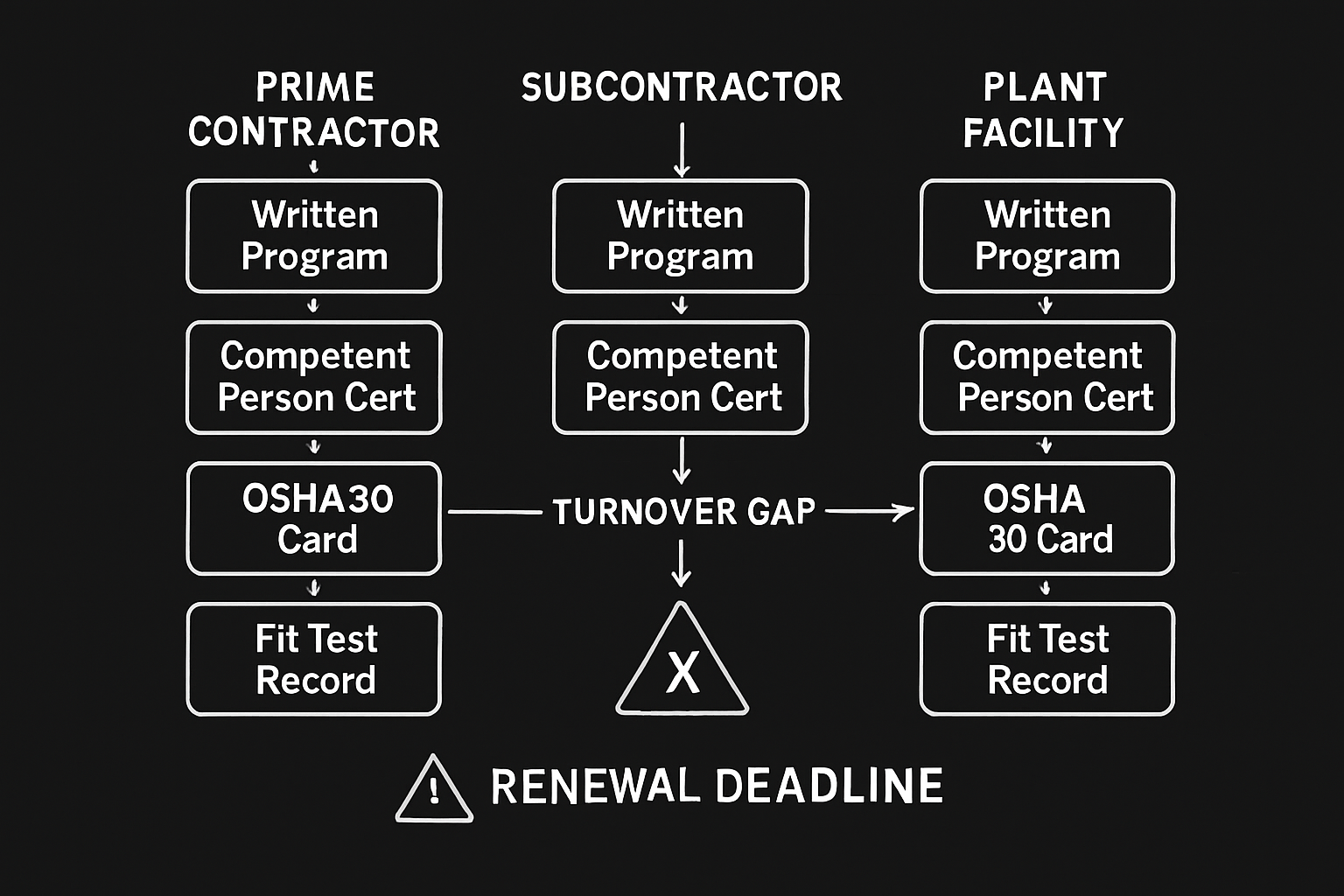
Most contractors keep close tabs on their insurance certificates. Those are obvious — the renewal notice hits the owner's inbox and it gets handled. What disappears quietly are the personnel-tied documents: competent person designations, OSHA 10 and OSHA 30 cards, fall protection training certifications, confined space entry authorizations, and respiratory protection fit-test records.
Here's how it breaks down in a manufacturing environment. A mid-size mechanical contractor running maintenance crews inside a stamping plant has three or four workers who hold formal competent person status for fall protection and excavation. One of them leaves in March. You backfill with a new hire who has experience but whose OSHA 30 is from a previous employer and expired eight months ago. Nobody flags it because the onboarding checklist only checks for the card — not the date on the card.
When the ISNetworld annual renewal comes up in June, the competent person documentation is now incomplete. The written program still references the employee who left. The new hire's training record shows up as expired in the system. Grade drops. Work stops.
Subcontractor Layering Makes This Worse
General contractors managing plant shutdowns at mid-size facilities often bring in specialty subs — electrical, rigging, insulation — who are named in the prime's ISNetworld or Avetta profile as covered workers. When those subs turn over their own crews mid-project or between outages, the prime contractor's documentation doesn't automatically update. The prime is still showing the original sub's roster and training records.
Most safety coordinators assume the subcontractor is managing their own documentation — but the real problem is that ISNetworld evaluates the prime's submitted records, and those records have to reflect everyone working under that scope. A rigging sub that quietly swapped out two crane operators between the spring and fall outages just handed you a compliance gap you didn't know you had.
OSHA's lockout/tagout standard (1910.147) requires authorized employee training records to be current and verifiable. If your prequalification portal audit pulls those records and finds gaps tied to swapped-out personnel, a serious violation starts at $16,131 per instance. Willful or repeat findings go to $161,323. The plant's procurement team doesn't wait for the citation — they just pull your badge access while it gets sorted out.
The Written Program Problem Nobody Talks About
Rapid hiring doesn't just create training record gaps — it exposes written programs that were built around a specific organizational structure that no longer exists. A confined space entry program that lists your lead maintenance tech as the entry supervisor is now wrong if that person transferred to a different shift or left the company entirely. The program itself becomes a liability during an audit because it names a person who either isn't there or isn't in that role.
Prequalification reviewers — whether they're sitting at ISNetworld or doing a desk audit for a plant EHS manager — cross-reference written programs against personnel records. A respiratory protection program that designates a specific safety coordinator as the program administrator, where that coordinator is no longer employed, is a finding. Not a paperwork technicality — an actual audit finding that flags your program as unmanaged.
What a Functional Renewal Process Actually Looks Like
The contractors who stay green through turnover cycles aren't doing anything exotic. They're running a quarterly personnel audit — not annually, quarterly — against every document that ties to a named individual or a job classification. That means:
- Competent person designations checked against current active employees every 90 days
- OSHA 10/30 expiration dates tracked by employee, not just confirmed at hire
- Subcontractor rosters updated in the prequalification portal within 30 days of any crew change
- Written programs reviewed any time a named administrator or designated employee changes roles or leaves
- Fit-test records for respirator users verified against the current shift schedule, not the roster from six months ago
That last one catches people. A manufacturing plant running production workers through respiratory protection for chemical handling in a finishing or coating operation will have fit-test records tied to specific respirator models and specific employees. Swap the employee, you need a new fit test. Miss it, and you're showing an authorized user record that doesn't match the person actually wearing the equipment.
The Real Cost Is Not the Fine
The fine is bad. Losing a prequalification grade and getting locked out of a facility during a scheduled shutdown is worse — because the downstream costs are immediate. Crew standby time, subcontractor demobilization fees, rescheduling against the plant's production calendar. A 72-hour shutdown outage at a mid-size manufacturer doesn't get rescheduled in a week. You're looking at months before the next available window, and your contract relationship has taken a visible hit.
The contractors who manage this well don't have larger safety departments. They have a system that runs the updates on a schedule instead of waiting for the renewal notice to panic about it.
FAQ
Which documents most often cause ISNetworld grade drops during contractor turnover?
Competent person designations, OSHA 10/30 training records with expiration dates, respiratory protection fit-test records, and written program administrator designations tied to specific named employees are the most common culprits. These are personnel-specific documents that don't update automatically when staff changes occur.
How does subcontractor layering create prequalification compliance gaps?
When a prime contractor uses specialty subs whose crews turn over between projects, the prime's prequalification profile may still reflect outdated sub-employee training records. ISNetworld and Avetta evaluate the prime's submitted documentation — if sub rosters and certifications aren't updated to reflect current personnel, the prime carries the compliance exposure.
How often should contractors audit personnel-tied safety documents?
Quarterly is the practical standard for contractors working inside facilities with active prequalification requirements. Annual reviews only catch problems after a renewal cycle has already flagged them — quarterly reviews catch gaps before they affect the grade.
What happens if a written safety program names an employee who no longer works there?
During an audit, a written program referencing a former employee as the designated program administrator or competent person is treated as an unmanaged program — not a minor paperwork gap. It signals to reviewers that the program isn't being actively maintained, which affects your overall compliance score.
Can EHS, Inc. manage prequalification renewals for contractors dealing with high turnover?
Yes. EHS, Inc. manages ISNetworld and Avetta profiles, tracks personnel-tied document expiration dates, updates written programs when roles change, and handles renewal submissions so contractors aren't scrambling when the cycle comes around. If this is eating your time, reach out here.
AW
Aaron West
Founder, EHS, Inc. — 18+ years in EHS compliance and contractor safety
Aaron West has spent over 18 years helping contractors and businesses navigate OSHA compliance, ISNetworld® certification, and workplace safety management. He founded EHS, Inc. to make enterprise-level EHS accessible to companies of all sizes — serving contractors and businesses nationwide — without long-term contracts or enterprise overhead.
Ready to simplify your EHS compliance?
Our team handles the complexity so you can focus on running your business. No long-term contracts, no learning curve.
Talk to EHSRelated Articles
Your Avetta Score After Winning a Large Public Contract
Winning a large public contract can crater your Avetta score overnight — here's what that costs and how to stop it.
ISNetworld Grade Drop: When Insurance Limits Fall Short
Your ISNetworld grade can crater overnight when your renewed policy carries lower limits than your operator contract requires — here's exactly how it happens.
Avetta Score After a New Contract Win: What Changes and Why
Winning a new utility contract can silently tank your Avetta score — here's what in-house safety managers miss until the damage is done.
Medium & Enterprise
Safety Culture System
Framework to achieve zero incidents
Get Free System →
Small Businesses
50+ Safety Topics
Stop hitting paywalls
Get Free Topics →
All Companies
Audio Safety Topics
54 topics in English & Spanish
Get Free Audio →