How to Get Back on an Approved Vendor List After ISNetworld or Avetta Removal
Getting removed from an approved vendor list isn't just a paperwork problem — here's what actually gets industrial maintenance contractors reinstated.
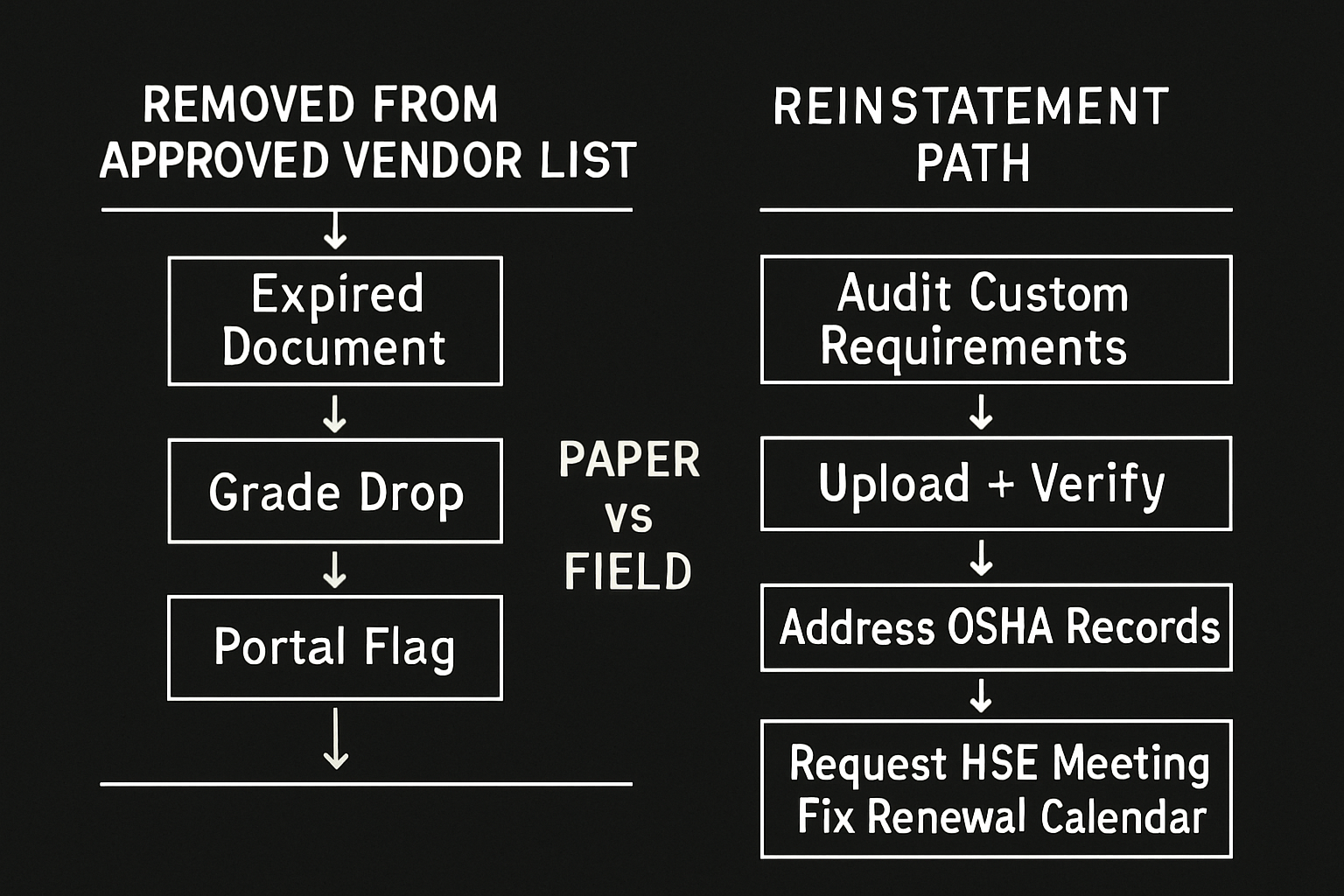
How a Contractor Gets Back on an Approved Vendor List After Being Removed for a Lapsed ISNetworld or Avetta Document
You got the call. Or maybe you got an email. Or maybe you just showed up at the refinery gate for turnaround mobilization and the safety coordinator at the desk told you your company wasn't on the approved vendor list anymore. Your ISNetworld grade dropped below the facility's minimum threshold — or your Avetta account flagged an expired document — and now you're standing in a parking lot watching a competitor's crew walk through the gate.
This happens to industrial maintenance contractors more than anyone wants to admit. Especially in the turnaround and plant shutdown world, where the window between "we got the bid" and "crews mobilize" can be 30 days or less. There's no slow season to catch up on compliance paperwork. And the consequence isn't just embarrassing — it's a direct revenue event.
Why Industrial Maintenance Contractors Get Removed in the First Place
Most safety coordinators assume the removal happened because someone forgot to upload a document. That's the surface answer. The real problem is almost always a system issue, not a human one.
Here's what actually happens at a company running three simultaneous turnarounds: the safety coordinator who owns the ISNetworld account leaves in February. The incoming person doesn't know the renewal calendar. OSHA 300A logs were due in ISNetworld by March 2. Nobody uploaded them. The confined space entry program that was last updated in 2021 hits its review expiration. The first-aid/CPR cards for two lead maintenance techs expired in April. None of these feel like emergencies on their own — but ISNetworld's grading algorithm doesn't care about context. It starts deducting points.
By the time the facility's procurement team runs their quarterly vendor audit, your grade has dropped from an 87 to a 61. Their minimum is 70. You're off the list.
Most safety coordinators assume the fix is to upload the missing documents. But the real problem is that the facility now has a record that your company was non-compliant — and reinstatement requires more than a document drop.
The Gap Between Your Written Program and What OSHA Would Find On-Site
This is the part nobody talks about honestly. When a refinery or petrochemical plant reviews your ISNetworld profile for reinstatement, they're not just looking at your grades. Their HSE team is evaluating whether your written safety program reflects actual on-site practice — because they've been burned before.
A contractor walks in with a 92 in ISNetworld. Beautiful written confined space program. Hot work permit procedure that looks like it was written by a process safety engineer. Then their maintenance techs show up to work a heat exchanger bundle pull, and the competent person they designated for confined space entry hasn't done a real permit-required entry in two years. The atmosphere monitoring equipment is in a pelican case that hasn't been opened since the last turnaround. The LOTO procedure in the written program references equipment tags that don't match what's hanging in the field.
OSHA doesn't grade your PDF. They watch what happens when a craft worker opens a flange on a line that was supposedly isolated. A serious violation for failure to follow LOTO/TAGOUT procedures under 29 CFR 1910.147 runs up to $16,131 per citation. A willful or repeat violation — if OSHA determines you knew the procedure wasn't being followed and didn't fix it — goes up to $161,323 per instance. And that's before the facility terminates your contract and blacklists your company from their entire network of plants.
Reinstatement isn't just a documentation exercise. Facilities that have been doing this long enough want to see that the gap between the written program and field execution has been closed — not papered over.
The Reinstatement Process That Actually Works
Here's the sequence that gets industrial maintenance contractors back on approved vendor lists without burning another 90 days:
- Audit your ISNetworld or Avetta account against the specific facility's requirements. Not the platform's generic checklist — the facility's custom requirements document. Refineries and petrochemical plants layer their own requirements on top of the platform minimums. A chemical plant in the Gulf Coast region may require contractor-specific process safety training, site-specific emergency response procedures, and verification that your competent persons are current on facility-specific confined space classifications. Generic compliance won't get you reinstated at a facility with custom requirements.
- Don't just upload — verify the document is accepted. ISNetworld has a review queue. Avetta has reviewers. An uploaded document is not an approved document. Follow up. Contractors who assume "uploaded = done" lose another two weeks.
- Address the trailing indicators in your OSHA recordkeeping. If your TRIR or DART rate is what triggered the review, uploading a new safety policy doesn't fix the number. You need to be able to explain the incidents, demonstrate corrective actions that were actually implemented, and show trending data. Facilities have seen contractors manufacture corrective action documentation after the fact. They know what it looks like.
- Request a reinstatement meeting — don't just wait for a grade to update. For tier-1 refineries and major petrochemical operators, a phone call or on-site meeting with the facility's HSE coordinator moves faster than any portal update. Come with documentation of what changed operationally, not just what was uploaded.
- Fix the renewal calendar permanently. The document that lapsed will lapse again in 12 months. The competent person cert that expired will expire again. Set recurring reminders, assign backup ownership, and build a 60-day advance review cycle into your operation. If you don't have a dedicated person to own this, that's the real root cause — not the expired document.
What Facilities Are Actually Looking For
The HSE manager at a major refinery isn't looking for a perfect ISNetworld score. They're looking for a contractor who won't create a process safety incident during a 21-day turnaround when 400 contractors are working simultaneously in a process unit. They want evidence that your maintenance techs know your procedures, your competent persons are actually competent, and your safety coordinator isn't learning confined space permitting from a YouTube video.
The approved vendor list is the facility's first line of defense against that outcome. When you get removed, the message isn't "your paperwork is messy." The message is "we don't know if your field execution matches your binder." Reinstatement means answering that question convincingly. See OSHA's contractor safety guidance for the baseline expectations facilities are measuring against.
Frequently Asked Questions
How long does ISNetworld reinstatement take for a contractor removed for expired documents?
It depends on the documents and the facility's review cycle. Simple document uploads — updated OSHA 300A logs, renewed first-aid certs — can clear in 5–10 business days if ISNetworld reviewers are current on the queue. Facilities with custom requirements may run their own internal approval process on top of the platform review, which can add another 2–4 weeks. The fastest reinstatements happen when the contractor proactively contacts the facility's procurement or HSE team directly rather than waiting for the portal to update.
Can a contractor be reinstated on an Avetta approved vendor list after a safety incident caused the removal?
Yes, but the bar is higher. Avetta's grading model weights incident history, and a recordable incident that drove removal will stay in the calculation for the three-year lookback period. Reinstatement in this scenario requires demonstrating corrective actions that were operationally implemented — not just documented — and often requires a direct conversation with the subscribing client's HSE team. A written corrective action plan that references specific procedural changes, training completions, and supervision adjustments carries more weight than a grade recovery alone.
What documents most commonly cause industrial maintenance contractors to fall below the approved threshold?
In the refinery and plant shutdown space, the most common triggers are: lapsed OSHA 300A annual summary uploads, expired competent person certifications (confined space, fall protection, rigging), written programs that have hit their review expiration date without being updated, and EMR documentation that wasn't resubmitted after the policy renewal. Certificate of insurance lapses are also common — particularly when a contractor's broker renews coverage but doesn't push updated COIs to the prequalification portals automatically.
Does a dropped ISNetworld grade affect contract bids even if the contractor hasn't been formally removed?
Yes. Many facilities set bid eligibility thresholds in their procurement systems — a contractor below a certain grade simply doesn't appear as a qualified vendor when sourcing teams run searches. The contractor may not receive a formal removal notice; their company just stops getting invited to bid. By the time someone notices, multiple bid cycles have already passed.
If your ISNetworld or Avetta compliance is running on whoever has time to deal with it today, it's not a system — it's a liability. EHS, Inc. manages prequalification portals, written programs, OSHA recordkeeping, and safety training for industrial maintenance contractors so the compliance side stays current whether or not you have dedicated safety staff. Take two minutes and find out where your account actually stands.
Find out if your company qualifies — take the free 2-minute ISNetworld & Avetta Readiness Check.
AW
Aaron West
Founder, EHS, Inc. — 18+ years in EHS compliance and contractor safety
Aaron West has spent over 18 years helping contractors and businesses navigate OSHA compliance, ISNetworld® certification, and workplace safety management. He founded EHS, Inc. to make enterprise-level EHS accessible to companies of all sizes — serving contractors and businesses nationwide — without long-term contracts or enterprise overhead.
Ready to simplify your EHS compliance?
Our team handles the complexity so you can focus on running your business. No long-term contracts, no learning curve.
Talk to EHSRelated Articles
Your Avetta Score After Winning a Large Public Contract
Winning a large public contract can crater your Avetta score overnight — here's what that costs and how to stop it.
ISNetworld Grade Drop: When Insurance Limits Fall Short
Your ISNetworld grade can crater overnight when your renewed policy carries lower limits than your operator contract requires — here's exactly how it happens.
Avetta Score After a New Contract Win: What Changes and Why
Winning a new utility contract can silently tank your Avetta score — here's what in-house safety managers miss until the damage is done.
Medium & Enterprise
Safety Culture System
Framework to achieve zero incidents
Get Free System →
Small Businesses
50+ Safety Topics
Stop hitting paywalls
Get Free Topics →
All Companies
Audio Safety Topics
54 topics in English & Spanish
Get Free Audio →