ISNetworld Grade Dropping During Employee Turnover Season
Mid-size manufacturers lose ISNetworld grades every summer — not from safety failures, but from turnover paperwork that nobody tracked.
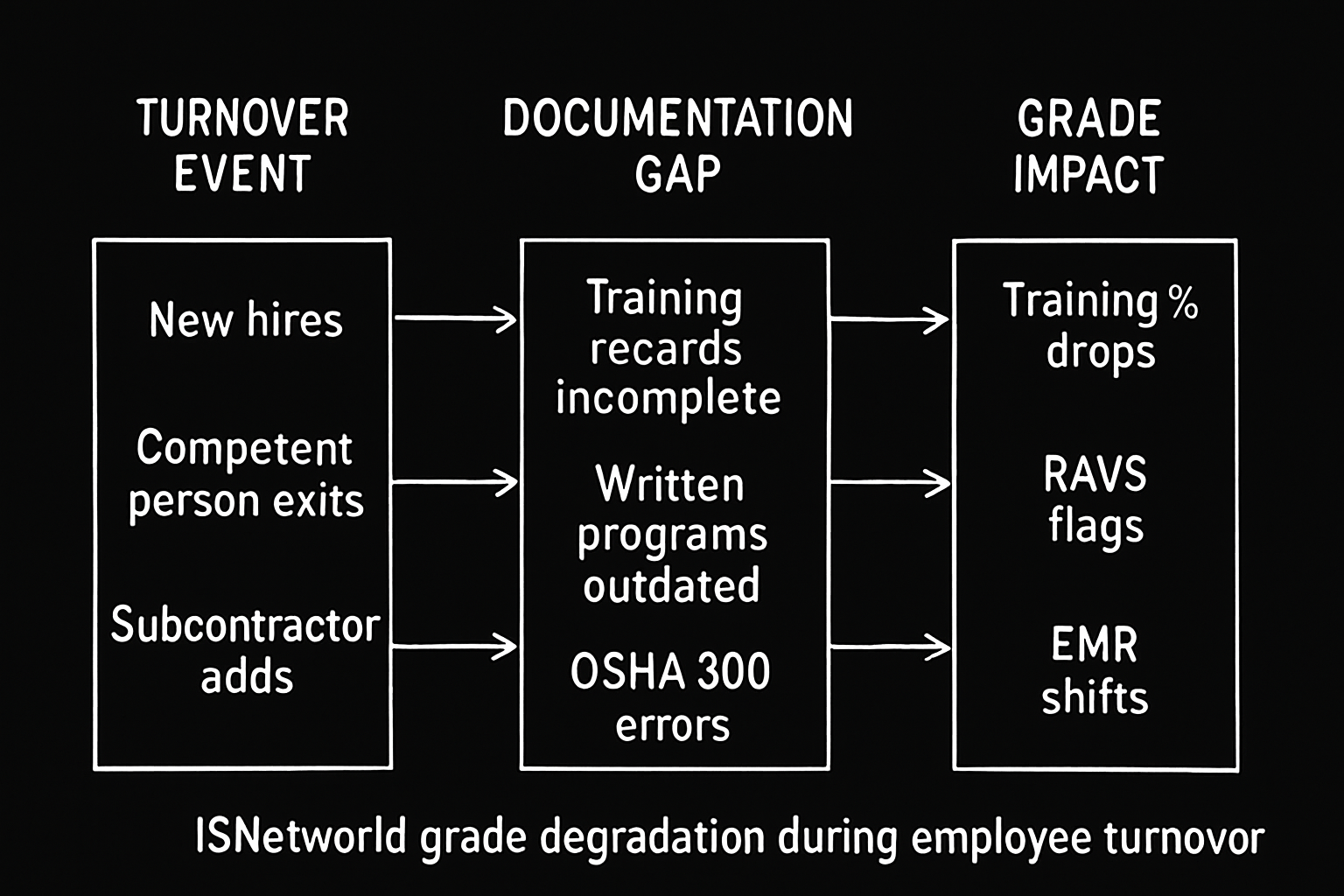
ISNetworld Grade Dropping During Employee Turnover Season
Summer hits a 150-person metal fabrication shop and three things happen at once: the maintenance crew turns over, two production lines add a second shift, and the safety coordinator who knew the ISNetworld login is now at a competitor. By the time the plant manager notices the grade dropped from an A to a C, two contracts are already on hold. This is not a hypothetical. This is July at a mid-size general industry facility, and it plays out the same way every year.
Why Turnover Breaks ISNetworld Grades — Specifically
ISNetworld grades are a composite. Your RAVS score (the written program audit), your training completion percentages, your OSHA recordkeeping data, your EMR — they all feed it. When headcount spikes or churns, every one of those inputs gets stressed simultaneously.
Here's what actually happens at a 200-employee stamping plant during a hiring push: the HR team onboards 30 new press operators in six weeks. Half of them need forklift certification, all of them need LOTO/energy control training, and several are being placed near confined spaces that require awareness-level training at minimum. The safety coordinator is trying to run orientations in batches of ten while also covering for a maintenance tech who quit mid-July. Training records get logged inconsistently — some in the LMS, some on paper sign-in sheets that live in a filing cabinet. When ISNetworld pulls the training completion percentage on renewal, it reflects what's documented, not what actually happened on the floor. The grade drops.
The Counterintuitive Part Nobody Talks About
Most plant managers assume their ISNetworld grade drops because someone got hurt or because they missed a renewal deadline. The real problem is usually the competent person gap — and it's invisible until the audit.
OSHA requires a designated competent person for fall protection, excavation, scaffolding, and several other regulated activities. In manufacturing, this surfaces most often around confined space entry and powered industrial truck operations. When your experienced maintenance techs leave and you're running with newer hires, the person who was your competent person for permit-required confined space entry may no longer be on payroll. ISNetworld's RAVS auditors ask about this directly. If you can't document who holds that role and that they've been trained, the program gets flagged — and flagged programs tank your score. You can have zero recordables and still fail this portion of the audit.
Subcontractor Layering Makes It Worse
Mid-size manufacturers increasingly bring in subcontractors to cover production gaps during turnover season — a machine repair firm for three weeks, a rigging crew for a capital equipment install, a temp-to-hire labor service running the floor while permanent headcount stabilizes. Every one of those subcontractors can create an ISNetworld liability if you're the contractor of record on a client's platform.
The client facility expects you to vouch for your subs. If a rigging crew doesn't have their training documentation current in ISNetworld — or worse, if they're not listed in your account at all — you're the one who absorbs the grade hit. A serious OSHA violation tied to a subcontractor's equipment operation can run up to $16,131 per citation. A willful or repeat violation goes to $161,323. That's the regulatory side. The contract side is faster and quieter: your prequalification grade drops below the client's threshold, the purchase order gets pulled, and nobody calls to explain why.
What the Grade Actually Measures During a Hiring Surge
Three areas of the ISNetworld grade are most vulnerable during rapid hiring or turnover:
- Training completion rate: If 30 new press operators aren't logged in the LMS with completed LOTO and forklift modules, your completion percentage craters. ISNetworld sees percentages, not context.
- Written program currency: Programs tied to specific job roles — confined space, respiratory protection, hearing conservation — often list named responsible parties. When those people leave, the program is technically outdated. RAVS auditors catch this.
- OSHA 300 log accuracy: New supervisors who don't know recordkeeping rules misclassify incidents constantly. A first-aid case gets logged as a recordable. A recordable doesn't get logged at all. Either way, your TRIR moves and your EMR follows — with a three-year lag that affects every bid you submit through that window.
For more on ISNetworld's grading criteria, ISNetworld's contractor resource center outlines what RAVS auditors are evaluating.
What the Fix Actually Requires
The facilities that hold their ISNetworld grade through turnover season aren't the ones with more disciplined employees. They're the ones with a system that runs independently of any single person. Training records flow directly into the LMS and sync to ISNetworld without a safety coordinator manually exporting spreadsheets. Written programs are reviewed on a schedule, not when someone remembers. Competent person designations are documented by role, not by name — so when a maintenance tech leaves, the role gets reassigned and documented before the next shift starts, not three weeks later when the auditor asks.
Most 50–300 employee manufacturers don't have the internal bandwidth to run that system during a normal quarter, let alone during July when half the floor is new and the safety coordinator is covering three jobs. That's not a criticism — it's just the math of running a mid-size operation.
Frequently Asked Questions
How quickly can an ISNetworld grade drop during employee turnover?
It can happen within a single renewal cycle — sometimes faster if a client facility is actively monitoring contractor grades and pulls a real-time report. Training completion percentages update as ISNetworld audits documentation, so a hiring surge with incomplete records can show up within weeks of the new hires starting.
Does replacing a subcontractor affect our ISNetworld grade?
Yes. If a subcontractor is listed in your ISNetworld account and their documentation lapses — or if you bring in a new sub without adding them properly — it affects your prequalification standing with clients who require subcontractor documentation. Some client facilities require subs to be independently registered in ISNetworld.
What's the most common reason ISNetworld grades drop at manufacturing facilities specifically?
Incomplete training records during hiring surges and outdated written programs that still reference employees who have left. Both are fixable — but only if someone is actively managing the account, not just logging in at renewal time.
Can a zero-recordable year still result in a grade drop?
Absolutely. ISNetworld grades are not purely safety-performance based. Program documentation gaps, missing competent person records, and incomplete training percentages all affect the score independently of your injury rate.
This Is What We Handle
EHS, Inc. manages ISNetworld accounts, training documentation, written programs, and OSHA recordkeeping for contractors and manufacturing facilities that are tired of watching their grade move every time their headcount does. If turnover season is already starting to stress your prequalification standing, reach out — we take it off your plate completely.
AW
Aaron West
Founder, EHS, Inc. — 18+ years in EHS compliance and contractor safety
Aaron West has spent over 18 years helping contractors and businesses navigate OSHA compliance, ISNetworld® certification, and workplace safety management. He founded EHS, Inc. to make enterprise-level EHS accessible to companies of all sizes — serving contractors and businesses nationwide — without long-term contracts or enterprise overhead.
Ready to simplify your EHS compliance?
Our team handles the complexity so you can focus on running your business. No long-term contracts, no learning curve.
Talk to EHSRelated Articles
Your Avetta Score After Winning a Large Public Contract
Winning a large public contract can crater your Avetta score overnight — here's what that costs and how to stop it.
ISNetworld Grade Drop: When Insurance Limits Fall Short
Your ISNetworld grade can crater overnight when your renewed policy carries lower limits than your operator contract requires — here's exactly how it happens.
Avetta Score After a New Contract Win: What Changes and Why
Winning a new utility contract can silently tank your Avetta score — here's what in-house safety managers miss until the damage is done.
Medium & Enterprise
Safety Culture System
Framework to achieve zero incidents
Get Free System →
Small Businesses
50+ Safety Topics
Stop hitting paywalls
Get Free Topics →
All Companies
Audio Safety Topics
54 topics in English & Spanish
Get Free Audio →