OSHA Inspections: The Training Records Problem Nobody Warns You About
When an OSHA inspector asks for training records, most safety managers discover their documentation gaps in real time. Here's how to stop that.
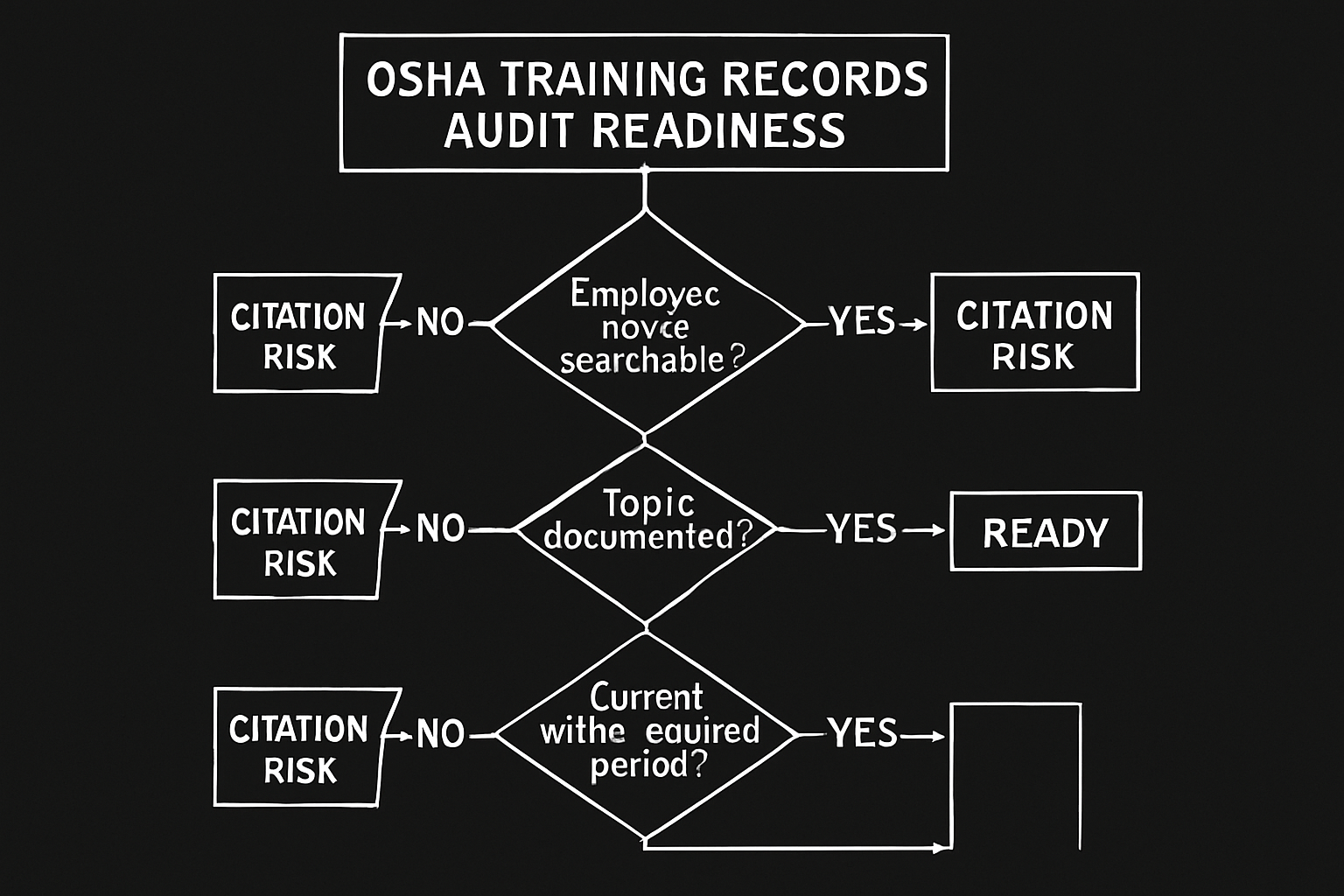
OSHA Inspection Preparation: The Training Records Gap That Gets Safety Managers Every Time
OSHA inspection preparation advice usually covers the obvious stuff — post your 300 log, have your written programs in a binder, know your rights during the opening conference. Fine. But there's one failure mode that plays out quietly in inspection after inspection, and it almost never makes the prep checklists: a compliance officer asks for training records for a specific employee on a specific topic, and you cannot produce them quickly, cleanly, or at all.
Not because the training didn't happen. Because of how it was tracked — or wasn't.
The Scenario That Ends Badly
Picture a mid-size electrical contractor. Sixty-five field employees spread across four active job sites. The safety manager — call her Dana — has been running safety for three years. She knows her people. She runs toolbox talks every Monday, coordinates OSHA 10 cards for new hires, and chases annual refreshers when she remembers to. Training happens. It just doesn't always land in the same place twice.
Some certificates are in a shared Google Drive folder that three people have renamed at least once. Some are scanned PDFs in email threads. A few are paper sign-in sheets in a filing cabinet. The OSHA 10 cards? Dana has a spreadsheet, but it's six months behind because Q4 was brutal.
An OSHA compliance officer shows up for a programmed inspection — electrical contractors are on the list in her region this year. She asks, during the opening conference, for training documentation for employees working with energized equipment. Specifically: evidence of qualified worker training under 1910.332 for anyone doing electrical work.
Dana knows this training happened. She just can't prove it in the next twenty minutes. What follows is an afternoon of frantic searching, a couple of phone calls to employees in the field, and the particular anxiety of watching a compliance officer take notes while you reassemble your own records in front of her.
This is not a horror story. This is a Tuesday.
Why Training Documentation Falls Apart Under Pressure
The problem isn't that safety managers don't care about records. It's that training documentation is almost always the last system built and the first one to get messy when the team is busy actually doing safety work.
Most mid-size operations piece together their training records from three or four different sources: a Learning Management System for some things, paper sign-in sheets for toolbox talks, third-party certificates stored inconsistently, and a spreadsheet that was accurate in 2022. None of these systems talk to each other. When an inspector asks a simple question — "Show me everyone who completed lockout/tagout training in the last 12 months" — the answer requires manually pulling from all four sources and hoping nothing falls through the cracks.
OSHA doesn't require a specific format for training records. What OSHA does require is that training records be available and that they document who was trained, on what, by whom, and when. The format is flexible. The availability is not.
What "Ready" Actually Looks Like
For training documentation specifically, inspection-ready means one thing: you can answer a targeted records request in under five minutes, without making phone calls.
That means your records need to be:
- Centralized. One place. Not four. If a compliance officer asks for all confined space entry training from the past year, you open one system and run one query.
- Employee-specific. Searchable by name, not just by topic. "We did LOTO training in March" is not a record. "Here's the completion log with employee names, dates, and trainer" is a record.
- Current. A certificate from 2019 for a worker who just transferred in last spring tells the inspector nothing about what that employee knows today.
- Tied to job function. Inspectors will cross-reference the work being performed on site with the training on file. A laborer whose records show only OSHA 10 but who's been doing work that requires task-specific training is a citation waiting to happen.
The Part Most Prep Guides Skip
There's a quiet assumption baked into most OSHA inspection prep advice: that you already have a functioning training management system, and you just need to organize it before the inspection. For a lot of safety managers, that assumption is doing a lot of heavy lifting.
The real prep question isn't "where did I put these records" — it's "do I have a system that produces clean documentation on demand, or am I rebuilding my records every time someone asks for them?" Those are two very different problems. The first is an organization problem. The second is a structural one that inspection prep checklists can't fix.
FAQ
How long do I need to keep employee training records?
It depends on the standard. OSHA's Hazard Communication standard (1910.1200) doesn't specify a retention period for training, but OSHA 300 logs must be kept for five years. For many safety-critical topics — respiratory protection, bloodborne pathogens, hearing conservation — the standard specifies retention periods ranging from one year to the duration of employment plus 30 years. When in doubt, keep it longer than you think you need to.
Can a compliance officer ask for training records during a walkaround, or only during the opening conference?
Both. A compliance officer can request documentation at any point during the inspection. Requests often come up during the walkaround when they observe something that triggers a question about whether workers were trained for that specific task or hazard.
What if I genuinely don't know where a record is?
Tell the inspector you'll locate it and provide it by a specific time. Do not guess, and do not say "I think we did that training." Saying you'll follow up and then following up promptly is far better than producing the wrong document confidently.
If the Admin Is Eating Your Inspection Readiness
If you're running training but losing the documentation — or spending more time hunting records than building safety culture — that's an operational problem, not a knowledge problem. EHS, Inc. manages training administration, LMS tracking, and compliance documentation so safety managers aren't rebuilding their records from scratch every time someone asks for them.
Grab our free safety topics pack to see how we structure this, or talk to EHS if you want to see what handing off the admin looks like in practice.
AW
Aaron West
Founder, EHS, Inc. — 18+ years in EHS compliance and contractor safety
Aaron West has spent over 18 years helping contractors and businesses navigate OSHA compliance, ISNetworld® certification, and workplace safety management. He founded EHS, Inc. to make enterprise-level EHS accessible to companies of all sizes — serving contractors and businesses nationwide — without long-term contracts or enterprise overhead.
Ready to simplify your EHS compliance?
Our team handles the complexity so you can focus on running your business. No long-term contracts, no learning curve.
Talk to EHSRelated Articles
ISO 45001 Clause 6.1: Auditing the Output, Skipping the Process
Oil & gas contractors get cited not because the hazard wasn't identified—because nobody documented how they identified it.
Hierarchy of Controls: Why Elimination Gets Skipped and What It Costs
Utility safety managers learn the hierarchy of controls from a standard. Here's what they miss by never learning it from the field.
Heinrich vs. Bird's Triangle: Your SIF Ratio Is Lying to You
Turnover and subcontractor layering don't just thin your workforce—they silently collapse the near-miss data your triangle depends on.
Medium & Enterprise
Safety Culture System
Framework to achieve zero incidents
Get Free System →
Small Businesses
50+ Safety Topics
Stop hitting paywalls
Get Free Topics →
All Companies
Audio Safety Topics
54 topics in English & Spanish
Get Free Audio →