What Happens to Your ISNetworld Grade When You Miss a Document Renewal Deadline
Missing one document renewal deadline in ISNetworld can drop your grade overnight — here's exactly what that costs oil & gas contractors.
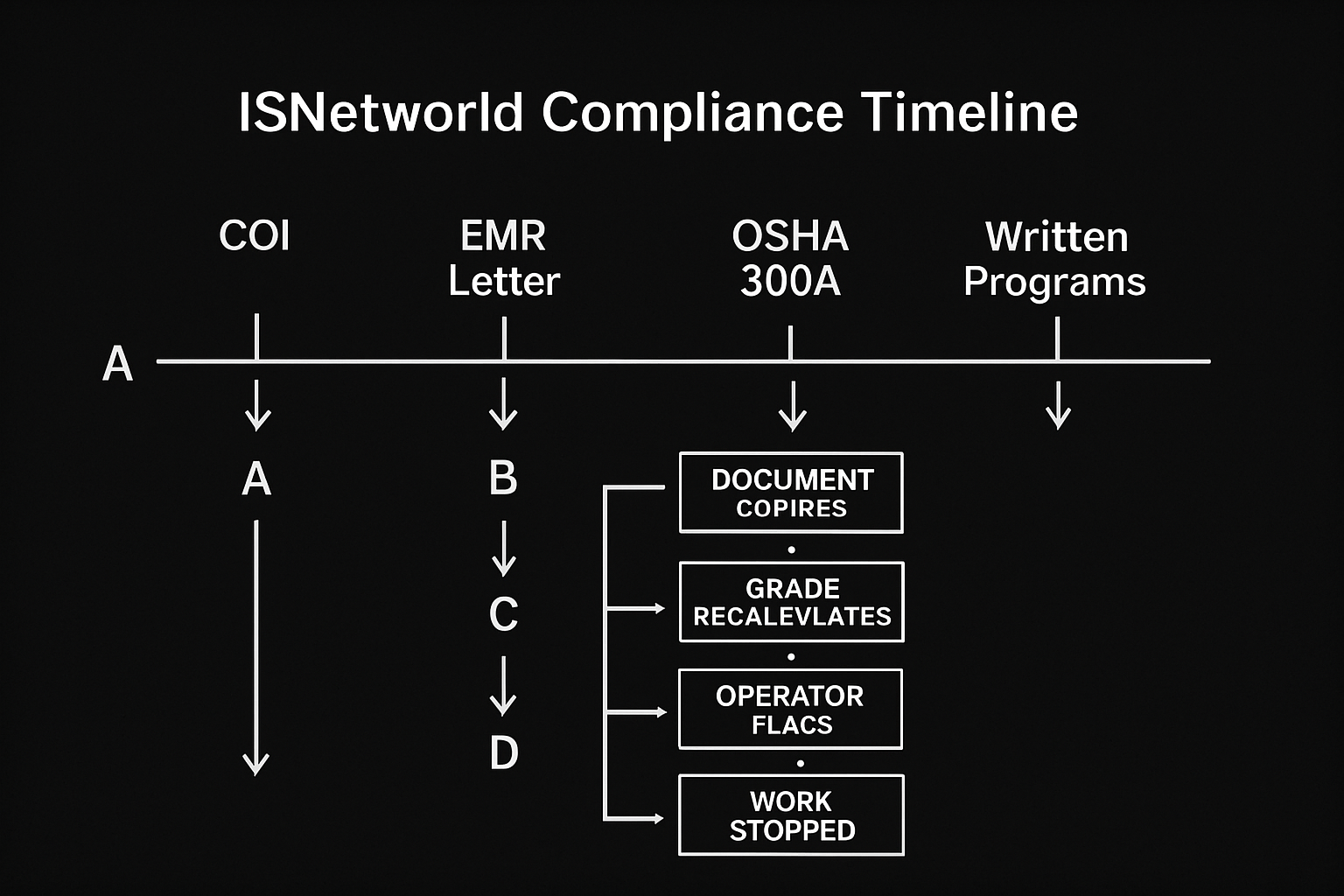
What Happens to Your ISNetworld Grade When You Miss a Document Renewal Deadline
Your crew is on location. The pumping unit is running. The well servicing job is moving. And somewhere back at the office, a certificate of insurance expired four days ago — and nobody caught it. Your ISNetworld grade just dropped from an A to a C, and you won't find out until the operator's procurement team calls to tell you you're off the approved vendor list.
That's not a safety failure. That's a paperwork failure. And in upstream oil and gas, paperwork failures cost just as much as the real ones.
How ISNetworld Grades Actually Work
ISNetworld assigns grades based on document completeness and compliance scoring. Operators set their own minimum grade thresholds — typically B or above — to maintain approved contractor status. When a document expires, ISNetworld doesn't warn you with a phone call. It marks the item non-compliant, the scoring algorithm recalculates, and your grade drops. Automatically. Immediately. Often without anyone at your company noticing until it's too late.
For upstream drilling and pipeline contractors, the documents that trigger this most frequently include:
- Certificate of Insurance (COI) — expires annually, sometimes mid-contract
- EMR letter from your insurer — often required to be dated within the last 12 months
- OSHA 300A annual summary upload — due after February 1 each year
- Written safety programs — many operators flag these if not reviewed within 12 months
- Competent person designations — especially for excavation, scaffolding, and confined space on pipeline jobs
- Drug and alcohol program documentation — renewal cycles vary by operator requirement
Each of these has its own renewal date. None of them align. And your safety coordinator is probably also managing training records, toolbox talk logs, and three other prequalification portals at the same time.
The Real-World Scenario That Plays Out Constantly
A well servicing contractor in the Permian Basin — maybe 40 field hands, a handful of service supervisors, one person handling compliance — gets a new MSA with a major operator. They upload everything, get approved, start work. Eight months in, the insurer issues a renewal COI. The broker emails it. The email goes to the office manager who is out that week. Nobody uploads the new certificate. The old one expires on a Tuesday. By Thursday morning, ISNetworld has recalculated the grade. By Friday, the operator's contractor management team has flagged the account.
The contractor doesn't lose the job that week. But they get put on administrative hold while the document is corrected. The push crew is sitting. The operator's scheduler has already called another vendor. Two days of standby time, a damaged relationship, and a permanent note in the operator's system that this vendor had a compliance lapse.
Nobody got hurt. No hazard was present. A PDF wasn't uploaded on time.
The Counterintuitive Part Most Safety Coordinators Miss
Most safety coordinators assume the risk is in the field — that the ISNetworld grade reflects whether the work is actually safe. So they spend their time on JHAs, toolbox talks, incident investigations, and site audits. That's where they should be spending their time.
But the real problem is that ISNetworld grades measure document status, not field conditions. An operator's procurement team doesn't see your toolbox talk sign-off sheets. They see a grade. A dropped grade pulls you from consideration before your safety record is ever reviewed. You can have a perfect TRIR, a low EMR, and an incident-free year — and still lose a bid because a competent person designation form wasn't re-uploaded after your lead well servicing supervisor left and was replaced.
The paperwork is the proxy for the work. And the proxy is what gets evaluated first.
What a Grade Drop Actually Costs
If your operator requires a B grade minimum and you drop to a C, you're off the approved list until the document is corrected and ISNetworld re-scores the account. That can take 24–72 hours even after the document is uploaded, depending on operator verification settings.
For a well servicing crew billing $8,000–$15,000 per day, a two-day hold is $16,000–$30,000 in lost revenue — before you account for standby pay, equipment sitting on location, and the possibility that the operator fills the slot with another vendor who stays there.
Beyond the immediate hit: operators track compliance history. A grade lapse on record is a yellow flag during the next bid cycle. Some operators use ISNetworld's historical data when evaluating contractors for longer-term MSAs. One administrative miss compounds.
This is separate from OSHA exposure. If the expired document is a safety program or a written procedure — and an OSHA inspector shows up during the lapse — a serious violation runs up to $16,131. A willful or repeat citation goes up to $161,323. OSHA's current penalty structure is published here. The citation isn't because the hazard was worse. It's because the paper wasn't current. Same outcome.
Why Tracking Spreadsheets Don't Solve This
Most small-to-mid-size drilling and pipeline contractors try to manage document renewal with a shared spreadsheet, calendar reminders, or just the memory of whoever owns the ISNetworld login. That works until it doesn't — and it stops working the moment that person goes on vacation, changes jobs, or just has a busy month during spring completions activity.
Turnover in the safety coordinator role is high. When that person leaves, the renewal calendar leaves with them. The new hire inherits an ISNetworld account with no documented renewal schedule, a handful of items already lapsed, and no clear picture of what operators require beyond the defaults.
Frequently Asked Questions
How quickly does an ISNetworld grade drop after a document expires?
Immediately. ISNetworld's system recalculates scores automatically when a document reaches its expiration date. There is no grace period on the grade — though some operators may not act on a dropped grade for a day or two depending on how frequently they audit their approved vendor lists.
Can you get your ISNetworld grade restored quickly after uploading a missing document?
Sometimes. If the document doesn't require operator review, the grade can update within hours. If the operator has manual verification enabled for that document type, it can take 24–72 hours or longer. For upstream contractors mid-project, that window is expensive.
Do all operators set the same ISNetworld grade minimums?
No. Each operator configures its own minimum requirements inside ISNetworld. A grade of B may be sufficient for one midstream pipeline operator and insufficient for an upstream E&P company with stricter prequalification standards. Contractors working across multiple operators need to know each client's threshold — not just the ISNetworld default.
Is missing a document renewal an OSHA violation?
It depends on the document. Expired written safety programs, outdated OSHA 300 logs, or lapsed competent person designations can be cited during an OSHA inspection — not because the hazard itself was uncontrolled, but because the required documentation wasn't current. Serious violations run up to $16,131 per item.
What's the most common document that causes ISNetworld grade drops for oilfield contractors?
The certificate of insurance is the most frequent culprit — it renews annually and is often managed by the insurance broker, not the safety coordinator. When the broker sends the renewal and nobody uploads it to ISNetworld, the old one expires and the grade drops. It's completely preventable and it happens constantly.
The Fix Is Boring. The Cost of Not Fixing It Isn't.
Managed properly, ISNetworld compliance is not complicated. Every document has a renewal date. Every renewal date can be tracked. Every upload can be verified before the expiration hits. It's calendar management and file management — not safety science.
The problem is that safety coordinators for upstream and well servicing contractors have actual safety work to do. Auditing locations. Investigating incidents. Running toolbox talks for crews rotating in and out. Managing ISNetworld renewals on top of that means something always gets dropped — and it's usually the administrative item, not the field item.
EHS, Inc. manages ISNetworld compliance completely — every document, every renewal deadline, every upload — so your safety coordinator can be on location instead of watching an expiration calendar. If you want to know where your account stands right now, take the free 2-minute readiness check.
Find out if your company qualifies — take the free 2-minute ISNetworld & Avetta Readiness Check.
AW
Aaron West
Founder, EHS, Inc. — 18+ years in EHS compliance and contractor safety
Aaron West has spent over 18 years helping contractors and businesses navigate OSHA compliance, ISNetworld® certification, and workplace safety management. He founded EHS, Inc. to make enterprise-level EHS accessible to companies of all sizes — serving contractors and businesses nationwide — without long-term contracts or enterprise overhead.
Ready to simplify your EHS compliance?
Our team handles the complexity so you can focus on running your business. No long-term contracts, no learning curve.
Talk to EHSRelated Articles
Your Avetta Score After Winning a Large Public Contract
Winning a large public contract can crater your Avetta score overnight — here's what that costs and how to stop it.
ISNetworld Grade Drop: When Insurance Limits Fall Short
Your ISNetworld grade can crater overnight when your renewed policy carries lower limits than your operator contract requires — here's exactly how it happens.
Avetta Score After a New Contract Win: What Changes and Why
Winning a new utility contract can silently tank your Avetta score — here's what in-house safety managers miss until the damage is done.
Medium & Enterprise
Safety Culture System
Framework to achieve zero incidents
Get Free System →
Small Businesses
50+ Safety Topics
Stop hitting paywalls
Get Free Topics →
All Companies
Audio Safety Topics
54 topics in English & Spanish
Get Free Audio →